By Roshan Jayasinghe
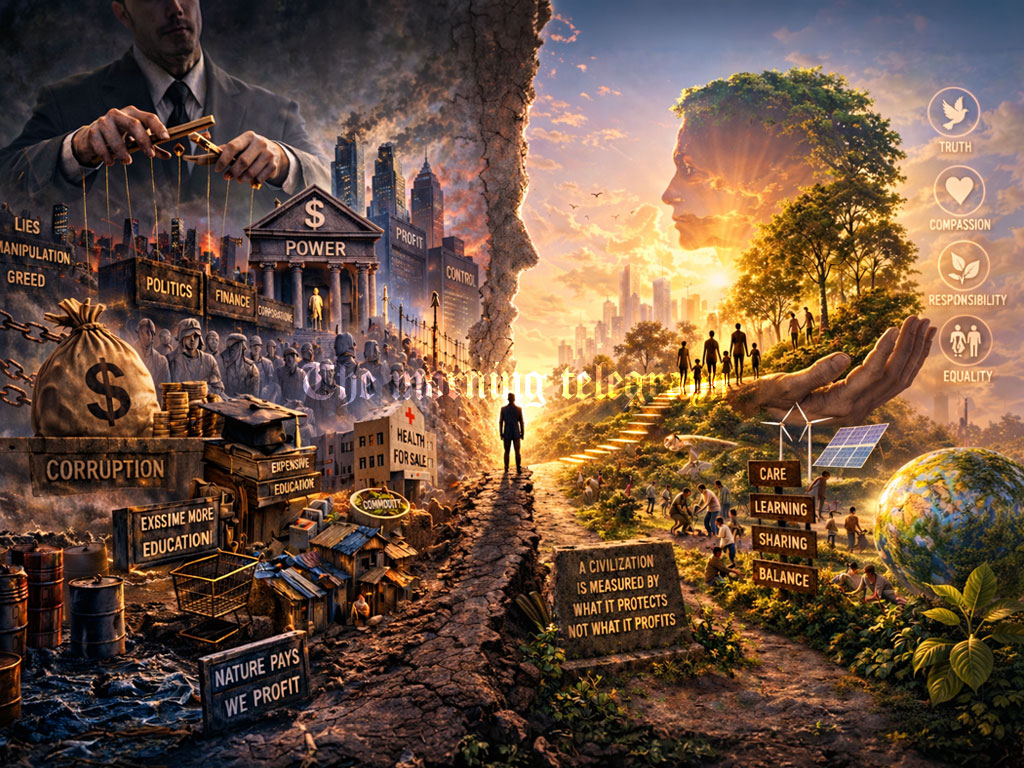
We have built a world that increasingly praises power, profit, prestige, and control, even when they come at the expense of truth, dignity, learning, health, shelter, nature, and human well-being. This reflection asks a simple but necessary question: when gain is protected more fiercely than life, what are we really calling success?
There comes a point when a human being must stop being impressed by the polish of the world and begin looking seriously at its motive. Much of what we are taught to admire power, wealth, institutional prestige, market success, political influence, corporate growth, is rarely examined deeply enough in relation to its human cost. We are encouraged to celebrate scale, dominance, expansion, and financial achievement as though these are self-evident signs of progress. Yet behind much of what is praised today lies a troubling truth: many of the systems we call successful do not sincerely serve humanity. They serve power. They serve preservation. They serve profit. And over time, if we are not conscious, we begin to accept corruption not as an exception, but as the ordinary language of civilization.

There is something deeply revealing in the way human beings have been taught to admire power. Not responsibility. Not wisdom. Not sincerity. Power. We admire those who can command, influence, dominate, expand, accumulate, and control. We call it leadership, success, growth, strategy, strength, market confidence, institutional prestige. We decorate it with polished language and present it to the world as something worthy of imitation. Yet beneath much of what is celebrated today lies a condition far more troubling than simple ambition. It is the quiet worship of corruption.
Corruption does not begin only when money is stolen, when laws are broken, or when a scandal comes into public view. By the time such things appear, corruption has usually been alive for quite some time. It begins much earlier, at the point where power loses its relationship to conscience. It begins when truth becomes negotiable in the service of gain. It begins when human beings are no longer seen as lives to be protected, but as instruments to be used. Once that shift happens, the rest follows naturally. Language is adjusted. Justifications are invented. Systems are built. Policies are crafted. Products are designed. Entire structures begin operating in ways that appear normal, respectable, and even intelligent, while quietly moving further away from humanity.
This is why corruption must be understood more deeply than merely as a legal problem or a political failure. It is not only an event. It is a way of thinking. It is a pattern of living. It is the gradual replacement of truth with advantage, of care with extraction, of service with manipulation. A society may still appear advanced on the outside while being inwardly disordered if its deepest motives are no longer aligned with life.
We see this condition in politics, where public language speaks constantly of service, justice, democracy, national interest, and freedom, yet beneath the stage one often finds image management, tribal loyalty, power preservation, and the endless protection of position. Public office, which should have been among the highest forms of responsibility, is too often treated as theatre, where ambition dresses itself in the language of duty. When leadership becomes more about retaining control than safeguarding human well-being, corruption is already present, even before any law is formally broken.
We see it in finance, where systems are often created not simply to support human stability, but to keep people in cycles of borrowing, repayment, anxiety, and dependence. All of it is wrapped in the language of opportunity, freedom, and growth. But one must ask plainly: if a system leaves millions burdened, fearful, and endlessly chasing relief, is it truly serving humanity, or is it serving itself? When money becomes more important than the peace and dignity of life, something has already gone wrong at the root.
We see it in services too, where genuine care is often reduced while charges increase and the human being is given less real attention than before. More efficiency, we are told. Better delivery. Streamlined experience. Yet so often what this means in reality is that human presence is removed, quality is reduced, accountability is diluted, and the person paying is left to accept less while being told it is progress. If service no longer serves, but only extracts, then it may still be called efficient in business terms, but it is no longer honest in human terms.
We see it in the world of manufactured goods, in ways so ordinary that people often fail to notice what is being revealed. Take something as common as a car. Human beings already possess the knowledge, technology, and design ability to build safer, more durable, more comfortable, and more thoughtful vehicles for human use. If that is so, then why is so much of manufacturing structured around tiers of insufficiency, cosmetic distinctions, withheld features, artificial upgrade paths, and endless versions designed to create desire rather than to fully serve need? Why do we so often build not the best expression of what human intelligence can offer at the time, but a ladder of controlled limitation, so that the buyer is kept reaching, upgrading, and paying again? Even here, the deeper motive reveals itself. Not what best serves life, but what best serves profit.
One of the most painful examples of this condition appears in education itself. Learning should never have been reduced to the marketplace burden we now accept as normal. Education is meant to guide a human life. It is meant to awaken intelligence, character, discernment, and responsibility. It is meant to prepare the young to live well, think clearly, and contribute meaningfully. Yet in our time it has been so heavily monetized that even this guiding responsibility has been bent toward profit, prestige, and institutional power. Schools and universities charge extraordinary fees, place immense pressure on younger generations, and still receive admiration for their status and recognition, as though high cost itself were evidence of worth. What early lesson is being taught here? That truth must be purchased. That growth must be financed. That dignity of learning belongs more easily to those who can afford the gates. This is a profound corruption because it enters at the beginning of life and shapes the mind before the person has even fully stepped into the world.
One sees the same distortion in medical care, in social welfare, in food, in poverty, and in the question of land itself. The care of the sick should have remained one of the clearest expressions of shared humanity, yet so often it is bent into systems of cost, exclusion, and profit. Social welfare, which should reflect a society’s conscience, is too often spoken of as a burden rather than a responsibility. Food itself, the very substance by which life is sustained, has also been captured by the same logic, where nourishment is compromised, quality is uneven, and access is too often shaped by money rather than human need. Poverty still remains in our vocabulary, not as an unacceptable failure of civilization, but as an ordinary condition we have learned to tolerate. And what does it say about us that land and shelter can be concentrated in the hands of a few while homelessness spreads among the many? At that point, the truth becomes difficult to avoid: the system is not arranged first around life, but around possession, profit, and power.
The same distortion appears in how humanity treats the natural world. We already know enough to reduce pollution, protect water, improve systems, and build with more care for the earth that carries all life. We know enough to do better. Yet again and again the response comes back in one familiar form: it costs too much. Better safeguards cost more. Cleaner systems cost more. Greater responsibility costs more. So the air is burdened, the water is burdened, the soil is burdened, the future is burdened, and all of this is tolerated because financial cost is treated as more serious than the cost to life itself. There one sees the condition very clearly. Are we acting in the interest of humanity and nature, or in the interest of the paper structures we have invented and agreed to worship because they benefit a few? When money is protected more fiercely than life, corruption is no longer hidden. It has become civilization’s habit.
This is one of the most painful truths to face. Many of the very practices that weaken human life are introduced to society as good practices. They are given professional names, strategic names, respectable names. They are called innovation, best practice, growth model, monetization strategy, expansion plan, market discipline. Yet no matter how refined the language becomes, the real question remains unchanged. Does it serve life? Does it protect the human being? Does it preserve dignity, clarity, balance, health, and truth? Or does it merely enrich a structure while the people beneath it grow more burdened, more distracted, more dependent, and less free?
A conscious society asks, what serves life?
A corrupted society asks, what pays most?
That may sound simple, but simplicity is often where truth lives. We complicate what should be plain because complication helps disguise motive. The more civilized corruption becomes, the more language it needs to protect itself. But the human conscience can still recognize the difference. A truthful system protects people. A corrupted system uses people. A truthful leader serves. A corrupted leader manipulates. A truthful institution exists for the well-being of life. A corrupted institution exists first for its own preservation.
The danger is not only that corruption exists at high levels. The deeper danger is that ordinary people become accustomed to it. They begin to admire it, excuse it, participate in it, or surrender to it because it has become common. Once this happens, society begins losing its moral sight. People start mistaking success for goodness. They start mistaking wealth for value, influence for wisdom, control for leadership, and visibility for truth. In such a world, corruption no longer feels shocking. It feels normal. That is when it becomes most dangerous.
This condition reaches into daily life more than many realize. It appears when products are designed not for real well-being but for repeated dependence. It appears when quality is sacrificed because the public will tolerate it. It appears when environmental harm is accepted because cleaner alternatives reduce margins. It appears when education becomes a burden to exploit rather than a responsibility to protect. It appears when food is shaped more by profit than nourishment. It appears when care becomes an industry rather than a human duty. It appears when shelter becomes a privilege while homelessness becomes familiar scenery. It appears when the customer is no longer respected, only managed. It appears when loyalty is valued more than honesty. It appears whenever a person or institution asks, what can I get from them, rather than what is right for them. These are not small matters. These are the daily signs of a civilization drifting away from its own humanity.
And yet, to see this clearly is not a reason for despair. It is a reason for awakening. It is always better to recognize a condition than to remain blind inside it. Recognition is already a form of correction. When a person begins to see that corruption is not only scandal but pattern, not only criminality but mentality, something begins to shift. The spell weakens. The admiration for power loses its shine. The mind begins to ask better questions. Truth begins to return.
What is needed now is not more cleverness without conscience. Not more power without restraint. Not more polished systems that feed on human weakness while speaking in the language of progress. What is needed is a return to truthful seeing. A return to the simple but serious question that should stand at the center of every institution, every product, every policy, and every act of leadership: does this truly serve life?
If humanity is to correct itself, it must stop being dazzled by power detached from moral responsibility. It must stop celebrating success that comes at the expense of the human spirit. It must stop accepting systems that profit from confusion, dependence, degradation, false need, and organized inequality. It must recover the courage to measure all things not by how profitable they are, not by how dominant they are, and not by how admired they are, but by how sincerely they honor life.
The first stepping stone to all corruption is power over another. Once a human being accepts that another exists to be used, directed, manipulated, sold to, profited from, or discarded, the inner fracture has already begun. From there, the structures only become more elaborate. The methods become more refined. The theatre becomes more convincing. But the root remains the same.
So the task before us is not merely to criticize the powerful. It is to see clearly the condition we have normalized and to refuse inwardly to worship it. It is to become more conscious in how we think, what we praise, what we purchase, what we excuse, and what we call success. The correction of a civilization begins first in the correction of perception.
Until human beings learn again to place truth above gain, conscience above influence, learning above monetization, nourishment above exploitation, care above profit, life above possession, and responsibility above power, corruption will continue to be praised under honorable names.
And so those who can still see it must keep speaking, not with hatred, not with performance, but with conscious truthfulness.
Author’s Note
I write this not to condemn for the sake of condemnation, but to invite a more conscious recognition of what we have come to accept as normal. Wherever truth is bent for gain and life is made secondary to power, profit, prestige, or possession, corruption has already begun. Our task is not only to notice it in the world around us, but to recover the courage to place what is human back at the center of how we live.