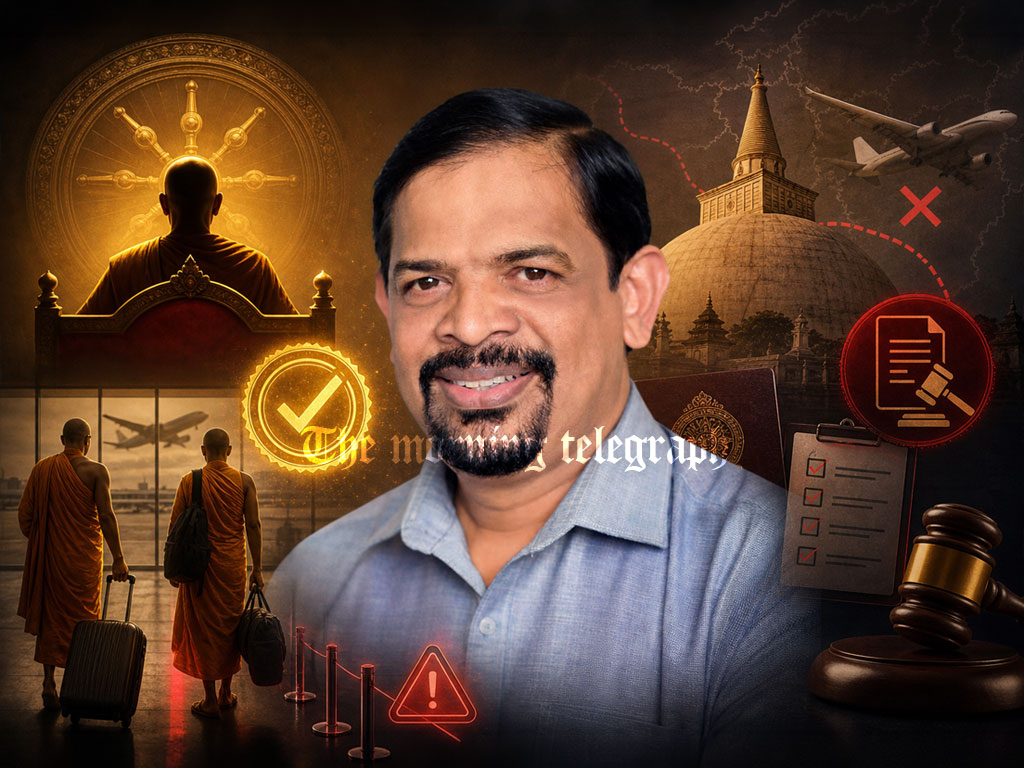
Monks abroad rule becomes mandatory as Buddha Sasana Deputy Minister says prelate approval is needed amid concern over 21 drug arrests.
The monks abroad rule has been tightened after Deputy Minister of Buddha Sasana, Religious and Cultural Affairs, Gamagedara Dissanayake, said Buddhist monks cannot travel overseas arbitrarily and must obtain formal approval from senior religious authorities.
He stated that if a Buddhist monk wishes to travel abroad, he must first obtain a recommendation from his preceptor, the regional chief incumbent, and the Most Venerable Prelate of the Nikaya he represents. The Deputy Minister said this was not a new procedure, but one that had existed previously and had become irregular in recent times for various reasons.

The move has drawn attention because it comes at a sensitive moment for Sri Lanka’s Buddhist clergy, following serious concerns over discipline, accountability, and the conduct of monks travelling outside the country. This raises concerns about whether existing internal controls within the Sasana had weakened over time.
Deputy Minister Gamagedara Dissanayake said Registrar monks representing all Nikayas had held a lengthy discussion with the President a few days ago regarding the matter. During that meeting, agreement had been reached on several issues connected to the foreign travel of monks.
He said it was decided that obtaining the permission of the Most Venerable Prelates when travelling abroad is mandatory. The decision is aimed at restoring order to a process that religious authorities believe must be regulated through proper recommendations and institutional oversight.
However, questions remain over how strictly the rule will be implemented and whether the system will be able to prevent misuse. The requirement places responsibility on the preceptor, the regional chief incumbent, and the Most Venerable Prelate of the relevant Nikaya before a monk is allowed to travel overseas.
The Deputy Minister also referred to the arrest of 21 monks in connection with drug trafficking, calling it an unfortunate incident. He said steps must be taken to ensure such incidents do not happen again, especially because such cases damage public trust in the Sasana and raise wider concerns about religious discipline.
He further stated that the law will be properly enforced regarding those monks. His remarks indicate that the government does not intend to treat the matter only as an internal religious issue, but also as a legal matter that must be handled through proper enforcement.
The Deputy Minister said Registrar monks, the Attorney General, and officials of the Ministry of Buddha Sasana have already initiated a very comprehensive discussion on the issue. These talks have focused on how to strengthen the legal and administrative framework governing temples, monks, and disciplinary action.
During those discussions, proposals were made to amend the Temples and Shrines Ordinance very quickly. The proposed changes include granting the power to act in such situations under Sections 41 and 42 to a board chaired by the Most Venerable Prelates.
What happens next could be critical for the future regulation of Buddhist monks in Sri Lanka, as the government and senior religious authorities now move toward tighter controls, faster legal amendments, and a stronger role for the Most Venerable Prelates in matters involving discipline and foreign travel.