By Roshan Jayasinghe
A nation shaped by many hands stands at a moment of remembering what it truly is.
There is a certain tension in the air today when it comes to America. It shows up in conversations about immigration, identity, borders, and belonging. It shows up in how people speak of who is inside, who is outside, and what the nation should become. These are not just political discussions. They are signs of something deeper, a moment where a nation is beginning to question itself.
There are times when you stop looking at a country through the noise of opinion and begin to see it through the quiet clarity of what it has been, what it has done, and what it is now becoming. America, when seen this way, is not just a nation defined by borders or power. It is a human movement that unfolded over time, layer by layer, choice by choice, consequence by consequence.

Before it was named, before it was mapped, this land was already lived upon. There were people here, human beings who did not stand apart from the land, but lived with it, understood it, and moved within its rhythm. Their existence was not a concept or a label. It was life as it was, in its natural relationship with the world around it.
Then came those who arrived from across oceans. Europeans who carried with them their own histories, struggles, ambitions, and limitations. What followed does not need decoration. Land was taken. Communities were broken. A way of living rooted in balance with nature was overtaken by a way of thinking that sought to organize, control, and expand. This is not said in judgment. It is simply what occurred. Without seeing that clearly, the rest of the story loses its grounding.
But history did not remain there. Over time, something else began to take shape, something far more complex than conquest alone. People from across the world began to arrive, not as rulers, but as individuals seeking a different possibility. They came from places where opportunity was limited, where identity was fixed, where movement was constrained. They came carrying their languages, their traditions, their skills, and their hopes.
But not all who became part of this land arrived by choice.
There were those taken from their own lands, removed from their homes, and brought here against their will. African men, women, and children who were made into labor, into property, into a system that denied their humanity while depending on their existence. Their presence in America was not a journey of seeking opportunity, it was one of force and survival.
And yet, through that history, through generations of hardship, endurance, and resistance, they too became an inseparable part of what America is today. Not by invitation, but by reality. Not by choice, but by the undeniable truth of their contribution to the foundation and growth of this nation.
To speak of America without acknowledging this is to leave out a part of its making.
And slowly, through effort, conflict, cooperation, and creation, America became something that had not existed before. Not perfect, not without contradiction, but undeniably distinct. It became a place where people could attempt to begin again. Where identity could shift. Where knowledge, technology, and economic systems were not only inherited, but built through the contribution of many who had once belonged elsewhere.
This is where the idea of America held a certain dignity. Not in its perfection, but in its openness. It became a convergence of the world itself.
What is often overlooked is that those who came here did not abandon where they came from. They remained connected. They sent back knowledge, resources, and support. They created bridges between this land and their lands of origin. In doing so, America did not stand separate from the world, it became deeply linked to it. Its growth extended beyond its borders, influencing and supporting other nations through the very people it had received.
But within this movement, there is also a quieter truth that shapes the present more than we often admit.
Those who arrived, struggled, and eventually found their footing here did not all remain open in the same way they once needed others to be open to them. Over time, some began to protect what they had built, not only from external pressures, but even from those who came after them from the very places they themselves once left behind.
This comes from many places. From sacrifices made. From fear of losing stability. From identity being reshaped. From a sense of having endured something that others must now endure on their own. These are not always spoken, but they are real.
And so, a duality forms.
The same person who once arrived seeking opportunity can, in another moment, resist that same opportunity being extended to someone else. The same community that once depended on openness can become guarded in its own way. Not out of clear intention to harm, but as part of the complex human response to survival, belonging, and preservation.
When this is seen clearly, without judgment, the present moment begins to make more sense.
Because what we are witnessing today is not shaped by one side alone. It is shaped by many layers of human behavior, across time, across communities, across lived experience.
America is in a moment of questioning itself.
The conversations around immigration, identity, borders, and belonging are not surface level debates. They are reflections of something deeper, uncertainty about direction, about values, about what the nation is becoming. And in that uncertainty, there is a natural human tendency to simplify, to divide, to draw lines where once there were bridges.
Voices grow louder. Positions become more rigid. And slowly, the broader idea begins to shrink into something more confined.
What we are seeing is not new. Nations, like individuals, move through phases. There are times of expansion, where they build and connect, and times of contraction, where they turn inward and protect. America is moving through such a moment now.
But what matters is not the moment itself, it is whether there is awareness within it.
Because the strength of a nation like America has never come from being one thing. It has come from its ability to hold many things at once, to allow difference without losing direction, to remain connected to the wider human story while shaping its own.
And when I look at it simply, without complication, what I see is this.
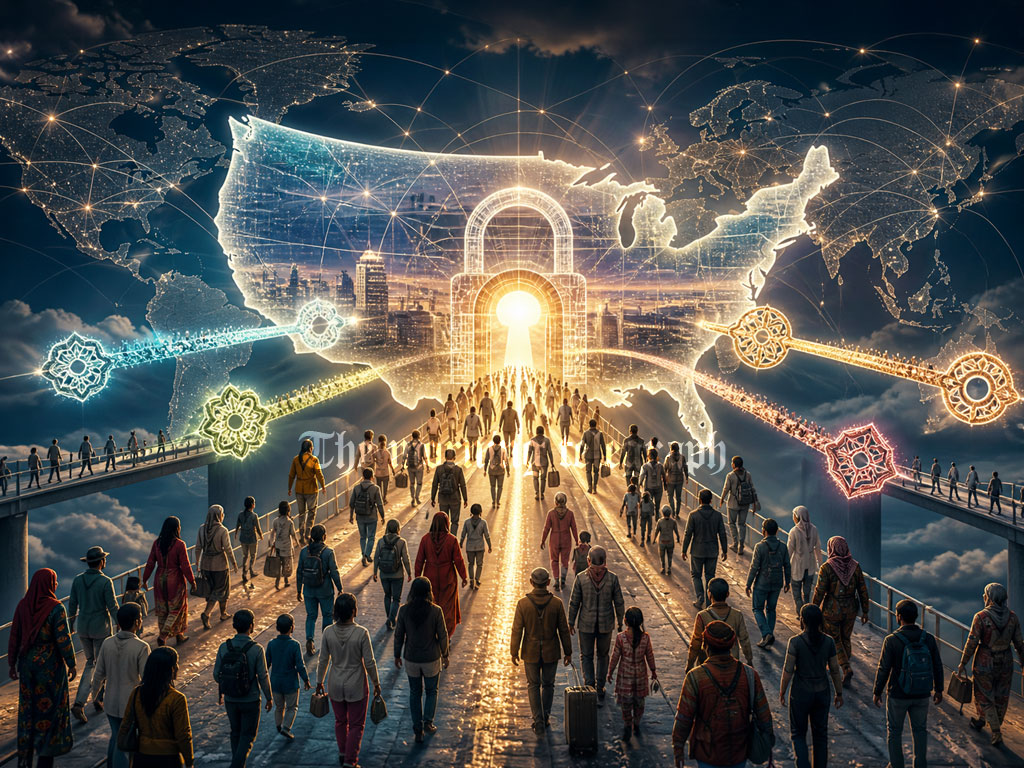
America is not separate from the world, it is the world, gathered in one place.
Every culture, every language, every struggle, every ambition has found its way here through human movement. It is all present, not as an idea, but as a lived reality through the people who are here.
In that sense, America becomes like a lock.
Not something closed, but something built with a certain structure that allows it to function.
The people of the world who arrive here are the keys.
Each one different. Each one shaped by where they come from, what they carry, and what they seek to become.
A lock does not open with just anything pushed into it. It opens when the key is shaped in a way that can engage its mechanism.
In the same way, it is not about where the key comes from, it is about whether it can work within what the lock is built upon.
When that happens, there is movement. There is access. There is the possibility of something opening.
When it does not, there is resistance.
It comes down to this, we are no longer seeing clearly how they belong together.
America, at its core, is not a fixed identity. It is an ongoing expression of human movement, effort, contradiction, and coexistence.
And what is being asked of it now is not to become something new, but to remember what it has always been.
Author’s Note:
What I’ve shared here is simply how I’ve come to see it through my own observation of life, people, and the movement of nations over time. When I look at America, I don’t see it as separate from the rest of the world, I see it as something shaped by it, and shaping it in return. There is a certain honesty in recognizing where something began, how it was built, and what it stands on today. Without that clarity, we begin to move and speak from fragments rather than truth. This is not about taking sides. It is about seeing the whole as it is, so we remain grounded in what it truly means to be human and humane within it.
About the Author
Roshan Jayasinghe is a writer and observer of human systems. His work explores the gap between man made constructs and lived humanity, with a focus on how economics, trade and everyday choices intersect with questions of fairness, responsibility and inner alignment. Through essays for publications in The Morning Telegraph, he aims to remind readers that they are not passengers in a fixed machine, but active custodians of a shared world.