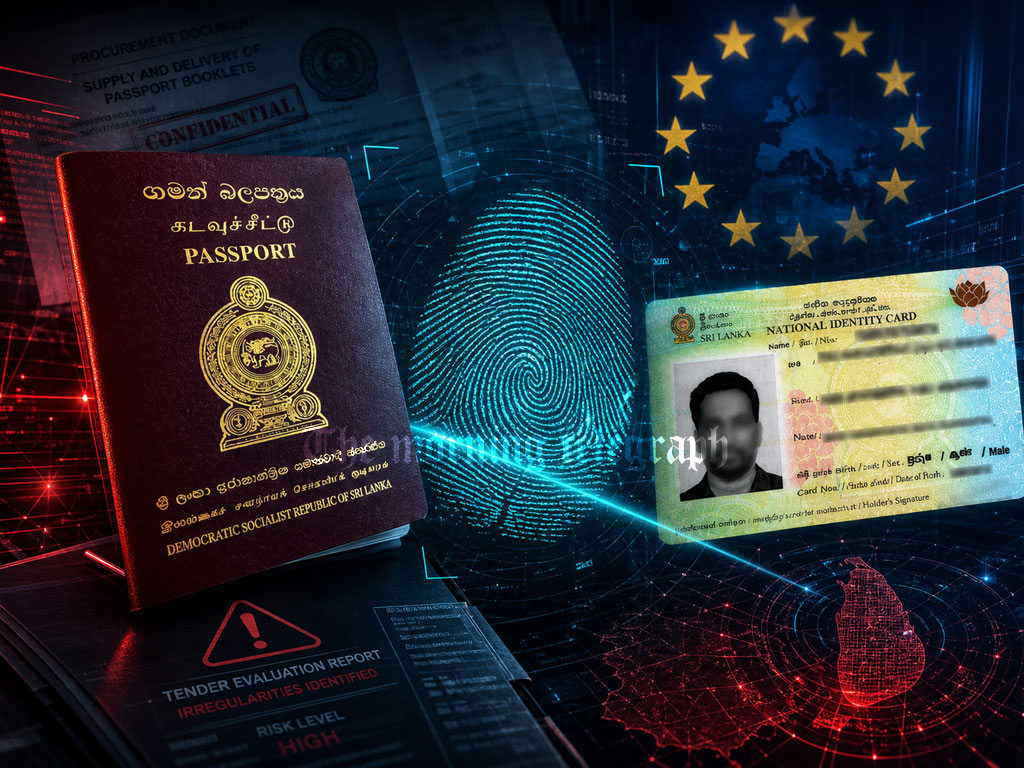
Passport tender fraud allegations deepen as Poland prepares to complain to the EU over Sri Lanka’s e-passport procurement process.
Passport tender fraud allegations have intensified after reports claimed the Polish government is preparing to complain to the European Union over Sri Lanka’s electronic passport procurement process.
The Daily Mirror reports that Poland is preparing to take the matter before the European Union following allegations of serious irregularities in the e-passport tender currently being handled by the Sri Lankan government.
The controversy follows the rejection of seven international bidders, including the Polish Security Printing Works, which is owned by the Polish government, allegedly without any reasonable justification.

The tender for issuing electronic passports for the Department of Immigration and Emigration was announced on April 27, 2025. Eight leading companies from Germany, India, the United Arab Emirates, France, Poland, and Malaysia submitted bids for the project.
The Polish Security Printing Works has claimed that despite meeting all required qualifications, the company was given a very low score and removed from the process. The tender has instead been awarded to a company named Thales Finland.
Four bidders, including the Polish company, have appealed to the Appeals Board over the decision.
The Appeals Board, while acknowledging that the PWPW company was technically qualified, informed the government to open its financial proposal and carry out a re evaluation.
However, it is reported that even after the re evaluation, the government has failed to open the company’s pricing.
This raises concerns about whether the procurement process was handled transparently and whether qualified bidders were treated fairly during the tender evaluation.
Polish representatives, suspecting an invisible influence within the process, have requested an opportunity to meet Foreign Minister Vijitha Herath to discuss the matter. However, no response has reportedly been received so far.
The Polish government has proposed that the tender be re examined by an independent technical evaluation committee.
It has suggested that such a committee should include officials from the Department of Immigration and Emigration, the Ministry of Public Security, the Ministry of Digital Economy, and the Ministry of Finance.
The Polish Embassy in New Delhi has also supported the request and has sent letters to the Sri Lankan Foreign Ministry.
The report further recalls that Thales Finland, the company that won the tender, had previously been selected during the tenure of former Minister Tiran Alles to supply 750,000 machine readable passports.
That transaction was also controversial and had been challenged in court over allegations of violating procurement guidelines.
What happens next could be critical, as the passport tender dispute may now move beyond Sri Lanka’s domestic procurement process and enter a wider diplomatic and European Union-level controversy.