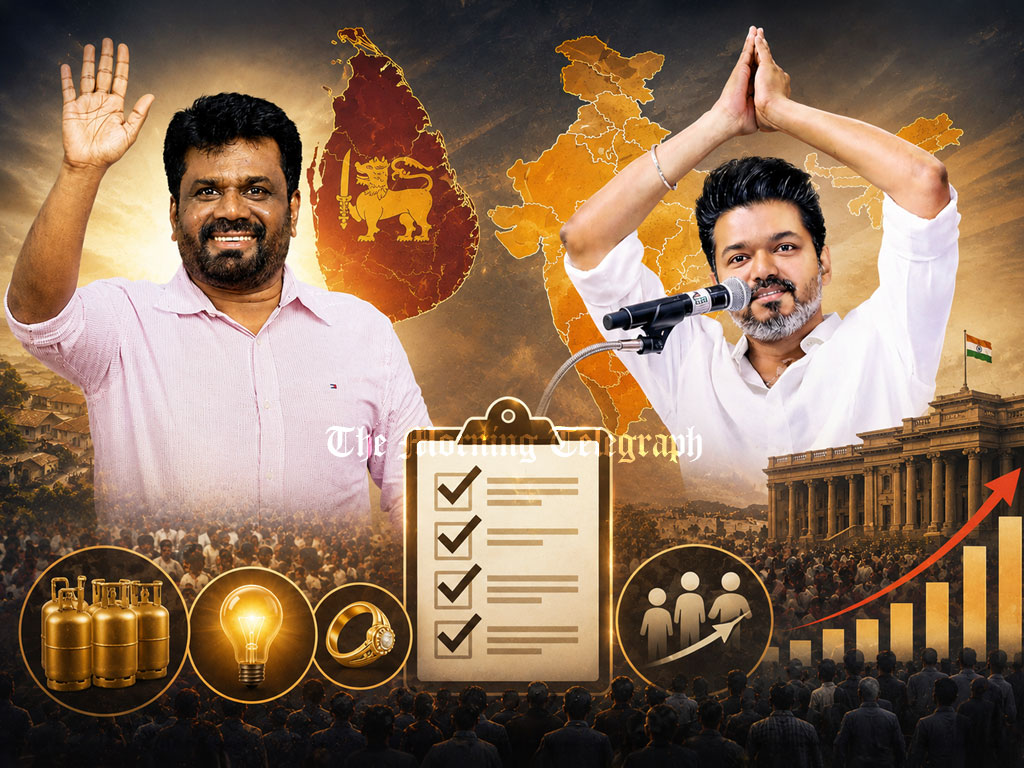
Thalapathy Vijay’s early political actions in Tamil Nadu spark comparisons with Anura’s election promises in Sri Lanka.
Thalapathy Vijay’s early political promises and actions are now drawing sharp comparisons with Sri Lankan politics and President Anura Kumara Dissanayake.
Actor-turned-politician Thalapathy Vijay has achieved a major political victory.
Whether that victory will ultimately be good or bad for Sri Lanka is something that must be analyzed politically.
His election promises were carefully shaped to match the needs and expectations of the people in the relevant region.
He presented exactly what the public wanted to hear.
That is why he sometimes made statements critical of Sri Lanka.
However, his personal beliefs or political philosophy may not necessarily align with those statements.
Still, it appeared that he held a political position opposed to Sri Lanka.

Vijay entered politics with a large number of promises, some of which appeared unrealistic from the beginning.
One of his promises was to provide free electricity.
Another was to provide four free gas cylinders annually to the people of Tamil Nadu.
At one point, he also promised a gold sovereign to newly married couples in Tamil Nadu.
That promise may have been made because people in the state are known to place high value on gold.
The population of Tamil Nadu is estimated to reach around 77.5 million by 2026.
Chennai alone has nearly 7 million residents.
Statistics indicate that the state has around 38.6 million males and 38.9 million females.
This may explain why Vijay introduced promises aimed especially at women.
Many of his pledges appeared designed to attract female voters.
He also promised to distribute four gas cylinders per household every year.
According to India’s last official census, Tamil Nadu has approximately 18.5 million households.
That includes 9,563,999 rural households and 8,996,487 urban households.
Under such conditions, providing four free gas cylinders annually to each family would require nearly 74 million gas cylinders every year.
That makes the promise an enormous undertaking.
These were the promises on which Vijay rose to power.
Now he is expected to fulfill them.
Reports suggest that he has already begun implementing some of his pledges.
Sri Lanka has experienced similar situations before, especially with the promises made by President Anura Kumara Dissanayake.
Although there were claims that those promises would be fulfilled, questions remain over how many have actually been implemented.
Vijay was sworn in on May 10, 2026, as leader of the Tamilaga Vettri Kazhagam party and became the new Chief Minister of Tamil Nadu.
Observers have already begun examining the actions he has taken since assuming office.
One of his first official orders was to provide 200 free electricity units to every household in the state.
That was exactly what he had promised in his election manifesto.
He also launched youth welfare programmes, including plans to create 5 million new job opportunities for young people.
Vijay stated that these initiatives would be implemented through the state budget.
In addition, unemployed graduates are to receive a monthly allowance of 4,000 Indian rupees.
Plans are also reportedly underway to provide free gas cylinders to every household.
Promises relating to gold sovereigns and silk sarees are also being pursued.
Vijay also made several promises connected to public security.
He announced the formation of a special task force to eliminate the drug menace.
Authorities have already begun removing bars located near religious institutions and schools.
Within 24 hours of being sworn in as Chief Minister, Vijay reportedly ordered the closure of 717 bars situated near schools and temples.
He also pledged to work toward securing the release of Sri Lankan fishermen detained in India.
Reports suggest that his administration is now preparing programmes for that purpose, including diplomatic communications with Sri Lanka.
Preparations have also reportedly been completed to guarantee a price of 4,500 Indian rupees per ton of sugarcane.
Against this backdrop, discussions have emerged in Sri Lanka over whether President Anura Kumara Dissanayake has fulfilled similar promises.
President Dissanayake came to power promising major political change under the policy framework titled “A Prosperous Country, A Beautiful Life.”
That framework included 30 key election promises.
According to the Verité Research Institute, 10 of those promises have been fully implemented.
They include tax relief, salary and allowance increases, education and student concessions, anti-corruption political reforms, and efforts toward macroeconomic stability.
However, another 10 promises are still being implemented.
Ten more remain unfulfilled.
Some promises made by politicians are simply unrealistic in practice.
Critics argue that such promises should not be made in the first place.
Among the unfulfilled promises are the abolition of the executive presidency, reforms to the Prevention of Terrorism Act, recovering stolen money held overseas, and punishing those responsible for Central Bank fraud.
Allegations have also emerged regarding political appointments made by the government.
President Dissanayake and the National People’s Power government had also promised to cancel bar licences allegedly distributed illegally by the previous Ranil Wickremesinghe administration as election bribes to MPs.
They also promised to reveal the names of those MPs.
However, to date, neither the licences have been cancelled nor the names disclosed.
Some argue that Vijay’s ability to act quickly may come from the fact that he governs a state.
Sri Lanka’s leadership, by contrast, governs an entire country.
Over time, changing conditions can make it difficult to fulfill certain promises.
Rebuilding after crises also takes longer than people expect.
Governments should not necessarily be blamed for every delay.
However, critics say politicians should avoid making promises that are impossible to deliver.
By the time leaders realize how difficult implementation truly is, the promises have already been made.
Despite all this, many Sri Lankans say their main concern remains President Anura Kumara Dissanayake rather than Vijay.
Whether Vijay becomes a political legend or not is seen as secondary.
Many people admired him primarily as an actor.
Some believe that if he returns to acting full-time, it could signal the end of his political career.