MAS India investment of about USD 93 million has renewed debate over Sri Lanka apparel jobs, factory restructuring and the role of regulators.
The MAS India investment of approximately USD 93 million has intensified debate over Sri Lanka’s apparel industry, local employment and the country’s ability to retain major manufacturers.
Sri Lanka’s apparel sector expanded significantly during the Ranasinghe Premadasa era of the 1980s and 1990s through the 200 Garment Factories Programme.
That industrial base depended heavily on generations of rural workers, particularly women. For decades, their labour helped build one of Sri Lanka’s most important sources of export earnings and foreign exchange.
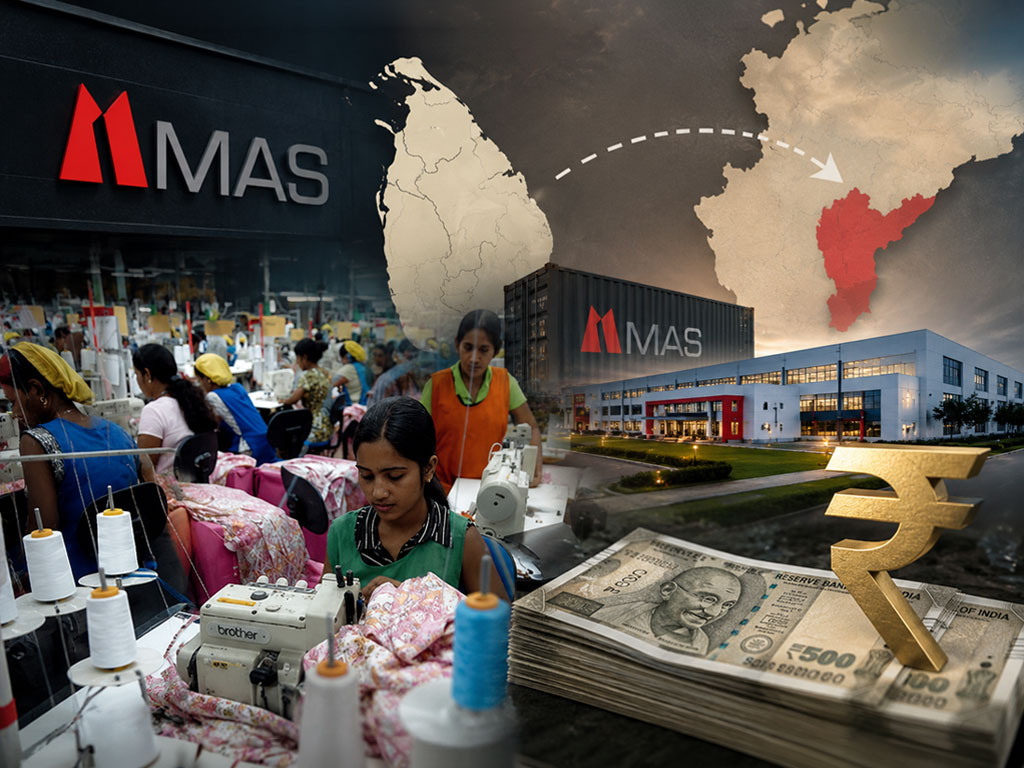
Against that history, concerns have emerged over MAS Holdings’ decision to invest approximately USD 93 million, or Indian Rs. 8.8 billion, in the Indian state of Tamil Nadu while simultaneously restructuring some operations in Sri Lanka.
MAS Holdings, owned by the Amaleen family, is described in the source material as Sri Lanka’s largest export company.

MAS India Investment Comes Amid Local Restructuring
Claims circulating on Sri Lankan social media that “MAS is closing factories and laying off 26,000 workers” have been exaggerated, according to the information presented.
However, the restructuring taking place locally has still raised serious concerns.
By February 2026, MAS had moved to cease garment sewing operations at its Mettliya facility in Tulhiriya.
Operations at the Thuruli factory were also closed following environmental risks linked to the Ditwa cyclone in late 2025.
These developments reportedly affected the working lives of nearly 3,800 employees.
The company has described the changes as part of a strategic restructuring intended to strengthen fabric production.
However, critics argue that the result is still a reduction in direct garment manufacturing activity and employment opportunities within Sri Lanka.
The controversy has therefore moved beyond exaggerated social media claims and toward a broader question about the direction of the domestic apparel industry.
Questions Over Capital, Employment and Tamil Nadu Expansion
The MAS India investment has also triggered criticism over how capital generated through Sri Lankan operations is being deployed internationally.
Some critics have questioned whether profits earned through decades of manufacturing in Sri Lanka were accumulated through overseas banking structures, including in countries such as Singapore, before being redirected toward investment in India.
Those claims remain allegations and are not established as fact in the information provided.
However, they reflect a wider concern over whether locally generated corporate profits should produce greater reinvestment within Sri Lanka.
The Tamil Nadu project is expected to create around 7,000 direct jobs.
Critics contrast those employment gains with the contraction of some MAS operations in Sri Lanka and argue that the country risks losing potential foreign exchange, investment and employment.
MAS maintains a business presence across 17 countries.
Those questioning the expansion say that while the company has become a major international manufacturer, the foundations of its growth were built significantly through Sri Lanka’s apparel workforce, particularly female factory workers.
BOI and EDB Face Questions Over Investment Climate
Attention has also turned to the Sri Lanka Board of Investment and the Export Development Board.
Critics argue that Sri Lanka’s investment approval system remains burdened by bureaucracy while competing locations are moving aggressively to attract manufacturers.
Tamil Nadu operates an investment facilitation mechanism known as “Guidance Tamil Nadu.”
According to the source material, factory approvals there can be completed within as little as 21 days.
That contrast has raised questions about whether Sri Lanka’s regulatory agencies are responding quickly enough to retain large industrial investors.
When changes were made at the Mettliya factory in Tulhiriya, EDB Chairperson Mangala Wijesinghe told the media:
“This is not a closure, but a restructuring to expand facilities for fabric production by redirecting workers to other places.”
Critics argue that regulators should go beyond explaining corporate restructuring and instead develop policies that protect employment, manufacturing capacity and future investment.
They also question whether Sri Lanka has adequate mechanisms to encourage locally earned corporate profits to be reinvested within the country.
Meanwhile, manufacturers continue to face concerns over electricity tariffs, raw material availability and taxation.
The argument presented by critics is that failure to address those issues could encourage more businesses to shift investment elsewhere.
For Sri Lanka, the MAS India investment has therefore become part of a much wider debate.
The issue is not simply whether one multinational company chooses to invest abroad. It is whether Sri Lanka can remain competitive enough to protect an apparel industry built over decades by its workforce.
If the Government, BOI and other agencies fail to strengthen the investment environment, critics warn that MAS may not be the last major manufacturer to expand elsewhere while reducing its local footprint.