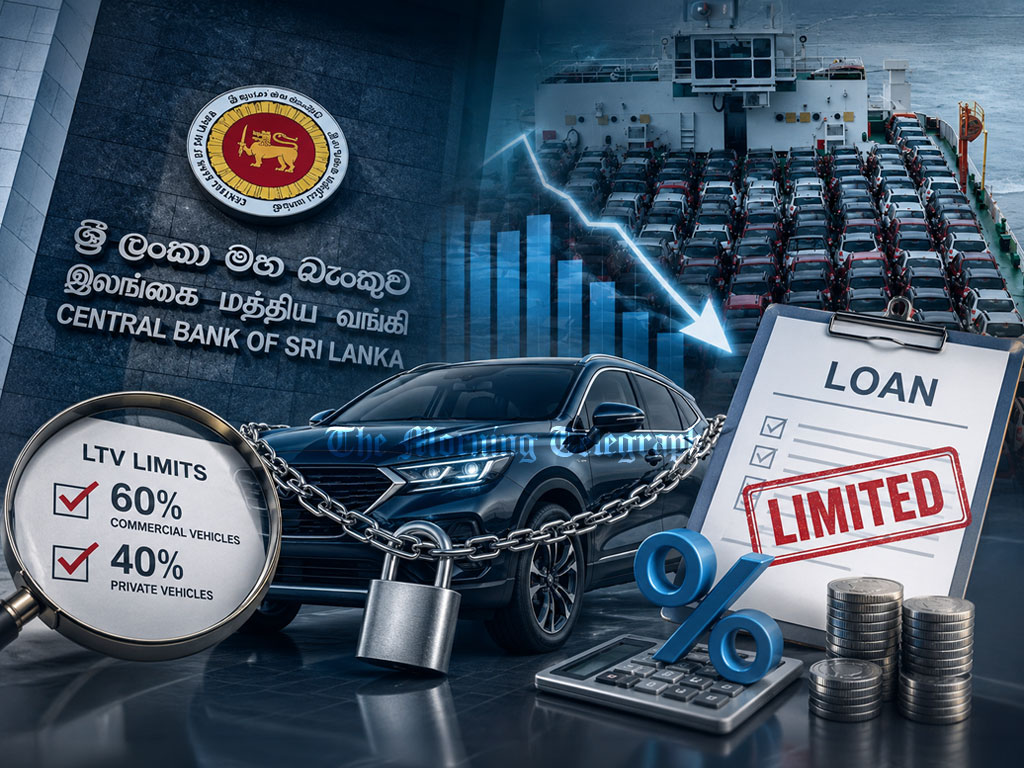
Central Bank imposes new vehicle loan limits from May 25, capping LTV ratios at 60% for commercial vehicles and 40% for private vehicles.
Central Bank vehicle loan limits have been tightened under new orders affecting credit facilities granted for motor vehicle purchases and use.
The Central Bank of Sri Lanka has issued a series of new orders under Section 105(1) of the Sri Lanka Central Bank Act No.16 of 2023.
The orders cap maximum Loan-to-Value ratios for credit facilities granted for the purchase or use of motor vehicles.
These new rules take effect from May 25, 2026.
They apply to all financial institutions regulated and supervised by the Central Bank.
This includes licensed commercial banks, licensed specialised banks, licensed finance companies, and registered financial leasing institutions.

According to the new orders, the maximum loan amount for vehicles used for more than one year after first registration in Sri Lanka will be 60% of the market value of that vehicle.
For unregistered vehicles and vehicles used for less than one year, maximum LTV limits will apply under two categories based on Department of Motor Traffic classifications.
Commercial vehicles, including light trucks, single cab trucks, and heavy transport vehicles under categories C1, C, CE, D1, D, DE, G1, G, and J, will have a maximum loan limit of 60%.
Private and other vehicles, including motor cars, SUVs, vans, three-wheelers, and motorcycles under categories B, B1, A1, and A, will face a reduced maximum loan limit of 40%.
The Central Bank has also introduced special transitional provisions for Letters of Credit linked to unregistered vehicles.
These apply to LCs opened before the new orders came into effect, meaning before May 25, 2026, but where credit facilities have not yet been obtained.
Accordingly, financial institutions may provide credit facilities under exceptions based on the period during which the relevant Letters of Credit were opened.
The applicable LC periods are before July 18, 2025, from July 18 to November 8, 2025, and from November 8, 2025 to May 25, 2026.
The main objective of the measure is to ensure financial system stability.
The Central Bank says the move is aimed at maintaining credit flows to the vehicle market at a macro-prudential level.