Judges’ retirement age proposal faces strong opposition from Colombo High Court lawyers, who warn it could damage judicial independence.
The judges’ retirement age proposal has drawn strong opposition from the Colombo High Court Lawyers’ Association, which has urged President Anura Kumara Dissanayake to withdraw it immediately.
The Association has objected to the government’s alleged move to increase the retirement age of Supreme Court and Court of Appeal judges, warning that such a step could cause serious damage to judicial independence.

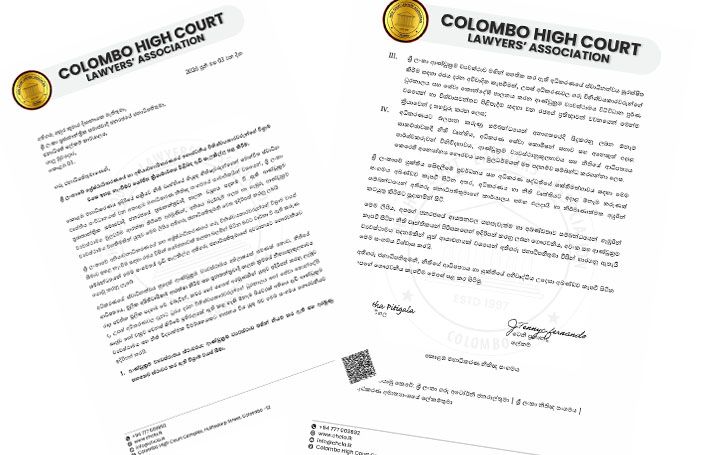
In a detailed nine-page memorandum sent to the President on June 03, 2026, the Association argued that the proposal threatens the rule of law within Sri Lanka’s democratic governance structure.
The letter also offers a sharp warning to society about what it describes as the wider crisis currently facing the country’s judicial system.
According to the memorandum, Articles 107 and 108 of the 1978 Constitution clearly provide that the retirement age of a Court of Appeal judge is 63 years.
The retirement age of a Supreme Court judge is also clearly stated as 65 years.
The Association points out that these limits were not accidental, but were intentionally included to achieve a balanced constitutional purpose.
That purpose, it says, is to benefit from the experience of senior judges while also allowing the talents of a new generation to enter the judiciary.
The Association argues that any attempt to alter these age limits without a strong and justifiable constitutional basis must be viewed as a serious constitutional inconsistency and an arbitrary act.
It further notes that the government has so far failed to present any public justification or explanation to the people for such a change.
According to the Association, that absence of explanation strengthens the concern that the proposal could amount to an attack on the basic structure of the Constitution.
The memorandum also warns that the proposal would obstruct the career progression of judicial officers who have dedicated their professional lives to the judicial service.
Many officers serving in lower courts aspire to be promoted to the higher courts after years of service, experience, and professional commitment.
Extending the tenure of currently serving judges would delay future vacancies that would otherwise arise in the Supreme Court and Court of Appeal.
The Association says this would deprive qualified and talented officers of legitimate promotions and directly damage the morale and spirit of officers across the judicial service.
It also raises the serious issue of executive influence over the judiciary.
The Association emphasizes that judicial independence is not merely a written provision in the Constitution. It must also be visibly demonstrated before the public.
A decision of this nature, it warns, may create strong public suspicion that the executive is attempting to retain judges who are favourable to it or supportive of government interests.
This concern becomes even more serious when judges whose terms may be extended are hearing important cases in which the government itself is a party.
In such circumstances, public confidence in the impartiality of the judiciary could be badly eroded.
The political reality beneath this crisis, the memorandum suggests, runs even deeper.
In a democratic state, the Constitution and the judiciary function as the higher legal order that stands above political power and to which all must submit.
The hidden political temptation of any executive, according to the argument advanced, is to escape those legal constraints and exercise power without obstruction.
If a judge is permitted to remain in office beyond the prescribed term through executive action, the necessary distance between law, judge, and political authority may be weakened.
Such a situation could create a sense of indebtedness by the judge towards the executive that enabled the extension.
The Association’s concern is that such a move may become advance preparation to secure favourable legal cover in future political conflicts.
These could include controversial tender transactions, state procurement disputes, or even constitutional crises.
The memorandum also rejects the argument that there is a shortage of qualified officers suitable for appointment to the higher courts.
It describes that claim as an ideological cover created by the executive.
According to the Association, Sri Lanka’s judicial service, the Attorney General’s Department, and the private legal profession contain sufficient officers and practitioners with the legal knowledge, experience, and ability required for such appointments.
The real crisis, it argues, is not a shortage of qualified persons, but the failure to fill existing vacancies in higher courts on time.
The Association describes this delay as a dereliction of constitutional duty.
It says the failure to promptly fill vacancies is one of the major reasons for case delays and the injustice suffered by citizens seeking relief through the courts.
Therefore, the Association argues, the government should not extend the retirement age of judges.
Instead, it should fill the existing vacancies constitutionally, transparently, and without delay.
Based on all these grounds, the Colombo High Court Lawyers’ Association has requested the President to immediately withdraw the proposed plan.
It has also urged the government to clearly reaffirm its commitment to protecting judicial independence.
The letter was issued under the signatures of Association President Lawyer Wasantha Pitigala and Secretary Lawyer J. Tenny Fernando.
Copies have also been forwarded to the Bar Association of Sri Lanka, the Attorney General, and the Secretary of the Ministry of Justice.
The broader message of the memorandum is that the symbolic power of the law must not be stripped away to serve the narrow needs of political authority.
The Association further proposes that any future decision on such a sensitive issue should be taken only after open dialogue with the legal profession and relevant stakeholders.
SOURCE :- SLLEADER.LK