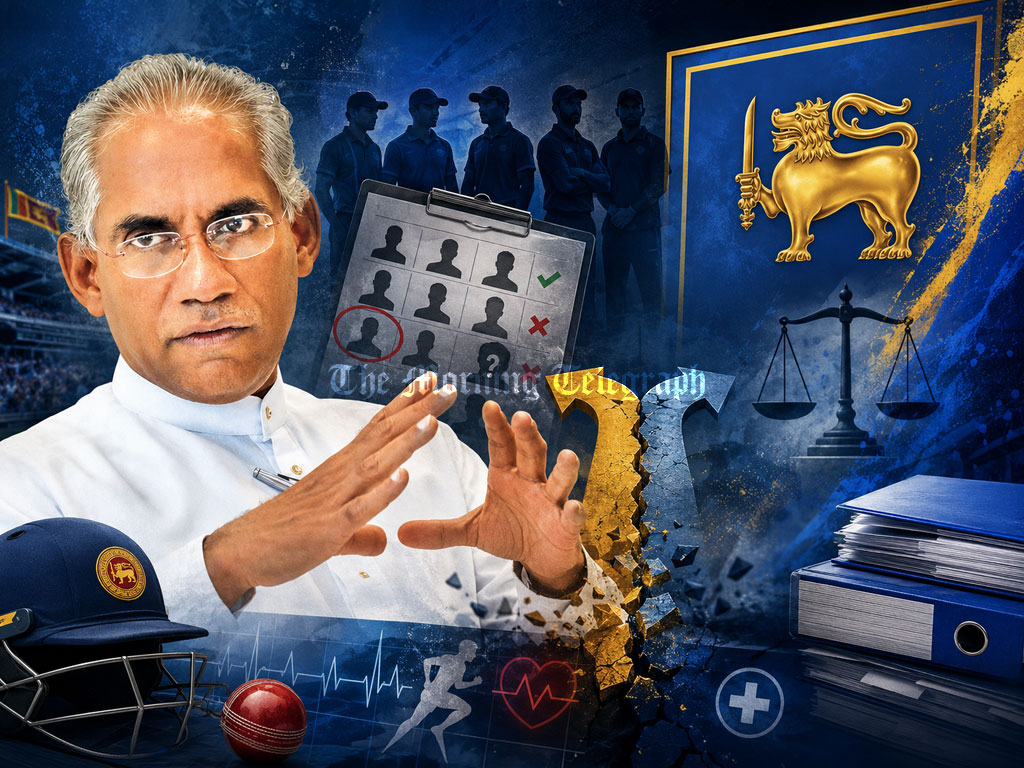
Sri Lanka Cricket faces fresh scrutiny as selection confusion, fitness policy shifts, and ‘A’ team choices raise doubts over reform promises.
The Sri Lanka Cricket reform drive has come under early scrutiny after recent decisions by the Interim Committee on selection and fitness guidelines triggered confusion over consistency, accountability, and double standards.
The newly appointed Sri Lanka Cricket Interim Committee, headed by Eran Wickramaratne, entered office promising a new beginning through a cleansing process. It moved quickly. Work has already begun on drafting a new constitution, which the committee has pledged to complete within six months. A forensic audit is also underway to identify the real problems within SLC’s financial operations.
The urgency to rebuild Sri Lanka cricket after years of disorder is understandable. The sport badly needs structural reform, accountability, discipline, and professional direction. That is exactly what is expected from the group of professionals now running SLC. Yet some of the committee’s own actions have already created uncertainty.

The selection committee confusion
The first major move was the appointment of a new selection committee. As a policy decision, there is nothing wrong with this. Any administration has the right to appoint individuals it trusts to important positions. However, the confusion lies in the manner in which the change was carried out.
The previous selection committee, chaired by Pramodya Wickramasinghe, had not even completed six months of its term. More importantly, there was no clear sign that its services had been formally terminated before the new committee was announced. That lack of clarity created unnecessary controversy and uncertainty.
Soon afterwards, the squads for the West Indies series were announced. The new chief selector, Kapila Wijegunawardena, stated that his committee had not picked those squads. That explanation is understandable. Only a few days had passed since the new committee assumed duties by the time the squad was named. But what followed only deepened the confusion.
Wickramasinghe admitted that he had selected the squads, including the new white-ball captain, before the handover of the selection committee. However, he also claimed that his board had changed the original squad he had submitted.
According to him, players such as Nuwan Thushara and Binura Fernando were included in the T20 squad, while Nishan Madushka and Kasun Rajitha were added to the Test squad. It is also reported that Dunith Wellalage was recommended as the ODI vice-captain, while vice-captaincy duties in Tests and T20s were assigned to Kamindu Mendis.
So, who actually made these changes?
Selection is one of the most sensitive areas in cricket. Every player in the system watches the process closely. Every omission causes disappointment. Every inclusion is judged heavily. When there is uncertainty over who is selecting the national teams, the credibility of the entire process begins to collapse.
The fitness policy reversal
The most striking example in this situation is the inclusion of Nuwan Thushara. There is no argument about his talent. He is one of Sri Lanka’s most promising white-ball bowlers and owns rare skills for the short format. Sri Lanka clearly needs a bowler of his type. But the issue here is not talent. The issue is policy consistency.
Under the previous administration and selection board, strict physical fitness standards were introduced. This programme was also supported by the Ministry of Sports. The logic behind it was simple. Sri Lankan players, especially fast bowlers and all-rounders, were increasingly breaking down with injuries. The policy was meant to protect players and the team, not punish individuals.
Sri Lanka suffered badly because of injuries to key players during the recently concluded World Cup tournament. Eshan Malinga, Wanindu Hasaranga, and Matheesha Pathirana were all unavailable at vital moments. Their absence weakened Sri Lanka’s campaign and cost the team a realistic chance of qualifying for the knockout round. If all three had been fit and ready, the outcome may have been different.
That painful experience was the reason for the stricter reintroduction of physical fitness benchmarks. Yet now, the message appears to have changed almost overnight. Wanindu Hasaranga and Nuwan Thushara, who missed IPL opportunities due to fitness-related issues, have returned to the national team. The only result of SLC’s earlier stance was that these players lost the chance to compete against the best in the world and earn valuable income through the IPL.
If policies can suddenly shift depending on who comes into power, what message does that send to players? A professional sport cannot be managed properly when the goalposts keep moving.
This instability may be the most worrying feature of the current situation. Fitness standards cannot be strict under one administration and flexible under another. Selection policies cannot keep changing based on individuals, political influence, sympathy, or emotion.
The ‘A’ team selection debate
The selections made for the Sri Lanka ‘A’ teams for the local triangular series involving India ‘A’ and Afghanistan ‘A’, along with the two four-day matches against India ‘A’, have also raised questions. The inclusion of Niroshan Dickwella in both squads, together with the vice-captaincy, has sparked fresh debate.
Dickwella, now approaching 33 years of age, is not a player being groomed for the future. ‘A’ team cricket is supposed to bridge the gap between domestic cricket and international cricket. Its purpose is to identify, develop, and prepare the next generation for the national side. It should not become a retirement home offering final chances to former internationals nearing the end of their careers.
There was a time when Dickwella carried great promise. He was an attacking left-handed batter, an unconventional wicketkeeper, and a player capable of changing the rhythm of a game quickly. Sri Lanka invested heavily in him. Even when he lacked discipline and consistency, he continued to receive opportunities and support.
Despite playing 54 Test matches, he has still not scored a single century, and his batting average does not reflect the talent he showed at the beginning of his career. His recent ban for cocaine use has also raised further questions about his commitment to the sport and the standards expected from players representing the country.
The need for a clear policy
SLC urgently needs a transparent and properly documented selection policy that does not change every time the administration changes. Whether the issue is fitness, discipline, captaincy appointments, squad selection, or long-term development, players must know exactly where they stand.
Sri Lanka cricket has already suffered too much from instability, unaccountable decisions, and constantly shifting agendas. The new administration came into office promising reform, professionalism, and a genuine clean-up. Real reform requires stability, clarity, fairness, and the courage to uphold standards even when doing so becomes uncomfortable.
Otherwise, Sri Lanka Cricket will continue to surprise the public — but for all the wrong reasons.