

NPP bribery scandal in Kurunegala raises questions after Deputy Mayor resumes duties despite arrest
NPP bribery scandal in Kurunegala have placed President Anura Kumara Dissanayake’s anti-corruption philosophy under a harsh public test, after a Deputy Mayor caught red-handed accepting a bribe returned to work as though nothing had happened.
The powerful anti-corruption message built by President Anura Kumara Dissanayake has now collided with an uncomfortable political reality inside the Kurunegala Municipal Council.
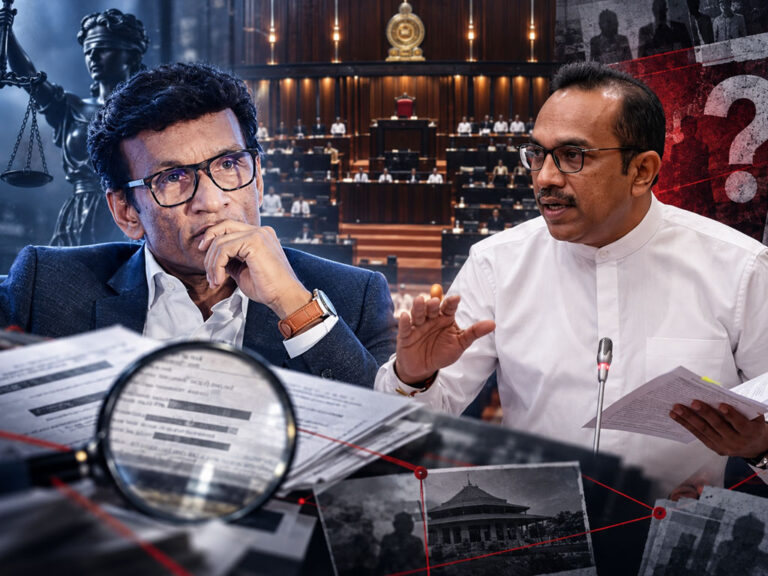
The controversy centres on Ashardeen Moinudeen, the Deputy Mayor of the Kurunegala Municipal Council, which functions under the NPP administration.
In the first week of last month, Moinudeen was caught red-handed by law enforcement authorities while caught red-handed accepting a bribe of Rs. 3,000,000.
The bribe had reportedly been demanded in exchange for awarding a tender connected to a public toilet system within the city.

At the time, the arrest appeared to be a significant success for anti-corruption agencies and seemed to support the government’s public promise to act against corruption at every level.
However, the story took an unexpected and controversial turn soon afterwards.
Despite being caught red-handed, Moinudeen was released on bail.
In a move that has shocked political observers, citizens, and critics of local government corruption, he did not step aside from office.
Instead, he returned to the Municipal Council and ceremonially resumed his duties as Deputy Mayor.
The development stands in sharp contrast to the sweeping public statements repeatedly made by President Anura Kumara Dissanayake, who has built much of his political identity on ending fraud, punishing corruption, and creating a new political culture.
The President’s Anti-Corruption Promise
Since assuming office, the President has repeatedly spoken of strict legal accountability and the need to change the country’s political system.
Among the key pillars of his public philosophy is the statement that “this is not a change of personnel, but a change of the entire system.”
He has also declared that “political power is not a license to escape the law” and that “before the law, the king and the citizen are equal.”
The President has repeatedly promised to close legal loopholes, saying, “We will completely eliminate the opportunities for thieves to escape by slipping through legal loopholes.”
He has also framed legal punishment not as political revenge, but as justice.
“Punishing wrongdoers is not revenge, but the delivery of justice,” he has said.
In another strong statement, the President declared, “Everyone who has looted public property in this country will have to face the law.”
He has further insisted that “we catch thieves not on stages, but inside courts.”
The President has also stated that “no one who has stolen public funds will be allowed to live freely,” while promising fresh investigations into every large-scale corruption case from the past.
A Political Test in Kurunegala
The ceremonial return of the Deputy Mayor has therefore created a politically damaging contrast with the President’s promise that “sending wrongdoers to prison is not revenge, but justice delivered to the people.”
For many members of the public, the question is simple.
If a public official caught red-handed caught accepting Rs. 3,000,000 as a bribe can obtain bail and return to office without stepping aside, how seriously is the government enforcing its own standards?
Critics argue that even a bribe of Rs. 3,000,000 is not a minor matter.
They say it strikes at the core of local governance, public trust, tender procedures, and the credibility of the administration’s anti-corruption campaign.
The incident also directly challenges the President’s declaration that “the moment theft and corruption are stopped, half of this country’s economy can be recovered.”
At present, it remains unclear whether the Deputy Mayor will be suspended, removed, or asked to step aside pending legal proceedings.
That uncertainty has only deepened the public debate.
For now, Ashardeen Moinudeen continues to hold his position as Deputy Mayor of the Kurunegala Municipal Council.
His return has left many asking whether the government’s anti-corruption campaign will apply with equal force to its own local representatives.
If a politician caught red-handed accepting a bribe can walk free on bail and ceremonially resume office, the question now hanging over the NPP administration is unavoidable.
What remains of President Anura’s pledge to build “a country where the law is implemented to the letter”?



He has to be sacked immediately, investigated, and sentenced by the judiciary. President must practice what he preaches!