By Marlon Dale Ferreira
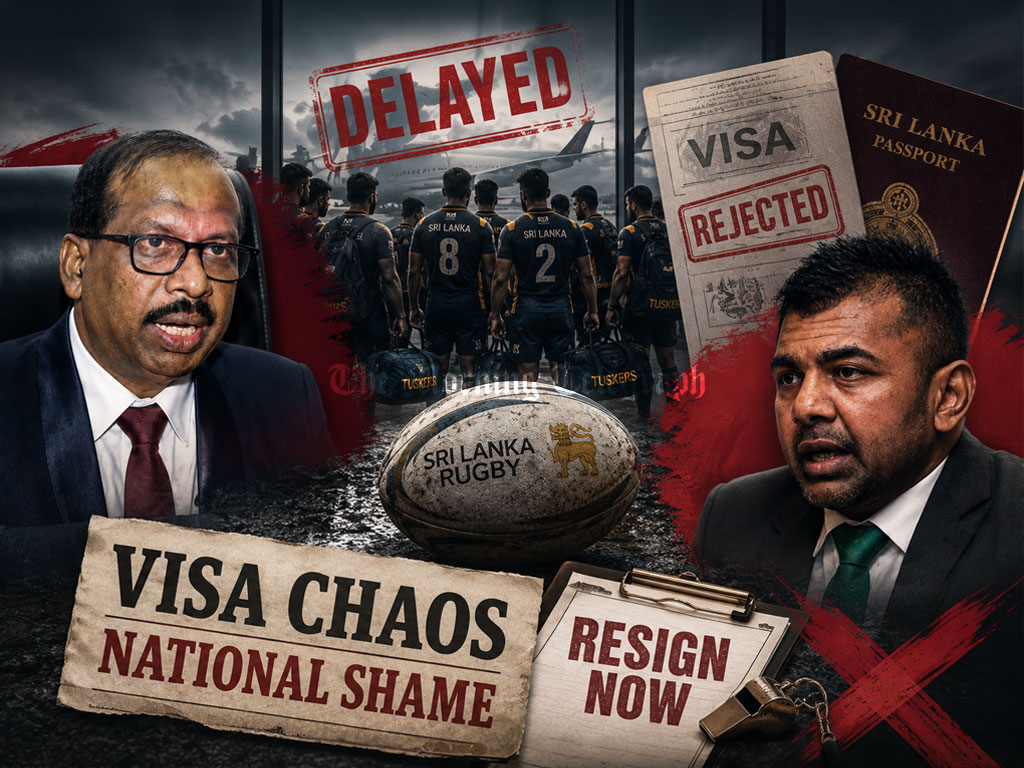
The Sri Lanka Rugby visa chaos has now moved beyond embarrassment. It has become a national disgrace that demands the immediate resignation of both Sri Lanka Rugby President Pavithra Fernando and Sports Minister Sunil Kumara Gamage.
In any country where public office, national sport, and taxpayer money are treated with seriousness, those responsible for a failure of this magnitude would not wait to be pushed. They would accept responsibility, apologise to the athletes and the public, and step down.
That is how accountable systems function.
That is how global best practice works.
That is what happens when leaders understand that positions are not decorations, but responsibilities.
Sadly, in Sri Lanka, officials too often cling to office after failure, hide behind excuses, blame junior officers, and wait for public anger to fade.
But this time, the anger must not fade.
The national Tuskers squad was left stranded in Colombo on the eve of its crucial Asia Rugby Men’s Championship fixture against South Korea, reportedly because of delays connected to the visa process. The issue became so serious that even Opposition Leader Sajith Premadasa was forced to raise the matter in Parliament, questioning the government over the treatment of national athletes.

That alone should have shamed the authorities.
A national team should never have to depend on parliamentary pressure to secure the basic administrative support needed to travel for an international fixture.
This was not bad luck.
This was not an unavoidable delay.
This was not a minor clerical error.
This was administrative incompetence displayed in public, at the expense of the players, the sport, and the Sri Lankan taxpayer.
A Failure From the Top
The responsibility for this disaster cannot be pushed down the chain.
When a national team is stranded before an international match, the blame must rise to the very top of both the sport and the ministry responsible for overseeing it.
Pavithra Fernando, as President of Sri Lanka Rugby, must answer for the failure of the association he leads.
Sunil Kumara Gamage, as Minister of Sports, must answer for the ministry machinery that failed to ensure the national team’s travel process was handled professionally and on time.
Both offices carry authority.
Both offices carry power.
Both offices also carry responsibility.
If they enjoy the titles when things go well, they must accept the blame when things collapse.
The Tuskers did not fail Sri Lanka.
The administrators failed the Tuskers.
A Controversial Election Now Comes Back to Haunt Rugby
This latest humiliation did not emerge from nowhere.
Many in the rugby community warned of trouble long before the controversial Sri Lanka Rugby election was permitted to proceed, despite serious concerns surrounding the eligibility of a presidential candidate.
That election, conducted under the watch of Minister Gamage, eventually resulted in Pavithra Fernando being elected President of Sri Lanka Rugby.
What followed, according to critics, was the rewarding of loyalists and supporters with key positions within the rugby administration.
Whether those appointments were based on competence or loyalty was always a question.
Now, after this visa fiasco, the answer appears painfully clear.
Sri Lanka Rugby is once again standing on its own head.
Ironically, those were the very words Minister Gamage had once used with great pride when he claimed that he and his supporters had turned around a rugby administration that was previously “standing on its head” and made it stand firmly on its feet.
But the sight of national athletes gathering at the CR & FC grounds on 10 June, ready to represent Sri Lanka, only to be confronted by bureaucratic failure, tells a very different story.
It was sad.
It was shameful.
It was unpardonable.
Hope Is Not Administration
We are told, once again, that authorities were trying to fast-track travel documents on the eve of departure.
But hope is not administration.
Hope is not planning.
Hope is not professionalism.
Hope is not a travel strategy for a national team.
When athletes are preparing to represent their country overseas, visas, tickets, approvals, and logistics must be handled early, clearly, and professionally. That is not an extraordinary expectation. It is the bare minimum.
Yet Sri Lankan sport continues to operate through last-minute panic, emergency phone calls, desperate excuses, and frantic damage control.
This is not governance.
This is chaos dressed up as administration.
And when that chaos affects a national team, the officials responsible must not be allowed to remain comfortably in office.
Players Punished for Official Failure
The men who wear the national jersey do not control visa applications.
They do not control ministry approvals.
They do not arrange airline tickets.
They do not sit in administrative offices.
They train, sacrifice, travel, and play for Sri Lanka.
Yet time and again, they are the ones forced to carry the shame created by officials who fail to perform the most basic duties of their positions.
Even if the Tuskers eventually secure travel clearance, the damage has already been done.
Late departures, transit delays, lack of recovery time, disrupted preparation, and mental stress can destroy an elite athlete’s performance before the match even begins.
To expect players to arrive exhausted and still perform against South Korea in an international fixture is unfair, unreasonable, and insulting to their preparation.
Sri Lanka had already shown promise after pushing eventual champions Hong Kong in a narrow one-point contest.
Now, a winnable fixture risks being thrown away not by the players, but by off-field administrative paralysis.
Taxpayers Again Carry the Cost
The financial consequences are also serious.
If Sri Lanka fails to take the field, the reported US$10,000 fine from Asia Rugby may only be the beginning.
The Korea Rugby Union could also seek reimbursement for logistical, accommodation, match preparation, and other costs.
Emergency ticketing, last-minute travel changes, inflated airfares, and avoidable delays all come at a cost.
And that cost does not fall on those who failed.
It falls on the public.
The national team is supported through the Ministry of Sports, which means taxpayers ultimately fund the consequences of administrative failure.
At a time when Sri Lanka is still struggling economically, public money cannot be wasted because officials cannot plan properly.
This is why resignation is not an extreme demand.
It is the minimum standard of accountability.
A Pattern That Cannot Be Ignored
This is not the first time Sri Lankan athletes have suffered because of administrative failure.
The recent travel debacle involving a tournament in Uzbekistan showed similar failures.
The reported issues surrounding the CASA tournament showed that lessons had not been learned.
The crisis involving the Under-18 men’s and women’s national volleyball teams, whose tour to Kazakhstan was derailed by visa delays, showed that the problem is not limited to rugby alone.
The Sri Lanka Volleyball Federation was later left to comfort young athletes, many from low-income families, by hosting a formal dinner and presenting them with national blazers to honour the opportunity they had been denied on court.
That was not a solution.
It was a consolation prize for a dream destroyed by bureaucracy.
Now rugby has been dragged into the same shameful pattern.
How many more national teams must be stranded before someone accepts responsibility?
Global Standards Demand Resignation
In serious sporting nations, resignations follow major administrative failure.
Not because resignation solves everything overnight, but because it sends a message that leadership means accountability.
When leaders fail to deliver, they step aside.
When public money is put at risk, they answer.
When national athletes are humiliated, they do not hide behind committees and excuses.
That is the standard Sri Lanka must demand.
Pavithra Fernando must resign as President of Sri Lanka Rugby because the association under his leadership has failed its national team.
Sunil Kumara Gamage must resign as Minister of Sports because the ministry under his authority has once again shown that it is far better at interfering in sports bodies than ensuring basic administrative competence.
The country does not need speeches.
It does not need excuses.
It does not need another internal inquiry designed to protect those at the top.
It needs accountability.
Sri Lanka Rugby Needs a Clean Break
The stakeholders, fans, sponsors, schools, clubs, and most importantly, the players, deserve a complete structural overhaul of Sri Lanka Rugby.
Travel planning must be professional.
Responsibilities must be clearly assigned.
Procurement must be transparent.
Appointments must be based on competence, not loyalty.
Those who fail must be removed.
The Ministry of Sports must also be forced to look inward. For decades, it has used the Sports Law No. 25 of 1973 to interfere in independent sports bodies, dissolve administrations, and install preferred structures.
But when the real test comes — helping national athletes travel for international competition — the same ministry appears unable to deliver the basics.
That contradiction is no longer tolerable.
A ministry that wants control must also show competence.
If it cannot, its leadership must step down.
The Tuskers Deserve Better
The Tuskers deserve better than last-minute panic.
They deserve better than visa chaos.
They deserve better than officials who only appear after the damage is done.
Sri Lanka deserves better than a sports system where athletes train like professionals but are managed by amateurs.
This visa fiasco is not merely an embarrassment before a match against South Korea.
It is a symbol of everything broken in Sri Lankan sports administration.
The players have done their part.
The public has paid its part.
Now the officials must do theirs.
Pavithra Fernando and Sunil Kumara Gamage should resign in shame.
Anything less would prove that accountability in Sri Lankan sport remains nothing more than another empty slogan.