A troubling financial controversy inside the Royal College School Development Society has now raised serious questions over how millions of rupees collected from parents are managed, monitored, and protected within Sri Lanka’s public school system.
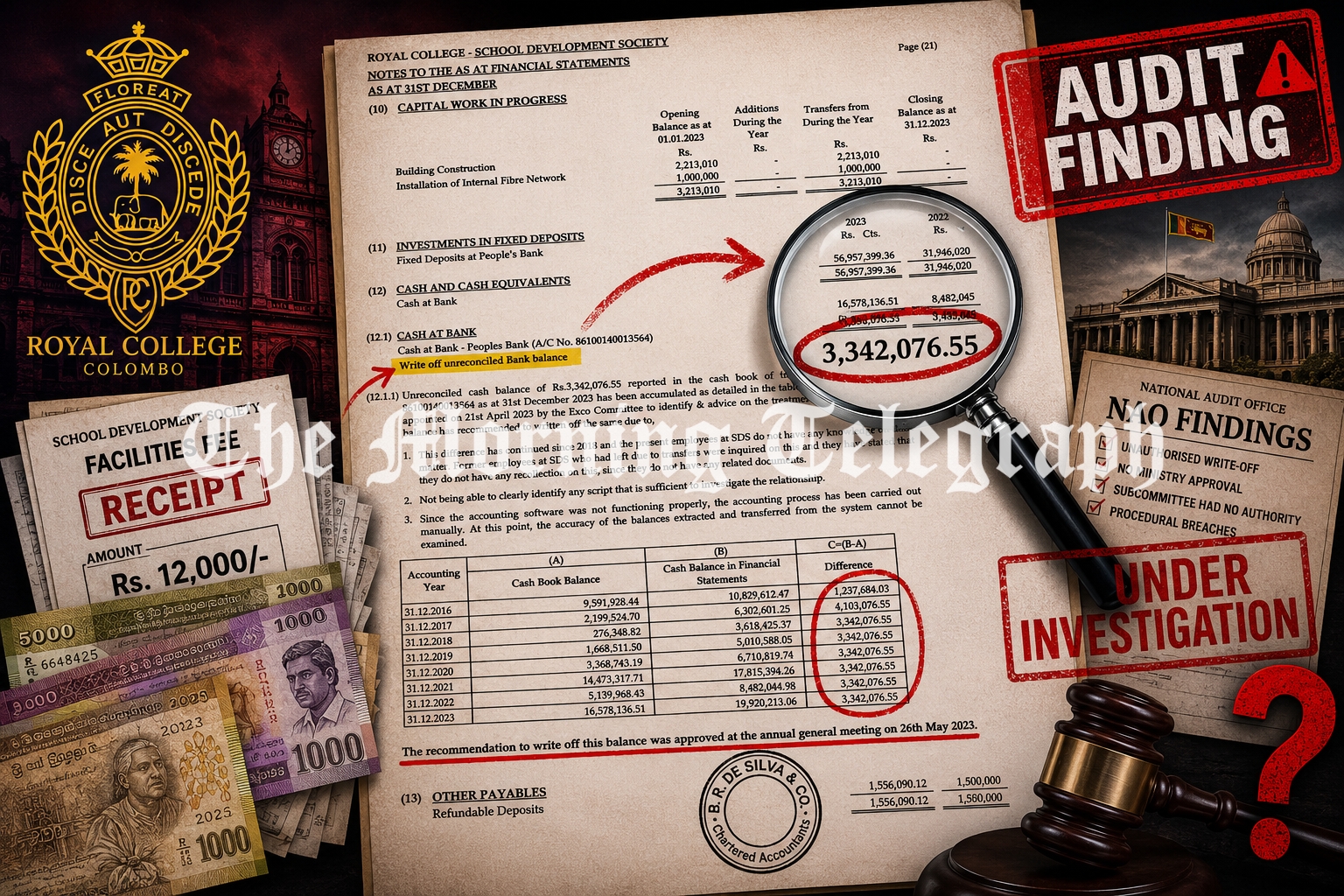
At the centre of the issue is an allegedly improper Rs. 3.3 million write-off from the Royal College SDS account in 2023, a decision now placed under scrutiny following findings by the National Audit Office.
The matter is no longer just an internal school accounting issue. It has the potential to reach the Committee on Public Accounts, opening the door for one of Sri Lanka’s most prominent public schools to have its finances questioned at the highest parliamentary level.
Millions Collected From Parents Every Year
The School Development Society, commonly known as the SDS, exists to collect and manage Facilities Fees used for the day-to-day maintenance of public schools, urgent repairs, and extracurricular activities.
What many parents and members of the public may not realise is that the SDS functions under the authority of the Ministry of Education and must operate according to the rules, regulations, and procedures laid down by the Ministry.
Each year, the Ministry of Education determines the Facilities Fee payable by students in each school, based on estimated expenditure requirements.
At present, the highest Facilities Fee charged by a public school is just under Rs. 12,000 per student.
With an estimated student population of nearly 8,000, the Royal College School Development Society receives close to Rs. 100 million annually, most of it reportedly collected within the first two weeks of January.
That staggering figure explains why strong financial controls, proper reporting, transparent accounting, and effective oversight are not optional.
They are essential.
When parents contribute such large sums, often through personal sacrifice, they have a right to know that their money is being used responsibly, legally, and transparently.
The Rs. 3.3 Million Question
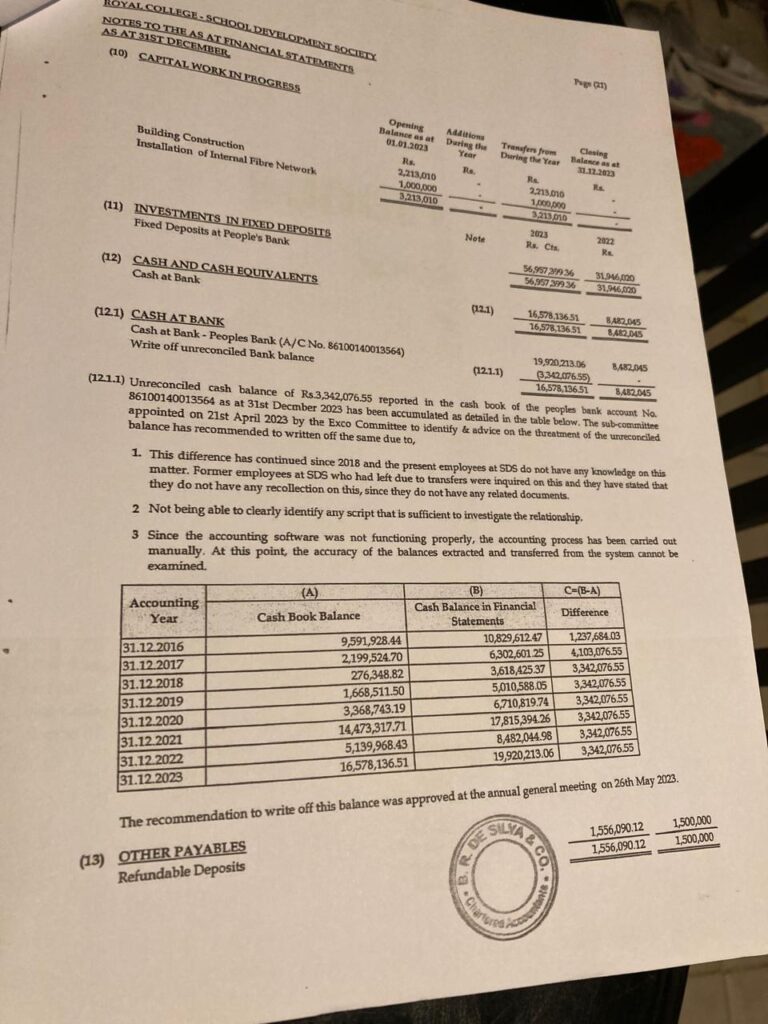
The controversy now centres on the recovery of Rs. 3.3 million that was reportedly written off from the Royal College SDS account in 2023.
According to audit reports, an unreconciled amount exceeding Rs. 1 million had existed since 2016 and had increased to more than Rs. 3 million by 2018.
Thanks to the intervention of the National Audit Office, the issue can no longer be quietly ignored or buried as another internal matter.
If the Secretary to the Ministry of Education, Nalaka Kaluwewa, fails to recover the amount from the Executive Committee of 2023, the issue is likely to come under scrutiny by COPA when the Ministry’s annual accounts are reviewed.
If that happens, it could become one of the first instances where the accounts of a school are examined at the highest parliamentary level — and sadly, for all the wrong reasons.
Why Was This Not Reported Earlier?
Several troubling questions now demand answers.
A substantial amount of public money is involved each year.
Four successive principals appear to have failed to report the matter to the Ministry of Education.
No complaint appears to have been made to the Criminal Investigation Department, the Fraud Bureau, the Bribery Commission, or even the National Audit Office, despite repeated references to the issue in annual internal audit reports.
That silence is deeply concerning.
If an unreconciled amount was first identified in 2016 and continued to grow by 2018, why was urgent action not taken at the time?
Why was the matter not escalated?
Why were investigative authorities not informed?
And why was the issue allowed to sit unresolved for years before a write-off was attempted?
Successive Administrations Under Scrutiny
Annual audit reports indicate that the discrepancy first arose during the tenure of former Principal Mr. B.A. Abeyrathne.
The amount then reportedly increased to over Rs. 3.3 million by 2018.
It appears that the matter was not escalated to the Secretary of Education when it was first identified in 2016, nor was it referred to the relevant investigative authorities.
Two subsequent principals, Mr. Sanath Jayalath and Mr. R.M.M. Rathnayake, also appear not to have taken effective action to resolve the matter.
Then, in 2023, Principal Waththuhewa sought to write off the amount.
However, a recent inquiry by the National Audit Office found serious procedural concerns.
The NAO reportedly found that the Executive Committee lacked the authority to appoint a subcommittee to recommend a write-off, that the subcommittee had no authority to make such a recommendation, and that the principal failed to obtain Ministry approval before proceeding.
Those findings raise a serious question: was the write-off legally and procedurally valid?
Education Ministry Secretary Now in the Spotlight
Under recent amendments to the National Audit Act, when such irregularities are reported to a ministry secretary, the secretary is required to take prompt legal and administrative action to recover losses from those responsible.
That now places responsibility firmly on the Ministry of Education.
Despite the National Audit Office findings, no visible recovery action has yet been taken.
This has raised serious concerns over administrative accountability, the effectiveness of oversight mechanisms, and whether public school finances are being treated with the seriousness they deserve.
The spotlight is now on Nalaka Kaluwewa, Secretary to the Ministry of Education.
If recovery action is not taken, and if the matter reaches COPA, the Ministry may be forced to answer why a school-level financial irregularity involving millions was not addressed promptly.
CIABOC, Fraud Bureau and NAO Enter the Picture
The issue has also moved beyond school-level administration.
A complaint submitted to the Commission to Investigate Allegations of Bribery or Corruption was initially referred back to the Ministry of Education for necessary action.
The Colombo Fraud Investigation Bureau recorded a statement and referred the matter for further consideration.
Thereafter, CIABOC confirmed that it had decided to investigate.
The National Audit Office has been particularly proactive. Despite limited resources, it conducted an audit inquiry at Royal College and concluded that the write-off had been carried out without proper authorisation.
That finding cannot be ignored.
When the country’s national audit authority concludes that a write-off was unauthorised, the responsible institutions must act.
Why This Is Bigger Than Royal College?
This issue extends far beyond one school.
Facilities Fees are paid by thousands of families across Sri Lanka, often through considerable financial sacrifice.
Parents pay because they believe the money will support the maintenance, activities, and development of their children’s schools.
But public confidence depends on one thing: trust.
That trust collapses when large sums are collected without clear public reporting, when audit queries are ignored, and when questionable write-offs are attempted without proper authority.
Public schools that collect and manage large sums of parent-funded money must be subject to strong financial disclosure standards.
Just as publicly listed companies disclose financial statements to protect shareholders and maintain market integrity, public schools handling millions of rupees must also publish annual financial accounts and follow strict reporting rules.
That would strengthen public trust, improve accountability, and ensure that funds contributed by parents are managed responsibly and in accordance with the law.
A Test Case for Public Accountability
For citizens exhausted by corruption and institutional silence, this case is a reminder that oversight can still work when individuals persist.
The process may be long.
It may be frustrating.
It may require repeated complaints, audit interventions, and pressure from oversight bodies.
But public institutions must ultimately answer to the people whose money sustains them.
The Royal College SDS issue now presents a critical test.
Will the Ministry of Education recover the money?
Will those responsible be held accountable?
Will the matter be allowed to quietly disappear?
Or will this become the case that finally forces transparency into the finances of Sri Lanka’s public schools?
What Must Happen Now?
Public funds collected through School Development Societies must be managed with the same level of accountability expected from any public institution.
Ministry officials and school administrators must act promptly when audit findings reveal financial irregularities.
Independent oversight bodies such as the National Audit Office, CIABOC, and COPA must play a central role in protecting public trust in school finances.
Citizens who raise concerns about public finance irregularities must be heard, and their complaints must be followed through to a transparent conclusion.
The question is no longer whether Royal College collects large sums through its SDS.
It does.
The question is whether those funds are being protected with the level of discipline, transparency, and accountability that parents and the public deserve.
Until the Rs. 3.3 million write-off is fully explained, recovered if necessary, and those responsible held accountable, this controversy will remain a stain on school financial governance.