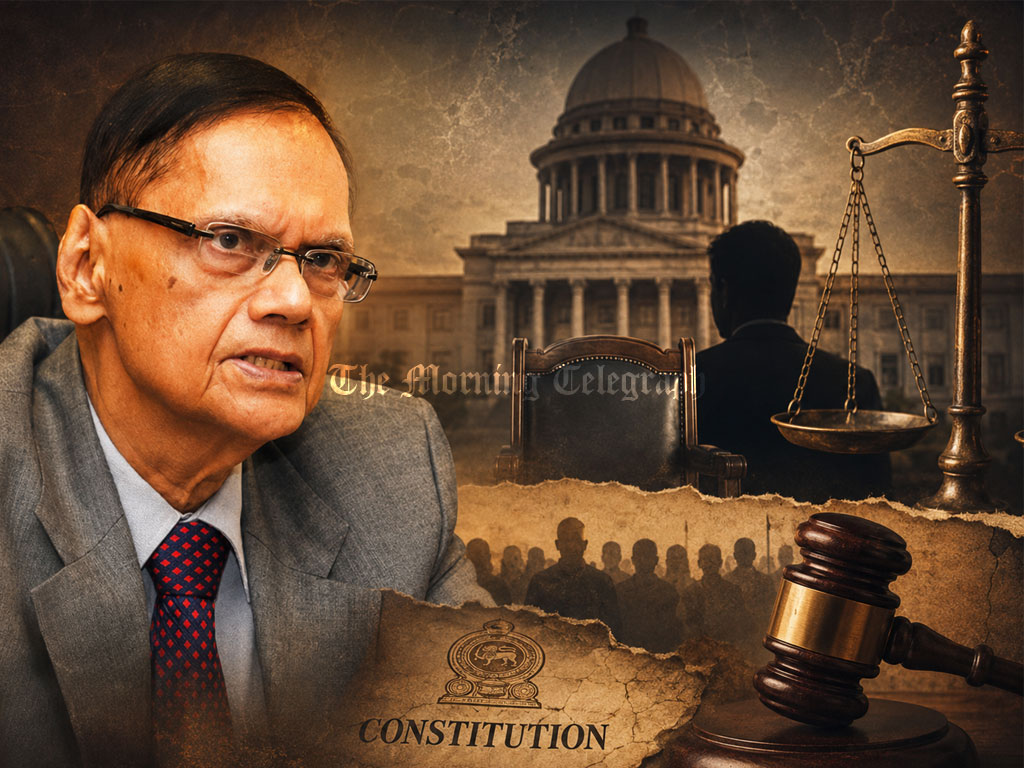
Judges’ retirement age proposal sparks warning from GL Peiris over court vacancies, promotions, equality, and judicial independence.
The proposed judges’ retirement age extension has triggered serious division and controversy, Professor G. L. Peiris has warned, arguing that the government’s move could damage judicial independence, weaken public confidence, and create long-term consequences across the legal system.
A strong wave of opposition has now emerged in society against the government’s alleged plan to extend the retirement age of superior court judges. Critics describe it as an extremely unpopular proposal, while powerful arguments have been presented urging the government not to proceed. In the more than 220-year history of Sri Lanka’s Supreme Court, there has never been a moment when four vacancies remained unfilled at the same time.

Amid this concern, the Daily Mirror newspaper launched a special series of discussions to obtain the views of legal experts on the matter. This article is a special adaptation for our readers based on that series of interviews.
Addressing Parliament on the issue, Minister of Justice and National Integration Harshana Nanayakkara stated that no official Cabinet approval or decision has yet been taken regarding the proposal. However, he said not only judges, but professionals in other sectors too, had requested an increase in retirement age, and that the government was positively considering some requests.
During the past two months, however, the issue has created a highly turbulent situation, especially within the judiciary and among independent professional bodies such as the Bar Association of Sri Lanka, the High Court Lawyers’ Association, and the Lawyers’ Collective.
Against this backdrop, we reproduce below the views expressed to the Daily Mirror by Professor G. L. Peiris, former Professor of Law at the University of Colombo and former Minister of Justice. Professor Peiris, who obtained his law degree from the University of Colombo and a D.Phil from Oxford University in 1971, was also involved in constitutional drafting in the early 1990s.
In the interview, Professor Peiris explains the serious consequences that could arise not only for the judiciary but also for other sectors if the government proceeds with its plan to extend the retirement age of the country’s senior-most judges.
Interview with Professor G. L. Peiris
Professor, why has this subject led to so much controversy at this point?
Answer:
One of the main controversial issues at this moment is the government’s proposal to extend the tenure of judges by two years. Although the government has not issued an official announcement, there is a widespread understanding that the government is paying serious attention to this. The first question that arises is: why is this being done? What is the necessity for this? Why is this being treated as a priority? It is already clear that strong opposition to this has come from the legal field as well as civil society.
The Bar Association of Sri Lanka (BASL) has issued a strong statement opposing this, and district bar associations, civil society organizations, political parties, and trade unions have also endorsed those main views. Therefore, a large wave of opposition has now been created. This is an extremely unpopular decision, and very strong reasons have been presented why this should not be proceeded with.
This has also created a very serious kind of division and disharmony. The best example of this is the recent meeting of the Judicial Service Association (JSA), the official body representing the lower judiciary.
There were reports that some organizations representing judicial officers did not oppose this. Is that true?
Answer:
It is said that at an unofficial discussion with the Honourable President, the President of the Judicial Service Association (JSA) assured the President that his association had no objection to extending the tenure of judges by two years. But this has been strongly rejected by the membership of the association. They have emphasized that this is not their opinion, that they were not consulted about it, and that the President of the association was not given any authority to convey such an opinion to the President on behalf of the association.
Under such circumstances, the JSA President denied making such a statement to the President. He said, “No, I did not do such a thing.” But the Secretary of the association, who attended that unofficial discussion, repeatedly stated that the President had made such a statement, rejecting that claim.
Later, a strong conflict of opinion arose, and according to newspaper reports, the JSA head finally admitted that he had no right to express such an opinion on behalf of the association, and this has also been recorded in the association’s records. These sharp conflicts of opinion do not do any service to the judiciary at all. If the President of the association made such a statement, it is now clear that it was done without the agreement of the membership.
Why do you think the government should give priority to this problem?
Answer:
During the past few weeks, a continuous discussion has been created about this in mainstream media as well as social media. Various opinions, editorials, cartoons, and inquiries about the professional lives and backgrounds of judges can be seen. Such controversial situations are clearly harmful to the dignity of the judiciary.
It can be said without exaggeration that the judiciary is the only institution in our country today that has earned the complete respect and acceptance of the public. Therefore, nothing that would harm that respect in any way should be done. A very important question that arises amidst this opposition is: why is the government persistently trying to implement this as a priority? If judicial sector reforms are considered an urgent necessity, there are many other clear things that need to be done.
The 20th Amendment to the Constitution made several important changes regarding the number of judges in the Supreme Court and the Court of Appeal. Previously, the Supreme Court consisted of the Chief Justice and up to ten other judges, totaling eleven. The Court of Appeal consisted of its President and eleven other judges, totaling twelve judges.
It was argued at the time that the most serious problem facing the judiciary was the delays in the law, the backlog of cases, and that delaying justice is a denial of justice. Therefore, the only practical solution to this was to significantly increase the number of judges, which would provide more judges to resolve the long-pending cases. Accordingly, as a result of the 20th Amendment, the number of Supreme Court judges was increased from eleven to seventeen, and the number of Court of Appeal judges was increased from twelve to twenty.
What is the situation regarding the vacancies that need to be filled in the superior courts?
Answer:
The surprising thing is that, although a constitutional amendment was brought to significantly increase the number of judges in these two courts, currently four vacancies remain to be filled in the Supreme Court and four vacancies in the Court of Appeal. In the over 220-year history of the Supreme Court, there has never been a time when as many as four vacancies existed simultaneously.
What is the reason for this? There are somewhat adverse speculations in society about the purpose of deliberately keeping these vacancies unfilled. If there is a genuine desire to resolve the delays in the law, the first thing to do is to fill these vacancies. Why is that not being done? Furthermore, it is a fact that there is now strong dissatisfaction among the lower court judges.
I have personal knowledge of this. As a Professor of Law and an academic, I have taught two generations of students over 26 years at the Faculty of Law of the University of Colombo. I have taught many of those who currently hold judicial positions in Sri Lanka. My students are in the Supreme Court, the Court of Appeal, and all the lower courts. I know that many of these judges have real unhappiness and anguish regarding matters that directly affect their service conditions.
One critical aspect of this is promotions. We accept without argument that seniority is not the only criterion. Talent must also certainly be considered. But the problem is the absence of a prepared yardstick to measure talent. Therefore, it should not become a cover for arbitrary and capricious decision-making. If a senior judge is overlooked, the reasons should be clear.
If there are good reasons, there is no problem. If there are issues with the judge not writing judgments on time or any other acceptable reason to deny a promotion, that is fair. There is no problem with that. But if no reason can be given and it cannot be explained, it will naturally lead to high-level frustration. Currently, there are about 35 judges who are suffering and highly dissatisfied with this situation.
There is also the issue of transfers. A well-known example of this is the case of High Court Judge A. G. Alex Raja of Jaffna. He was given an appointment in Jaffna and transferred to Badulla within a month. He did not even serve for a month. That is not normal. It is unusual. There may be reasons for that, but the public does not know those reasons. That is not a healthy situation. If a transfer is deemed necessary within such a short period, it should be done with some explanation. Then it is argued that all these are decisions of the Judicial Service Commission (JSC). But it is very important to emphasize that these decisions of the Judicial Service Commission represent the exercise of administrative power, not judicial power.
But isn’t the Judicial Service Commission (JSC) composed of judges?
Answer:
There is no doubt that the Judicial Service Commission is composed of judges. But when they act as members of the Judicial Service Commission, they are not exercising judicial power. Regarding promotions, transfers, and discipline of the lower judiciary, they take administrative decisions.
Accordingly, under Article 126(1) of the Constitution, this is an executive or administrative action and is subject to the fundamental rights jurisdiction of the Supreme Court. There is another matter that should be noted regarding this. The composition of the Judicial Service Commission is governed by Article 111(D)(2) of the Constitution.
According to that provision, the JSC consists of the Chief Justice, the senior-most judge of the Supreme Court, and the next senior-most Supreme Court judge who has experience serving in a court of first instance. Accordingly, the JSC consisted of the Chief Justice, and thirdly, Justice Samayavardhana. He fulfilled that requirement because he had served in the original court.
But surprisingly, the second vacancy had not been filled. The second vacancy is the senior-most judge of the Supreme Court after the Chief Justice. That vacancy arose on March 19th. There is no discretion regarding the identification of the second member of the JSC, because the Constitution specifically identifies the judge. He is the next senior-most judge after the Chief Justice. That is Justice Yasantha Kodagoda.
The Constitutional Council approved Justice Kodagoda’s appointment on May 22nd, and the approval was obtained on May 24th. Accordingly, that vacancy existed for over two months.
That is a violation of the Constitution. Because according to the Constitution, that appointment should have been obtained, and it is clearly essential for the JSC to have its full composition. Even though the Constitution specifically identified the judge who should be appointed, it is problematic that a vacancy existed for over two months. During the period this vacancy existed, decisions regarding promotions and transfers of judges were made by the JSC.
So, would it not be more appropriate for all three members of the JSC, that is, all three judges, to participate in making these decisions? That is a question that needs to be asked again. Why was that vacancy kept for so long? That is a violation of the Constitution, and there needs to be a public discourse on this.
Professor Harold Laski stated, “Eternal vigilance is the price of liberty.” These are matters that the public have both a right and a duty to discuss. And these are not judicial functions.
There is a famous statement made by Lord Atkin in the case of AMBARD v. Attorney General for Trinidad and Tobago. Lord Atkin declared that “Justice is not a cloistered virtue. She must be allowed to suffer the scrutiny and even the outspoken comments of ordinary men, however respectful.” Lord Atkin made this statement regarding judicial decisions. But these are not judicial decisions. These are decisions of an administrative body.
Therefore, further reasons add to why these are suitable and appropriate matters for public debate. No one is suggesting that the decisions taken during that period when the JSC was not fully constituted are invalid. That is not a question of legality. But it is a question of propriety and public acceptance. Why was it not done?
If the government proceeds to extend the retirement age of superior court judges, what will be the fate of the lower court judges?
Answer:
If the government tries to extend the tenure of Supreme Court and Court of Appeal judges by two years, the next clear problem that arises is the blocking of promotion avenues for all other judges. These are judges who have dedicated their entire professional lives to the judicial service.
Naturally, they look forward to promotions. But due to this unexpected change, because the judges of the two highest courts will serve another two years, they will have to retire earlier than they hoped. Is that fair? Due to this unexpected change, it is unavoidable that great frustration will arise among lower court judges due to the breach of legitimate expectations regarding promotions.
According to media reports, one view expressed by one party at the JSA meeting was that there is no objection if the service period of all judicial officers is extended by seven years. That is, an extension of seven years was proposed. This means that the retirement age of Supreme Court judges would be extended from 65 to 67, and for the Court of Appeal from 63 to 67? If it is proposed that all judges will serve until the age of 67, then the extension for the Supreme Court would be two years, for the Court of Appeal four years, and for the High Court six years.
The extension for District Courts and Magistrate’s Courts would be seven years. That is, if they all serve until the age of 67. Because currently a Magistrate or District Judge has to retire at 60. If they are allowed to work until 67, that is an extension of seven years. This is a major upheaval of the entire system.
What is the necessity for this? There is absolutely no clear reason or explanation for this. The question that repeatedly arises is whether there is a hidden purpose behind this. That hidden purpose is being openly discussed in society. That is certainly not a healthy situation. What seems to be proposed now is to bring an amendment to Article 107(5) of the Constitution. Article 107(5) defines the retirement age.
The retirement age for the Supreme Court is 65 and for the Court of Appeal is 63. Why is this being brought as a standalone amendment? A standalone amendment is brought when this will have implications on various other aspects of the Constitution. For example, the electoral system and the devolution of power under the 13th Amendment. All these are interconnected.
Why is the government choosing to change only this specific problem without any strong necessity? Let us consider what the situation would be if the government says it is resolving the problems of all judicial officers and that this will not prejudice anyone.
So, would this problem be resolved if all judges were given a service extension?
Answer:
Suppose everyone’s service period is extended by one year. But still, a very serious question remains. That question is this: there should be harmony and consistency across the entire public service. It is the same institution.
For example, during the 2022 reforms, the service conditions of Supreme Court judges and university professors were mentioned. An attempt was made to equate them. University professors retired at 65. So did Supreme Court judges. Specialist doctors retire at 63. But under special circumstances, their service can be extended to 65.
Departmental heads in the public service must retire at 60. Now all these categories remain as they were. None of them have a service extension. All of them—university professors, specialist doctors, administrative department heads—are in the same situation. But this special privilege exclusively for judicial officers is being created. This could be contrary to the principle of equality contained in Article 12(1) of the Constitution.
That is the principle of equality before the law and equal protection under the law. If this is done, it could be argued not as a question of classification, but as a question of discrimination. Professional bodies representing other sectors of the public service might also be interested in this matter.
For example, the Federation of University Teachers’ Associations (FUTA) and the Association of Medical Specialists (AMS) could go to court through a fundamental rights petition on the basis of unequal treatment.
But the difficulty here is that such a case would also have to be heard by the Supreme Court. Because under the Sri Lankan Constitution, the sole and exclusive jurisdiction regarding fundamental rights is vested in the Supreme Court. So, the very individuals who would benefit from this would be acting as judges in their own courts. That would be a violation of the rules of natural justice.
The final point is that all this is a question of perception. Perception is important. That is the famous principle stated by Lord Hewart: “It is not enough that justice is done; it must also be seen to be done.” Whether intended or not, this could appear as an inducement offered to the judiciary. It is subject to such an interpretation, and that is harmful to the dignity of the judiciary. This perception does not arise in a vacuum but in conjunction with various other situations.
For example, the statement made by the President at the May Day rally: he said that a judgment in a case heard on April 30th was scheduled to be delivered on May 25th, and that the public should be ready to applaud that judgment. That would imply that the President was aware of the judgment to be delivered. Since a judge has no right to discuss a pending judgment with anyone, this certainly compromises judicial tradition.
There was another instance. That is the statement made by JVP General Secretary Tilvin Silva regarding the special presidential commission of inquiry appointed to investigate the coal fraud. Speaking at the May Day rally in Hambantota, Tilvin Silva stated that this commission had been appointed and given six months to complete its work, but that at the end of three months it would become clear that the accused individuals themselves would become the accused, and that all individuals connected to the government would be acquitted and released.
One characteristic of a special presidential commission of inquiry is that all its members must be sitting judges, so this is clearly an insult to the special presidential commission of inquiry. Accordingly, the government has appointed one judge from the Supreme Court, one judge from the Court of Appeal, and one judge from the High Court. They are judges who hear day-to-day cases.
If the General Secretary, a high official of the ruling party, states that this will be the decision of the special presidential commission of inquiry, it is a denigration of the commission. It is an insult to the commission. Later, Tilvin Silva apologized. This was first mentioned in the ‘Anidda’ newspaper on March 13th, and I immediately responded to it and pointed out the dangerousness of this course of action. I still believe that this should not be proceeded with, as it causes real damage to judicial tradition.
Has the extension of judges’ retirement ages not happened in any other country for some justifiable reason?
Answer:
No, some countries like the United States of America do not have a retirement age. But we have had this system since the Constitution was enacted. Therefore, if it is to be done, there must be a strong reason for it. I cannot think of any other country that has done it in this manner without any clear reason. Therefore, due to the lack of any justification, any necessity, any practical need for this at this time, these various speculations have arisen. That is not good. And what is the reason preventing the filling of these eight vacancies in the superior courts? There is absolutely no reason.
The President is obliged to fill them. But he is not doing so, keeping them open.
So why? Why was the 20th Amendment passed? It was passed because more judges were needed. Then that amendment increased the number of judges. Despite that, these positions are kept vacant. So why was that amendment passed? Therefore, this has led to all kinds of speculation about its purpose. It should not appear manipulative. Whatever the real intention, it appears manipulative.
That is a violation of the Constitution. The President is obliged to appoint the relevant number of judges, and there is no practical obstacle or hindrance to it.
Is there any action or force a citizen can take when such a situation arises?
Answer:
The injustice is clear. But what is the benefit to the citizen? Ultimately, you have to go to the Supreme Court. That is the paradox. Consider a judge who has served his entire life in the judiciary. He ends his service from the Court of Appeal. He has reached the highest level of the Court of Appeal.
Then he reaches the retirement age of the Court of Appeal. That age is 63. But if he were appointed to the Supreme Court, he could serve another two years. But that is denied to him. Even though there is an opportunity for promotion, it has been denied to him. So, is that fair? Does it encourage judges? Is that proper respect for the judiciary? You want to encourage the people you want. You want to encourage them to do their best, not to discourage them. So, is this not a very powerful method of discouragement?
I want to ask a related but different question. Is it acceptable for past governments to give political appointments, such as ambassadorial positions, to retired judges, especially those from higher courts? Is that not similar to the various inducements given by governments?
Answer:
Yes, that has happened. The former Chief Justice of India delivered the Sujata Jayewardene Memorial Lecture at Karnataka University. During his lecture, he stated that when he was appointed Chief Justice, he made a public declaration that he would not accept any paid or unpaid appointment from any government after retirement. I attended that lecture. It received a huge round of applause from the audience.
They appreciated it. He further said that he felt such a declaration was necessary to emphasize his independence and integrity. That is why the applause was received. Unfortunately, previous governments in Sri Lanka have violated this.
That has happened. But there is a government that came to power promising to introduce a completely new culture. So, citing past precedents is useless, because the basis was that they belong to the past. They should have been rejected, and a new culture should have been established. Therefore, if a judge is appointed to a high ambassadorial post immediately after leaving the judicial position, suspicion may arise in the public mind about his impartiality during the past few years. So, the best remedy for that is the step taken by the former Chief Justice of India.
He said, “No, we make a public declaration that we will not accept such positions.”
That is a very healthy practice. It should be emulated.