The hidden bunker beneath Trincomalee Naval Dockyard remains one of Sri Lanka’s most disturbing post-war secrets. Once built to store ammunition, investigators say it became an underground torture and ransom center where dozens of victims disappeared behind sealed concrete walls, leaving families still searching for justice years later.
TRINCOMALEE, Sri Lanka – Deep within the high-security perimeter of the Trincomalee Naval Dockyard, behind layers of restricted checkpoints and dense foliage, lies a dark piece of wartime history that authorities spent years trying to keep underground.
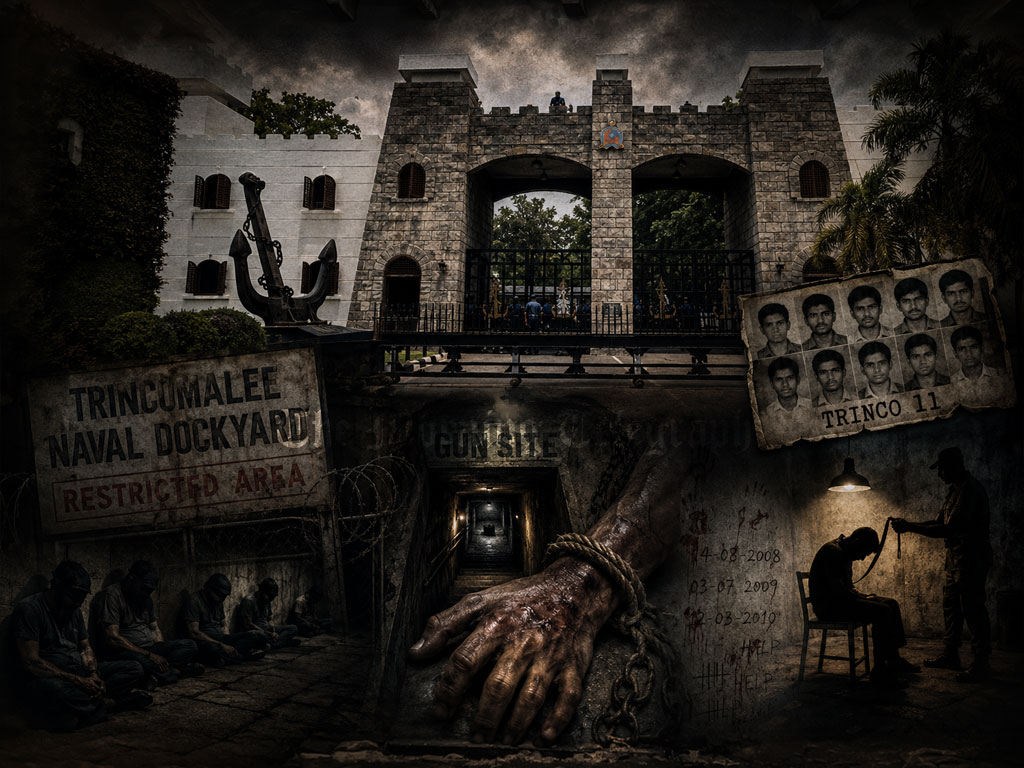
Initially built as a reinforced ammunition storage bunker, the subterranean complex, known chillingly among insiders as the “Gun Site, gradually transformed into a highly organized, illicit black site. According to evidence gathered by the Criminal Investigation Department (CID) and international observers, the facility was utilized by a rogue faction of naval intelligence personnel to unlawfully detain and torture at least 60 individuals.

For years, the Gun Site operated entirely outside the framework of the law. Investigations revealed that the bunker was not merely used for rogue interrogations, but functioned as the central hub for a brutal, highly lucrative extortion racket.
Wealthy businessmen, students, and teenagers were systematically targeted, abducted in unmarked vehicles, and transported to the subterranean dockyard facility. Once inside the Gun Site, victims were subjected to severe physical abuse and psychological terror. The primary objective of this systematic torture was to compel frantic families into paying astronomical ransom payments in exchange for the victims’ lives.
The horrific nature of the operation came to light following the end of the civil war, gaining global attention in November 2015 when the United Nations Working Group on Enforced or Involuntary Disappearances conducted a breakthrough inspection of the naval base.
Led by UN experts Bernard Duhaime, Tae-Ung Baik, and Ariel Dulitzky, the team discovered a network of 12 underground cells. Inside, investigators uncovered stark physical evidence of prolonged human suffering, including suspected historic bloodstains and desperate inscriptions carved directly into the concrete walls. Some of these dates stretched well into 2010, confirming that the bunker remained operational long after the armed conflict had officially concluded.
The exposures heavily linked the Gun Site to the infamous “Trinco 11” case, which involved the enforced disappearance of eleven young men abducted from Colombo and its suburbs between 2008 and 2009. While the navy leadership eventually acknowledged the existence of the bunker, they attributed its misuse strictly to a rogue unit operating an unauthorized criminal enterprise.
Following directives from the magistrate courts, the underground site was formally sealed to protect vital forensic evidence. However, over a decade since the abductions took place, the pursuit of total justice remains heavily compromised. Frequent transfers of key CID investigators and shifting political currents in Colombo have repeatedly stalled court proceedings, leaving many families of the victims still waiting for definitive accountability.