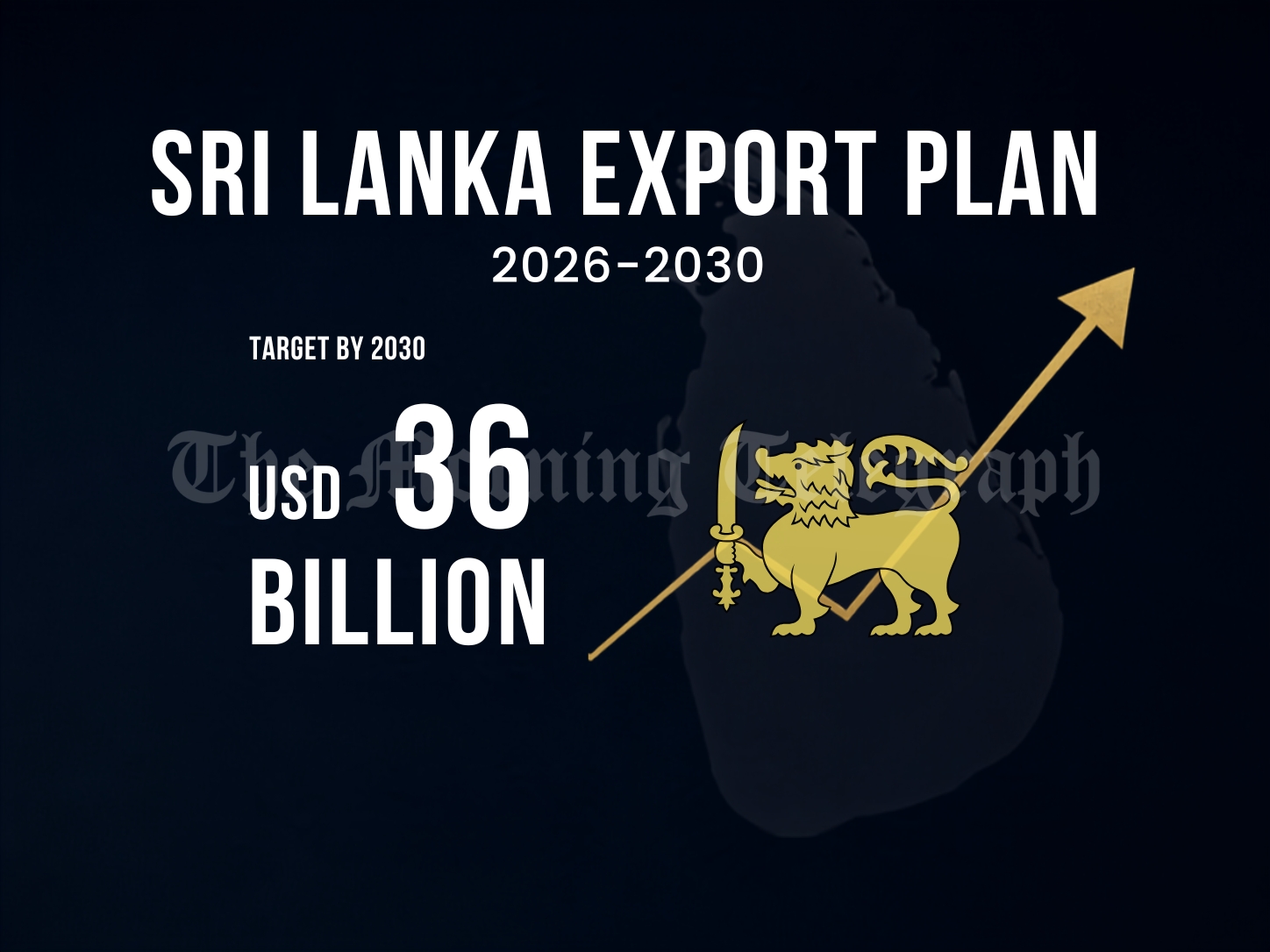
Sri Lanka’s export plan targets USD 36 billion by 2030, but past failures raise questions over delivery, strategy and real economic impact.
Sri Lanka export plan ambitions have returned to the national spotlight after the Government officially launched the National Export Development Plan 2026–2030.
The plan targets USD 36 billion in total export revenue by 2030, placing exports at the centre of Sri Lanka’s long-term economic recovery strategy.
The National Export Development Plan was launched on 16 June 2026 and is designed to strengthen Sri Lanka’s export competitiveness, diversify the country’s export base and support sustainable export-led growth.
The Cabinet of Ministers approved the proposal on 4 May 2026, following a submission by the Minister of Industry and Entrepreneurship Development.

The plan was formulated under the guidance of the Ministry of Industry and Entrepreneurship Development and the leadership of the Sri Lanka Export Development Board, with technical assistance from the Asian Development Bank.
According to the export roadmap, the 2030 target includes USD 28 billion in merchandise exports and more than USD 8 billion in services exports.
The plan focuses on eight priority sectors: auto components, mineral-based industries, rubber-based industries, marine-based industries including boat and ship building, spices and concentrates, digital products and services, electrical and electronic components, and processed food and beverages.
It also identifies six cross-sector enablers needed to support export growth. These include trade logistics and integrated hub operations, trade facilitation, trade finance, investment environment reform, trade promotion, market links, quality management, standards, ESG, skills development, entrepreneurship and innovation.
The Government’s wider vision is to position Sri Lanka as a competitive logistics and knowledge-intensive export hub serving regional and global markets.
That ambition is important because Sri Lanka continues to search for stronger foreign exchange earnings, wider market access and a more stable growth model after years of economic crisis.
For the Government, the export plan sends a positive signal. It shows an attempt to move beyond short-term crisis management and place trade, manufacturing, services and value addition at the centre of national recovery.
However, the real test is not whether Sri Lanka can produce another attractive strategy document. The harder question is whether this plan can succeed where previous export strategies failed.
Sri Lanka’s earlier National Export Strategy for 2018–2022 aimed to achieve USD 28 billion in export earnings by 2022. In reality, the country achieved only around USD 16 billion.
That gap is the warning sign. Sri Lanka has announced export targets before, but has repeatedly struggled to convert ambition into sustained results.
The problem has rarely been a lack of potential. Sri Lanka has strong products, skilled exporters, a strategic location, known brands such as Ceylon Tea and Ceylon Cinnamon, and emerging opportunities in technology, services, logistics and value-added manufacturing.
The deeper challenge has been implementation. Exporters have long faced issues linked to bureaucracy, policy inconsistency, cost of capital, weak trade facilitation, infrastructure gaps, limited market access and slow public-sector delivery.
The new plan appears to recognize many of these weaknesses by focusing not only on sectors, but also on systems that cut across the entire export economy.
If trade facilitation improves, exporters can move goods faster. If standards and quality systems are strengthened, Sri Lankan products can compete better abroad. If trade finance becomes more accessible, small and medium exporters may be able to scale beyond survival mode.
That is why the implementation framework matters. The plan is expected to be supported by a governance and monitoring structure, including stronger coordination, project management and reporting mechanisms.
This is where public confidence will be decided. Sri Lanka does not need another launch ceremony that disappears after the headlines fade. It needs measurable progress, sector-by-sector follow-up and clear support for exporters trying to enter or expand in global markets.
The Government deserves credit for placing exports back at the heart of the economic conversation. A country recovering from crisis cannot depend only on taxes, remittances, borrowing and tourism. It must produce and sell more to the world.
But the Government must also explain what is different this time. Previous strategies carried big targets too, but delivery fell far short.
For the National Export Development Plan 2026–2030 to become a turning point, exporters need more than speeches and policy documents. They need faster approvals, lower transaction costs, better financing, stronger branding, stable policy and active help in reaching buyers.
The USD 36 billion target is ambitious, but not meaningless. It can become a serious national goal if the State, private sector and development partners treat execution as urgently as announcement.
Sri Lanka’s export future will not be decided by the size of the target. It will be decided by whether the country finally fixes the systems that have held exporters back for decades.
#SriLankaExportPlan #SriLankaExports #SriLankaEconomy #NationalExportDevelopmentPlan #ExportDevelopmentBoard #SriLankaTrade #EconomicRecovery #SriLankaBusiness #ExportLedGrowth #ADB #SriLankaFinance #SriLankaNews #TheMorningTelegraph