By Roy Denish
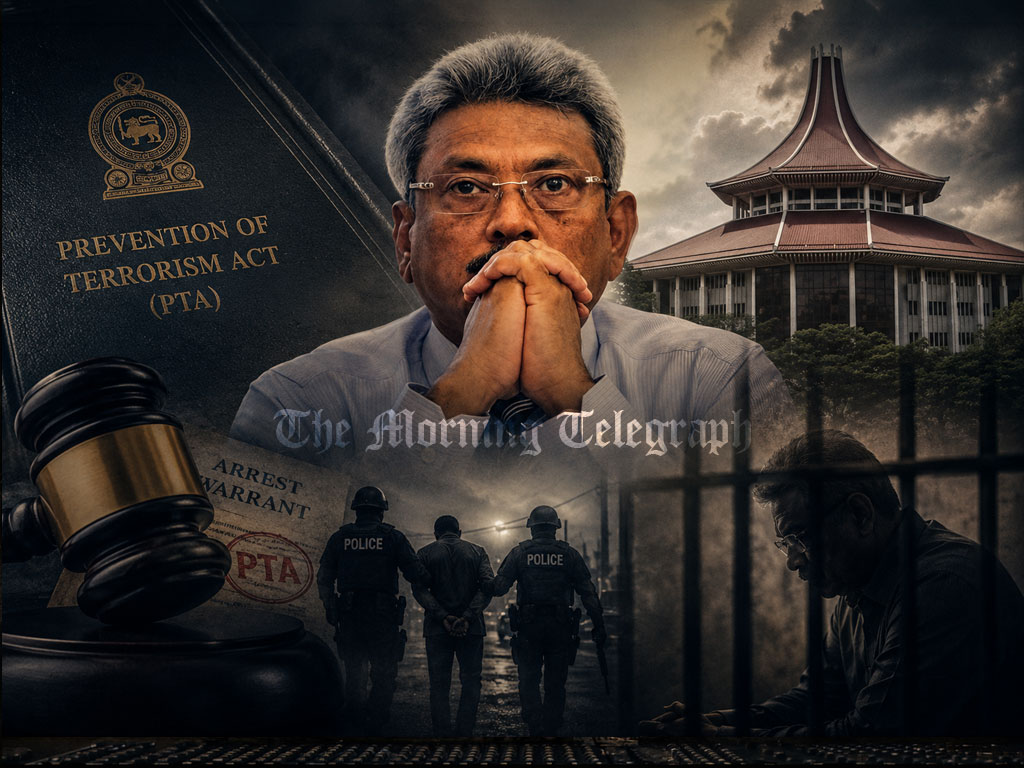
The man who once defended Sri Lanka’s toughest anti-terror law is now asking the courts to shield him from it. Gotabaya Rajapaksa’s bid to block a potential PTA arrest over the Easter attacks investigation has reignited a national debate about power, accountability, and the dangers of laws that can outlive the leaders who created them.
The shifting tides of political accountability in Sri Lanka have a way of producing profound historical ironies, but none so stark as the latest legal maneuver by former President Gotabaya Rajapaksa. Having recently filed a writ petition before the Court of Appeal to block his potential arrest under the Prevention of Terrorism Act (PTA), the former head of state finds himself pleading for protection from the very instrument of state power his own administration fiercely championed and expanded.
The move comes as investigators probe deeply into the handling of the 2019 Easter Sunday bombings, following a recent travel ban and the pivotal arrest of retired Major General Suresh Sallay. For a leader who campaigned on a platform of unyielding national security, the petition reveals a vulnerability that exposes the double-edged nature of institutional overreach.

The PTA, enacted in 1979 as a temporary measure, has long survived its shelf life to become a permanent feature of Sri Lanka’s administrative state. For over four decades, civil society organizations, international human rights watchdogs, and domestic legal analysts have criticized the act for facilitating arbitrary detention, restricting judicial oversight, and allowing prolonged remand without formal charges. Yet, during his presidency, Rajapaksa consistently rejected calls for its repeal. His administration went so far as to introduce new de-radicalization regulations that expanded detention powers, maintaining that such draconian tools were indispensable for safeguarding public safety.
Now, the legal reality changes when the architect of state authority faces the mechanics of that same system. In seeking an intervention against the Inspector General of Police and the Criminal Investigation Department, the former president is effectively admitting what critics have argued for years: that the statutory framework of the PTA lacks the safeguards necessary to guarantee due process. When a former commander-in-chief argues that the counter-terrorism apparatus cannot be trusted to act without judicial constraints, the structural flaws of the legislation are laid bare for all to see.
This petition underscores a broader lesson about governance and the rule of law. Powers created to bypass standard criminal procedure invariably outlast the administrations that establish them. When political leaders erode legal checks and balances to target political rivals or manage crises, they build a mechanism that can easily be turned against them when power shifts. Institutional overreach is rarely a permanent shield; more often, it becomes a structural liability.
Whether the Court of Appeal grants the requested intervention remains a matter of constitutional process. However, the political commentary is already written. The sight of a former leader using the courts to protect himself from an accountability process he once supervised serves as a vivid reminder that true security lies not in the expansion of arbitrary state power, but in the preservation of consistent, fair, and transparent legal protections for every citizen, regardless of status.