by Dwayne Ferreira.
Sri Lanka’s renewable energy can curb fuel imports, conserve foreign exchange and reduce the economy’s exposure to global oil shocks.
Sri Lanka’s renewable energy is usually discussed in terms of electricity supply or climate policy. However, its economic value could be just as important. Every additional share of power generated from domestic resources can potentially reduce the country’s dependence on imported fuel and the US dollars needed to pay for it.
For an economy that has repeatedly faced foreign-exchange shortages, renewable electricity therefore offers something more than cleaner energy.
It can become a long-term strategy for conserving dollars.
The basic argument is remarkably simple.
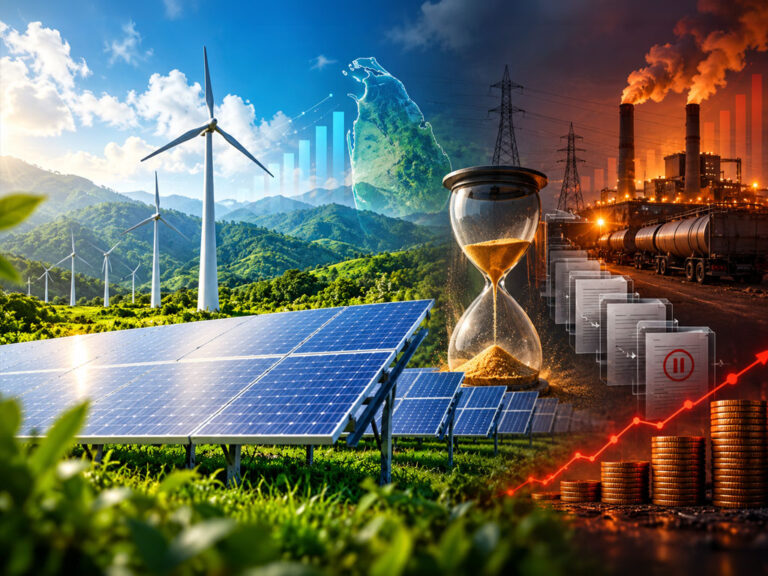
Sri Lanka does not import sunlight. The country does not need foreign currency to purchase rainfall. Wind does not arrive at Colombo Port with an invoice denominated in US dollars.
Petroleum does.
That difference matters enormously when Sri Lanka’s import bill is examined.
The Central Bank of Sri Lanka says fuel is the largest item in the country’s import basket. Over the past decade, it has accounted for around 20% of total import expenditure on average each year. Sri Lanka’s fuel import bill reached about US$4 billion in 2025, although this was below the US$4.4 billion recorded in 2024.
The risk became even clearer in 2026.
Sri Lanka spent approximately US$886 million on fuel imports in April alone. That represented a 149.9% increase from April 2025. The Central Bank attributed the rise to higher global fuel prices amid the Middle East conflict and increased import volumes.
Those dollars must first enter Sri Lanka through exports, tourism, worker remittances, investment or other foreign-currency sources before the country can spend them abroad.
Domestic Resources Change Sri Lanka’s Energy Equation
Sri Lanka possesses several important energy resources within its own borders.
The Sri Lanka Sustainable Energy Authority identifies biomass, hydropower, solar and wind among the country’s renewable resources. The authority also promotes greater use of domestic energy as part of improving energy security and reducing dependence on imported resources.
This is where the foreign-exchange argument for Sri Lanka’s renewable energy becomes especially powerful.

A thermal power station needs a continuous fuel supply. When that fuel comes from overseas, electricity generation also creates recurring demand for foreign currency.
Solar power operates differently.
A solar project requires equipment and upfront investment, some of which may itself involve imports. However, once installed, the country does not have to purchase the sunlight that produces its electricity.
The same principle applies to wind.
Hydropower is particularly important because Sri Lanka already has substantial infrastructure built around its water resources. The Sustainable Energy Authority says hydro remains a key electricity source and supplies both peak and base generation requirements. It also describes major hydro as a source of valuable low-cost electricity.
The impact can already be seen in daily electricity generation.
CEB figures for August 16 showed renewable sources producing 33.45 GWh, or 66.63% of Sri Lanka’s total net electricity generation that day. Fossil fuels supplied the remaining 16.76 GWh, or 33.37%.
On August 15, renewable generation had accounted for an even higher share of approximately 70.7%.
However, this does not mean every additional unit of renewable electricity automatically removes an equivalent quantity of petroleum imports.
Sri Lanka also uses imported coal. Meanwhile, thermal generation remains important for system stability, reliability and periods when hydro, wind or solar output cannot meet demand.
Nevertheless, whenever locally produced renewable electricity replaces generation that would otherwise require imported fossil fuel, the country reduces its need to spend foreign currency on energy.
Sri Lanka Renewable Energy Is Dollar-Saving Infrastructure
That changes the way renewable investment can be viewed.
A solar farm is not merely environmental infrastructure.
Over its operating life, it can reduce exposure to international fossil-fuel markets and the foreign currency needed to purchase those fuels.
Wind power provides similar protection.
Hydropower becomes particularly valuable when rainfall and reservoir conditions allow greater generation. Higher hydro output can reduce the need for more expensive thermal power.
Renewable electricity therefore gives Sri Lanka some control over a major economic vulnerability.
The country cannot determine world crude oil prices.
Sri Lanka cannot prevent conflict in the Middle East, disruption to international shipping routes or production decisions by major oil exporters.
But it can influence how much imported energy its economy requires.
The Ceylon Electricity Board’s Long Term Generation Expansion Plan 2025-2044 reflects that direction. It incorporates the national policy target of generating 70% of electricity from renewable sources by 2030. The plan also gives priority to indigenous renewable resources, including wind, solar, hydro and biomass.
The transition will still require major supporting investments.
The grid needs greater storage capacity, stronger transmission infrastructure and flexible generation because wind and solar output changes with weather and time of day. The CEB plan itself highlights pumped-hydro and battery storage as important components of a system with a much larger renewable share.
Therefore, installing renewable capacity alone will not eliminate Sri Lanka’s dependence on fossil fuels.
However, the broader economic direction is significant.
Every Dollar Sri Lanka Does Not Spend on Fuel Matters
Sri Lanka’s recent economic crisis demonstrated the danger of running short of foreign currency while essential imports still had to be purchased.
That experience makes the connection between energy and foreign exchange difficult to ignore.
Worker remittances bring dollars into Sri Lanka.
Tourism brings dollars into Sri Lanka.
Exports bring dollars into Sri Lanka.
Fuel imports send dollars out.
Reducing avoidable dependence on imported energy therefore works alongside policies aimed at increasing foreign-currency earnings.
That is why Sri Lanka’s renewable energy should not be viewed only through the climate or electricity debate.
Renewables can support energy security. They can reduce exposure to global fuel-price shocks. Most importantly, when they displace imported-fuel generation, they can conserve foreign exchange that Sri Lanka can use elsewhere.
The economic equation remains strikingly simple.
Sunlight costs Sri Lanka nothing to import.
Rainfall costs Sri Lanka nothing to import.
Wind costs Sri Lanka nothing to import.
Oil does.