
By Roy Denish
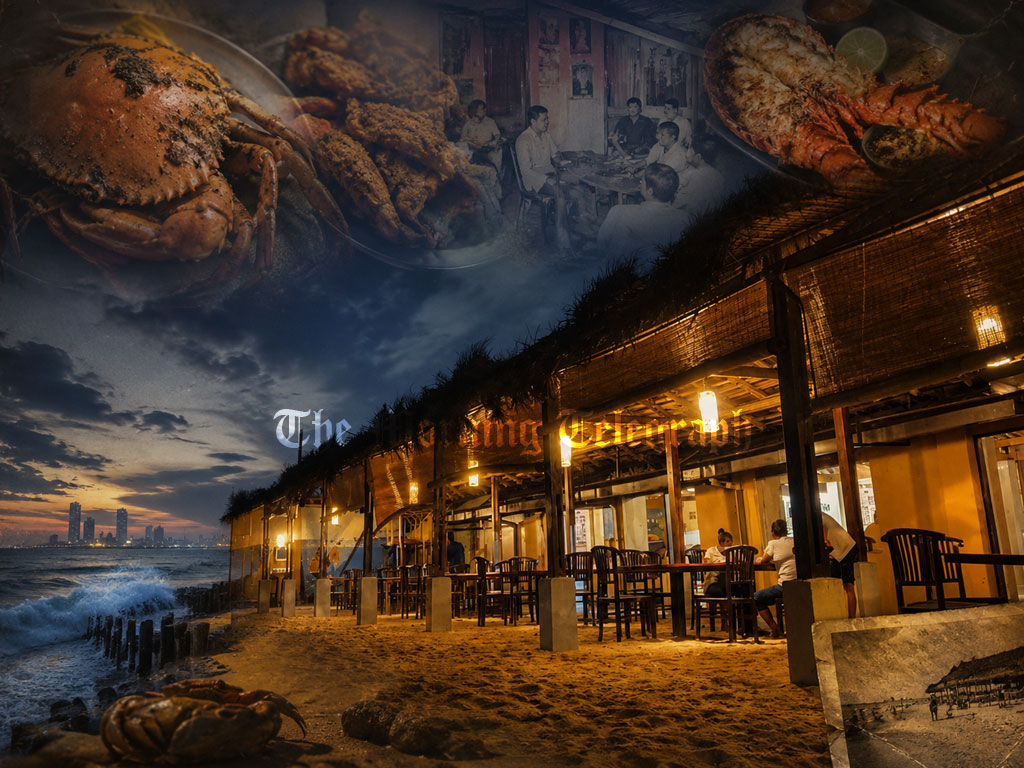
Beach Wadiya remains one of Colombo’s most unforgettable coastal legends, a place where fresh crab, sweet lobster, political history, cricket stories and sea-breeze diplomacy came together. Though time and the ocean have weakened its physical presence, its legacy still stands as a golden chapter in Sri Lankan hospitality.
A Philosophy Built on Freshness
The Beach Wadiya built its legendary reputation on a culinary philosophy that was deceptively simple: absolute freshness, minimal interference, and bold, authentic Sri Lankan coastal flavors.
Among its extensive seafood repertoire, the baked crab and the fried crab stood as the undisputed crowns of the establishment, especially when paired with pristine, sweet lobsters brought straight from the local ocean waters into the kitchen.

The Legendary Baked Crab
The baked crab at the Wadiya was a masterclass in rich, savory indulgence.
Unlike modern interpretations that rely heavily on heavy creams or cheeses, the traditional Wadiya preparation focused on celebrating the natural, sweet flavor of the crab meat.
The succulent meat was meticulously picked from the shell, seasoned with a precise blend of local black pepper, fine herbs, a touch of butter, and a hint of mustard, before being stuffed back into the clean shell.
Baked to a perfect, gentle golden brown, it offered a delicate balance where the initial buttery richness quickly gave way to the deep, sweet essence of the sea.
Fried Crab With Fire and Flavor
In contrast, the fried crab was an assertive, tactile experience.
Whole crabs were cracked and tossed directly into hot oil with cracked peppercorns, garlic, curry leaves, and a fiery hit of local chili.
The high heat flash-fried the shells to a beautiful crimson, sealing the natural juices inside the meat while creating an intensely fragrant, spicy crust on the outside.
Eating it required rolled-up sleeves and bare hands, cracking through the seasoned shells to reach the tender, steaming meat within.
Lobsters Treated With Respect
When it came to the lobsters, the kitchen treated them with the ultimate respect.
Brought in fresh by local divers, these lobsters required very little embellishment.
They were typically split down the middle and grilled gently over an open flame with nothing more than a brushing of lime butter and sea salt, or flash-fried to retain their firm, springy texture.
The result was a dish defined by its natural sweetness and clean coastal flavor, a luxury served without any of the stuffy etiquette of fine dining.
A Political Theater by the Sea
Beyond the food, the Wadiya functioned for decades as an unconventional, open-air political theater and a diplomatic neutral zone.
In the early 1980s, it famously became a preferred clearinghouse for gossip, strategy, and camaraderie, hosting heads of political parties, foreign diplomats, and visiting sports teams.
The legendary English cricket team of that era, seeking a break from rigid protocols, frequently found refuge under the thatched roof, enjoying cold beer and fiery seafood with their feet in the sand.
It was a space where the strict hierarchies of Colombo society dissolved.
Most notably, the venue served as the backdrop for pivotal moments in contemporary Sri Lankan political history; it was right here, amidst the casual sea breeze, that a young Mahinda Rajapaksa, soon after his entry into active politics, joined forces with Ossie Abeyagoonasekera to hold their very first press conference, cementing the shack’s status as a witness to history.
A Melancholy Monument to a Bygone Era
Today, however, the Beach Wadiya stands as a poignant, melancholy monument to a bygone era.
The current decline and dwindling sales are not the result of mismanagement, but rather a casualty of a shifting cultural landscape.
The unique, irreplaceable aura that once drew presidents, princes, and bohemian intellectuals alike has gradually dissipated as the city’s social center of gravity moved elsewhere.
Furthermore, the passing of time has taken a toll on the human element, with a noticeable loss of the fiercely loyal, highly motivated staff whose colorful personalities and dedicated hospitality were just as vital to the experience as the recipes themselves.
The Ocean Turns Against an Icon
Compounding these internal shifts, the physical environment has turned hostile.
The Beach Wadiya has found itself constantly facing the relentless, eroding wrath of the changing sea.
Decades of monsoons, high tides, and coastal changes have battered the structure, stripping away the vibrant, bustling atmosphere of its heyday.
Today, passing by the Wellawatte tracks, the establishment presents a heartbreaking sight — it exists largely as a skeletal frame of its former self, with little remaining to catch the eye other than the iconic name board standing defiantly outside against the elements.
A Golden Milestone of Sri Lankan Hospitality
In conclusion, the story of the Beach Wadiya is the story of Colombo itself, a narrative of vibrant cultural fusion, historic milestones, and the inevitable, bittersweet passage of time.
While its physical structure may now be reduced to a quiet shadow on the sand, its legacy remains entirely intact.
The Wadiya was never just about the walls that housed it, but about the spirit of unpretentious gathering, the legendary flavors of its kitchen, and the historic conversations that echoed over the sound of the waves.
It endures in the collective memory of the city as a golden milestone of Sri Lankan hospitality, a reminder of an era when the finest things in life required nothing more than fresh seafood, good company, and the open ocean.


Sadly the quality of the food dropped after the passing away of it’s Proprietor Ally W.