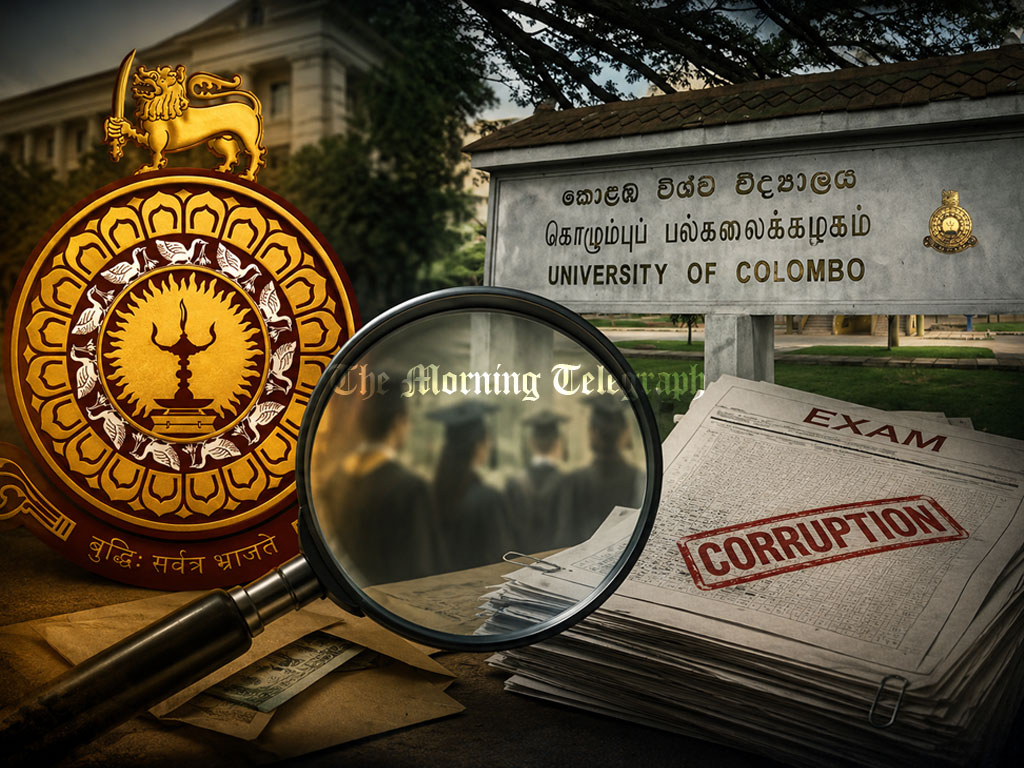
Colombo University corruption allegations over a diploma course have triggered wider concern about Sri Lanka’s state university system.
The Colombo University corruption investigation launched by the Commission to Investigate Allegations of Bribery or Corruption has sent shockwaves through Sri Lanka’s state education system. The inquiry into one of the country’s most prestigious higher education institutions, centred on the Management Higher Diploma course, is no longer seen as an isolated university problem. It has become a disturbing reflection of the wider crisis facing the entire state university system.

Allegations That Strike at Public Trust
According to complaints submitted by a group of students, the alleged irregularities within the relevant University of Colombo course are of a nature that should never occur inside any educational institution.
Education Allegedly Traded for Money and Favours
If allegations that examination papers were revealed before exams and marks were awarded in exchange for money are proven true, they amount to a direct attack on the sanctity of the entire education process.
Retaliation and Arbitrary Conduct
The alleged failure of students who refused to submit to improper demands by lecturers, together with the violation of accepted procedures, suggests that certain lecturers may have acted as though they were above the law.
Administrative Failure and Institutional Weakness
The alleged issuing of fake results after questioning failed students, as well as arranging degree conferrals without properly examining student complaints, shows how weak or corrupt the institutional administration may have become. The absence of proper responses from the Vice-Chancellor’s or Registrar’s side during media inquiries has further deepened these suspicions.
State Universities Then and Now
When examining this incident critically, it is no secret that Sri Lanka’s state university system has suffered a serious decline, as reflected in recent media reports and public discussion. However, even if not at this level, similar incidents have existed in state universities to varying degrees throughout history.
Commercial Courses Over Academic Quality
Beyond internal degree programmes, state universities have increasingly turned external degrees, diplomas and postgraduate courses into revenue-generating ventures. Since many of these programmes operate without sufficient regulation, certain lecturers have allegedly converted them into money-making machines. The fact that the University of Colombo controversy is also linked to such a diploma course makes it a clear example of this danger.
Academic Autonomy Without Accountability
University lecturers remain among the most respected professionals in society. Yet recent media reports have repeatedly highlighted allegations involving irregularities, sexual bribery demands and political partisanship by certain lecturers. Some individuals appear to have been emboldened to act without accountability, hiding behind the idea of university “autonomy.”
Brain Drain and the Shortage of Honest Talent
The ongoing economic crisis has driven many capable and honest lecturers out of the country. This has placed a heavy burden on the remaining minority, while certain corrupt individuals, taking advantage of the weakened system, are accused of taking control and acting arbitrarily.
The Urgent Need for Reform
The greatest injustice in large-scale examination fraud falls on innocent students who study with dedication, often sacrificing their nights for academic success. When such reports reach the international community, they also place the recognition of degrees and diplomas issued by Sri Lanka’s state universities in serious danger.
The Bribery Commission’s investigation is therefore both timely and necessary. It must be completed transparently, without political or institutional interference. The University Grants Commission (UGC) and the Ministry of Education should not treat this as an isolated problem within one university. They must conduct a strict audit of quality control and examination administration across the entire state university system.
An education system built on fake marks and bribes can never produce competent or effective professionals. The warning emerging from the University of Colombo may be the final opportunity to cleanse the entire system before public trust is damaged beyond repair.