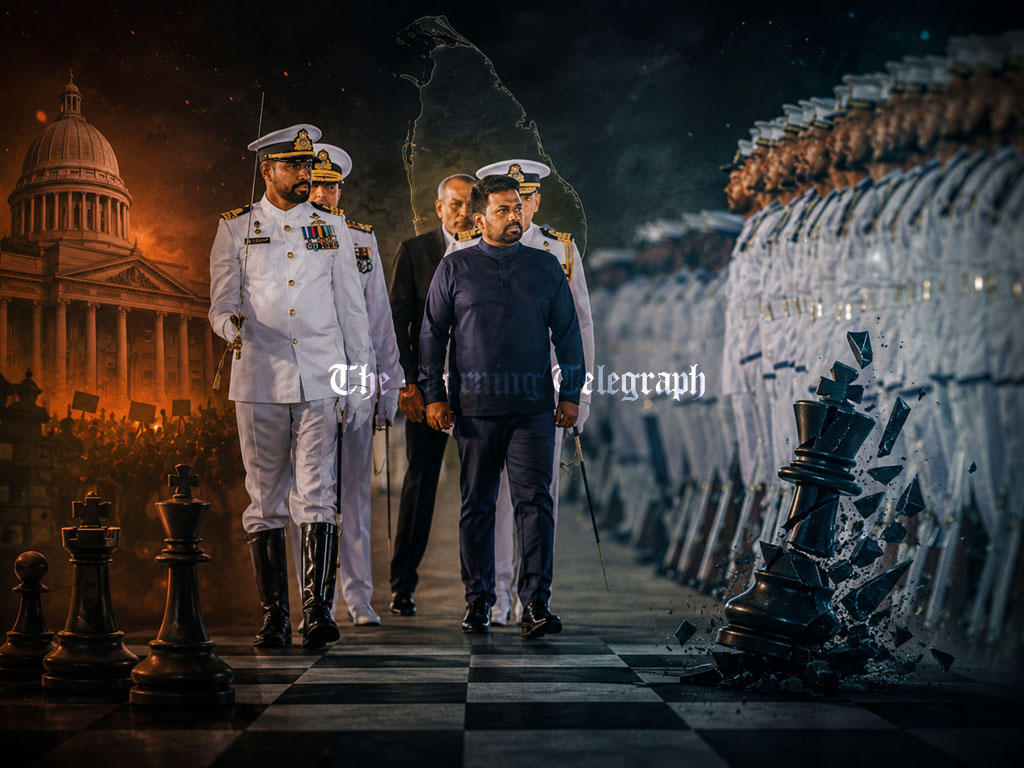
The JVP now faces its toughest challenge as governing replaces opposition, raising questions over accountability, reform and political credibility.
The JVP now finds itself confronting the greatest challenge in its political history, not defeating the old political establishment, but proving it can successfully govern after decades spent opposing the system. The movement built its identity around resistance, yet its success in government will ultimately depend not on criticism, but on its ability to rebuild institutions, deliver results and meet the expectations that brought it to power.

For more than six decades, the Janatha Vimukthi Peramuna built its political identity around confrontation with the existing state structure. Its political language was never one of gradual reform, compromise or institutional adjustment. Instead, it was the language of transformation, resistance and the complete rejection of a political order it consistently described as corrupt, exploitative and morally bankrupt. The JVP did not seek to become merely another participant within Sri Lanka’s traditional political competition. It presented itself as the alternative to that entire political culture.
That political history cannot simply disappear because the movement has now moved into the centre of state power.
The greatest contradiction confronting President Anura Kumara Dissanayake and the National People’s Power government is not whether they can overcome their political rivals. That was always the easier battle. The far more difficult question is whether a movement that spent decades defining itself through criticism, rejection and opposition can now persuade the country that it has mastered the much harder responsibility of governing, rebuilding institutions and producing measurable results.
Destroying an existing political order and constructing an effective state require entirely different political abilities. A movement may gain popularity by exposing failures. A government earns legitimacy by producing solutions.
That is the uncomfortable political reality confronting the present administration.
President Dissanayake’s recent speech in Parliament illustrated this contradiction with remarkable clarity. A considerable portion of his address focused on civility, acceptable conduct and the moral standards expected from those criticizing the government. The message appeared responsible. No democratic society should dismiss the value of respectful political discourse. Yet one deeper question remains unresolved. Who ultimately possesses the authority to decide what is civilized and what is not?
Within a democracy, criticism is not an act of vulgarity. It is one of the fundamental responsibilities of citizenship.
The irony is that many political movements which once fought for the right to challenge those in power frequently become uncomfortable when that same democratic right is exercised against them. The language of resistance comes easily while standing outside government institutions. The genuine test begins when that same movement occupies those institutions and discovers that criticism does not disappear simply because those now being challenged were once demanding accountability themselves.
This has remained one of the oldest contradictions of political power.
Those who spend decades insisting that governments answer difficult questions eventually discover that they themselves must answer those very same questions.
The concern surrounding the President’s parliamentary speech was not confined to what he said, but extended equally to what he chose not to address. Sri Lanka continues to face serious questions concerning economic recovery, institutional independence, corruption investigations, public confidence, state reform and whether promises made during years of opposition politics can survive the practical realities of governing. These issues cannot be permanently replaced by political theatre or emotionally persuasive speeches.
No government can govern indefinitely by reminding citizens how badly previous governments performed. Eventually, every administration must stop explaining the failures of the past and begin explaining the achievements of the present. This is precisely where the JVP’s historical contradiction becomes impossible to ignore.
For decades, the party argued that Sri Lanka’s political system had become corrupted beyond repair. It maintained that the traditional political parties were trapped within networks of privilege, family influence, financial power and institutional decay. That message resonated deeply among a population exhausted by repeated political disappointments and broken promises. But attaining power creates an entirely different responsibility.
A party that spent decades promising to replace a broken political system must now demonstrate that it can operate within that very system without becoming another version of what it once opposed.
The question is therefore not whether the JVP has changed. Every political movement must evolve if it intends to govern. The more important question is whether that transformation runs deep enough to reshape political behaviour rather than simply changing political language.
History repeatedly demonstrates that revolutionary movements often experience their greatest crisis only after achieving victory. Opposition politics rewards certainty. Governance demands humility. Opposition politics flourishes by exposing contradictions. Governance requires resolving them.
A political movement can survive by arguing that the entire system is fundamentally broken. A government must identify which institutions can be repaired, which structures require strengthening and how meaningful reform can be achieved without creating new forms of political arrogance.
The greatest danger begins when any government starts believing that because it came to power carrying a morally superior narrative, every decision it makes automatically becomes morally superior as well. No government inherits permanent moral authority from its own history. Every administration must continuously earn legitimacy through transparency, accountability and measurable performance.
The JVP’s political past cannot remain its permanent defence. A revolutionary history does not automatically produce revolutionary governance. A long record of opposing corruption does not automatically guarantee the elimination of corruption. A reputation for integrity does not remove the obligation to answer difficult questions.
The people did not elect the JVP merely because they wanted different politicians delivering different speeches. They elected it because they wanted a fundamentally different political reality. That reality will never be measured by how effectively the government criticizes its opponents. It will instead be measured by whether institutions become stronger, corruption declines, justice remains independent and ordinary citizens experience genuine improvement in their daily lives.
The most dangerous moment for any political movement arrives when it begins confusing its own political narrative with objective truth. Every successful movement eventually encounters this temptation. It begins by insisting that society must change before gradually believing that society should change only according to its own definition of what is right.
That is how movements that begin with promises of liberation can ultimately create new forms of control. The JVP’s greatest challenge, therefore, is no longer defeating Sri Lanka’s old political establishment. That chapter has already changed. Its greatest challenge is demonstrating that it will not become merely another chapter within the very same political story.
The citizens who brought this movement into power are no longer asking for revolutionary speeches. They are asking for competent government. They are no longer asking who destroyed the past. They are asking who possesses the ability to build the future. The ultimate paradox of political power is that those who spend decades demanding accountability eventually discover that accountability becomes the highest price of power itself.
The JVP has now reached the point where history is no longer judging what it promised to destroy. History is now watching what it chooses to build.