By Roy Denish.
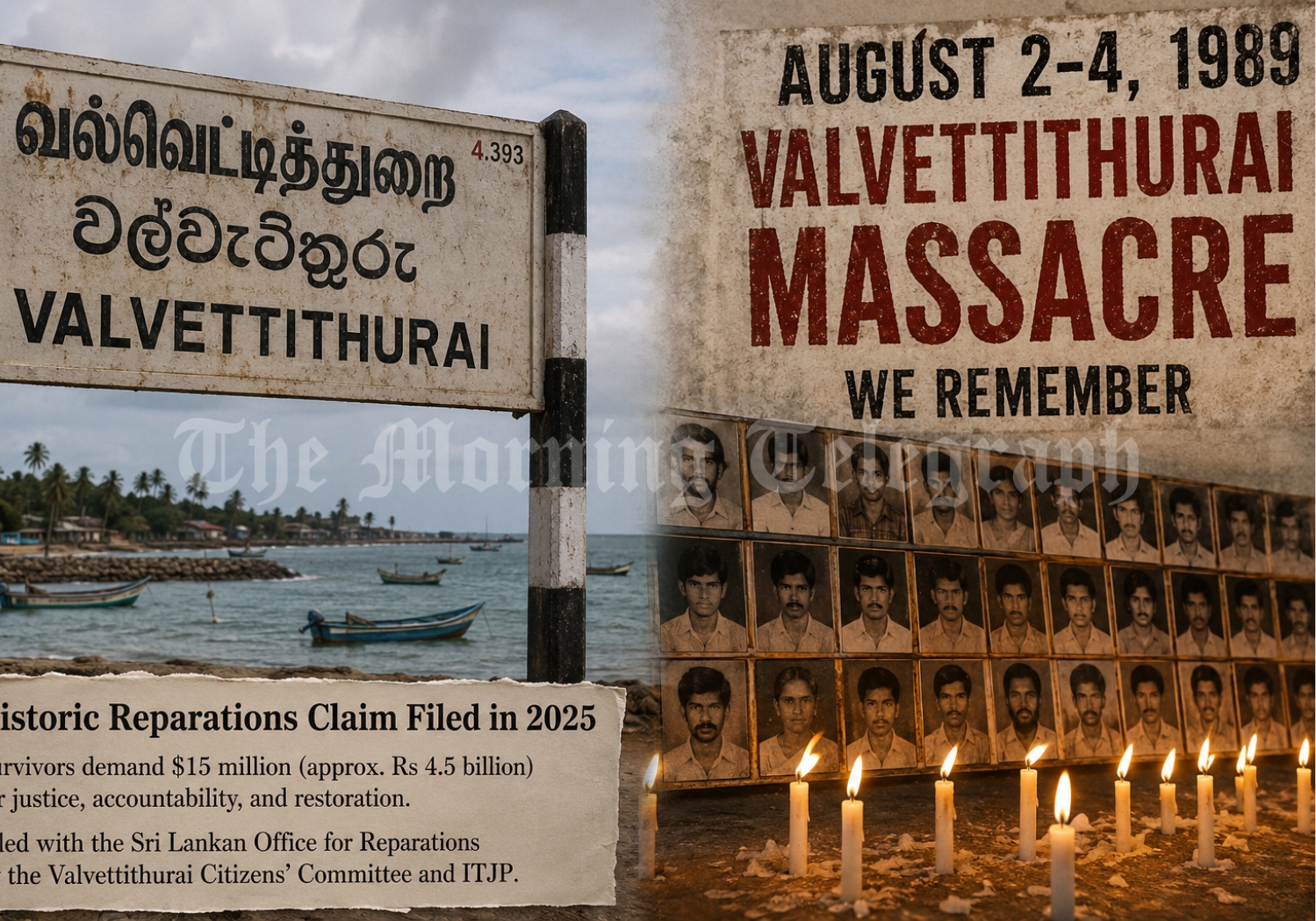
Valvettithurai Massacre survivors seek $15 million in reparations over the 1989 killings, burned homes and lost livelihoods in Jaffna.
The Valvettithurai Massacre still hangs over this northern coastal town, where calm water and quiet lanes hide one of the most painful chapters of Sri Lanka’s war.
In the early morning, sunlight strikes the Palk Strait and turns the sea into a blinding sheet of silver. Small wooden fishing boats bob close to shore. From a distance, the scene looks peaceful. Yet residents know these waters once carried the dark runoff of burning nylon nets, scorched homes, and human blood.
The silence in Valvettithurai, on Sri Lanka’s Jaffna Peninsula, is not the silence of healing. It is the careful quiet of a community that learned survival through discretion. For thirty-six years, that silence acted as a shield. To speak too openly about what the Indian Peace Keeping Force did over three days in August 1989 meant inviting danger.
First came the foreign troops, who remained until their quiet withdrawal. Then came internal militant factions, which kept the region under an iron grip. Later, successive domestic administrations preferred to write conflict history in broad, selective strokes.
Still, memory survived beneath the surface. It remained in the sharp breath of an elderly woman passing the concrete walls where her sons were forced to kneel. It remained in households pushed into generational poverty after the main breadwinner disappeared into a makeshift interrogation cell and never came home.
A Town That Became An Open Cemetery
To outsiders, Valvettithurai often appears as a wartime footnote. Some remember it as a coastal town in the Sri Lankan Civil War. Others know it as the birthplace of the Liberation Tigers of Tamil Eelam.
For survivors, however, Valvettithurai is an open cemetery. Its narrow lanes still carry memories of August 2 to 4, 1989, when a foreign peacekeeping force turned its guns on civilians it had been sent to protect.
In March 2025, the International Truth and Justice Project, an independent human rights organization based in London, released a detailed investigative dossier titled the ITJP Valvettithurai Report. The report used cross-checked eyewitness accounts, forensic mapping, and contemporaneous medical documentation to bring one of the region’s most suppressed episodes back into public view.
That episode was the 1989 Valvettithurai Massacre, carried out by Indian troops, according to the report. Months later, in late October 2025, the same documentation became the basis of an unprecedented legal move.
Working with the Valvettithurai Citizens’ Committee, the human rights group submitted a detailed reparations claim to the Sri Lankan Office for Reparations. The claim seeks fifteen million US dollars, approximately four and a half billion Sri Lankan rupees, for survivors and victims’ families.
The filing changed the nature of the town’s long silence. It took whispered accounts of house-to-house searches, killings, torture, and burned livelihoods, then placed them into precise legal language. By demanding a formal response from Colombo and New Delhi, survivors pushed a buried historical reality into the cold light of international law.
How The 1987 Accord Set The Stage
To understand Valvettithurai’s tragedy, one must return to the geopolitical chessboard of the late 1980s. In July 1987, Indian Prime Minister Rajiv Gandhi and Sri Lankan President J.R. Jayewardene signed the Indo-Sri Lanka Accord.
The accord aimed to resolve the escalating Sri Lankan Civil War. It promised a measure of devolution to the Tamil-majority Northern and Eastern provinces. It also sought to disarm Tamil militant groups and deploy an Indian intervention force to guarantee stability.
What began as a peacekeeping mission soon descended into a harsh counterinsurgency campaign. By late 1987, relations between the Indian force and the Tamil Tigers had collapsed. The northern peninsula then became the center of a devastating three-cornered war involving foreign troops, Sri Lankan forces, and rival Tamil militant factions.
Civilians remained trapped in the middle. They faced surveillance, curfews, abductions, and reprisal attacks. By August 1989, the Indian military presence in Jaffna had come under intense pressure.
The Sri Lankan government, which was also battling a violent Marxist insurrection in the south, had begun demanding the full withdrawal of Indian troops. In this tense and volatile climate, a Tamil Tiger ambush on an Indian patrol in Valvettithurai on the morning of August 2, 1989, triggered the violence that changed the town forever.
Valvettithurai Massacre Reconstructed By Survivors
The investigative report builds a detailed chronology of the massacre through the accounts of people who lived through it. After the ambush, which killed several Indian soldiers, regular infantry units of the Indian army cordoned off Valvettithurai.
Survivors describe what followed not as a standard military sweep, but as a systematic punitive rampage. Over the next seventy-two hours, at least sixty-six Tamil civilians were extrajudicially executed.
The killings, according to the report, showed cold precision. In one incident described by multiple witnesses, a large group of residents took shelter inside a strong concrete home. They believed its thick walls would protect them from crossfire.
Indian soldiers breached the compound. They separated men from women and children, then forced the men to kneel. An eyewitness, in a deposition included in the report, said the kneeling pairs were shot in front of their mothers, wives, children, and other relatives.
The witness said the horrible sight ended within five minutes. Soldiers then threatened to shoot anyone who cried or screamed.
The report presents these accounts as part of a wider pattern. It says the violence did not end with summary executions. Instead, it spread through homes, schools, streets, and public buildings.
Torture, Sexual Violence And Scorched Livelihoods
Hundreds of young men and boys were rounded up, stripped, bound, and beaten, according to the dossier. Soldiers used local schools and public buildings as makeshift interrogation centers.
Multiple testimonies also recount conflict-related sexual assaults against women trapped inside homes during house-to-house searches. For decades, cultural stigma, fear for safety, and the threat of social ostracization kept these violations buried.
Human rights organizations that have documented the wider Indian intervention note that underreporting prevents a precise figure for the entire peninsula. However, testimonies gathered over the years confirm that multiple women were targeted during the three days of house searches in Valvettithurai alone.
The report places these allegations within a broader regional landscape. It says elements of the peacekeeping force used sexual violence in ways that left silent, intergenerational psychological trauma.
The military response also included a scorched-earth strategy, according to survivors. Soldiers systematically set fire to homes, market stalls, fishing boats, and nylon nets. These were not incidental losses. They were the lifelines of a coastal economy.
More than one hundred homes were completely burned. Thousands were forced into immediate internal displacement. For three days, the town remained under strict curfew.
Red Cross vehicles and local medical professionals were repeatedly denied entry to treat the wounded. Families could not recover the bodies of their loved ones. Many bodies lay under the tropical sun in front yards and public squares, a grim warning to those who survived.
Colombo’s Secret Pact With The Tigers
Valvettithurai’s tragedy also sits inside a second, highly controversial layer of Sri Lankan political maneuvering. During the height of the Indian military presence in late 1989, the Sri Lankan government entered a clandestine and paradoxical relationship with the Tamil Tigers.
This was the same organization the state had historically sought to neutralize. Yet President Ranasinghe Premadasa faced extreme pressure in the south from a violent, anti-treaty Marxist insurrection. He also viewed the foreign military presence as a violation of national sovereignty.
As a result, Premadasa launched a secret policy to accelerate the Indian army’s departure. In mid-1989, his administration forged a temporary tactical alliance with the Tamil Tigers.
Under top-secret executive directives, senior defense officials bypassed normal military protocols. They delivered truckloads of brand-new government weapons, ammunition, rocket-propelled grenades, and communication gear directly to insurgents in the northern jungles.
The immediate rationale was tactical. Colombo wanted the Tamil Tigers to fight the Tamil National Army, a proxy militia raised by Indian forces. It also wanted to increase operational pressure on Indian troops to leave.
The policy helped push the Indian military out of the island by March 1990. However, it became a catastrophic miscalculation. The state-supplied weapons allowed a weakened insurgent force to rearm and recover.
After the foreign troops left, the tactical truce collapsed. By June 1990, the civil war had erupted again with renewed ferocity. The Tamil Tigers then turned those same government weapons against Sri Lankan security forces, helping prolong the war for nearly two more decades.
The Five Pillars Of The Reparations Claim
For thirty-five years, successive governments in Colombo and New Delhi ignored the cries of Valvettithurai. Small ad hoc relief projects sometimes reached the north. But no comprehensive acknowledgment of the mass murder emerged.
The fifteen million dollar reparations framework developed in late 2025 by international legal experts and the Valvettithurai Citizens’ Committee moves beyond traditional charity. It rests on internationally recognized transitional justice principles.
The claim adapts the United Nations Basic Principles and Guidelines on the Right to a Remedy and Reparation for Victims of Gross Violations of International Human Rights Law. It is structured around five core pillars.
The first is restitution. It demands restoration of the victims’ situation before the violations occurred. This includes reestablishing lost identity documents, restoring land rights, and rehabilitating property that remains derelict or unbuildable due to structural damage or historical military occupation.
The second pillar is compensation. It provides an econometric breakdown of measurable economic damage. This includes loss of life calculated through projected lifetime earnings of deceased providers.
It also covers permanent physical or psychological disability caused by torture or gunshot wounds. In addition, it accounts for physical damage to houses, commercial shops, and fishing fleets.
The third pillar is rehabilitation. It recognizes that trauma did not end in 1989. It calls for long-term medical care, specialized psychiatric support, and targeted psychological counseling for survivors living with complex post-traumatic stress disorder and intergenerational trauma.
Apology, Memory And Non-Repetition
The fourth pillar, satisfaction, is among the most politically sensitive parts of the claim. It demands a formal public apology from the government of India for the specific actions of its deployment force.
It also calls for official memorial sites, annual and unhindered commemorations for victims, and the inclusion of these historical facts in regional educational curricula. The goal is to prevent erasure.
The fifth pillar seeks guarantees of non-repetition. It demands institutional and legislative reforms inside Sri Lanka. These include the complete demilitarization of civilian administration in the north, stronger witness protection, and legal reforms to prevent foreign or domestic military forces from operating outside civilian judicial oversight.
The October 2025 filing before the Sri Lankan Office for Reparations has drawn serious attention in regional diplomatic circles. Traditionally, reparations claims for wartime atrocities target the host state where the crimes occurred.
This claim does something different. It directly points to the actions of a foreign military force on Sri Lankan soil. In doing so, the legal team and the Citizens’ Committee have opened an audacious legal path.
Yasmin Sooka, executive director of the ITJP and a veteran transitional justice expert, said the submission marks a historic step toward accountability for foreign military abuses on Sri Lankan soil. She also said it sets an important precedent for marginalized communities worldwide seeking justice when their own states or foreign intervening powers have failed them.
A Legal Test For Colombo And New Delhi
The framework places the Sri Lankan Office for Reparations in a delicate position. If the office accepts the claim’s validity, it must choose between two difficult options.
It can allocate Sri Lankan state funds to compensate victims for the actions of a foreign army. Or it can initiate formal diplomatic and legal channels to demand that New Delhi underwrite the compensation package.
Legal scholars argue that the case draws from an evolving doctrine of transnational state responsibility. The Indian force operated under the 1987 bilateral state treaty. Therefore, the sending state, India, and the host state, Sri Lanka, carry overlapping obligations, according to that view.
India sent the force. Sri Lanka failed to protect its citizens from its treaty partner. The claim argues that both states therefore bear responsibility to provide an effective remedy.
To grasp the need for the 2025 reparations claim, one must look past legal language and into the lived reality of Valvettithurai. The economic and social destruction of 1989 created a decades-long domino effect.
When fishing fleets and markets burned, property loss was only the beginning. The destruction dismantled an entire local economy. Families that had once lived with self-sufficiency fell into systemic poverty overnight.
Without capital to rebuild or replace equipment, many residents had few options. Some entered low-wage manual work. Others became dependent on unstable welfare systems.
Widows, Children And Inherited Trauma
The executions also removed many male heads of households. That sudden loss created a vulnerable generation of young widows.
These women had to raise traumatized children inside a deeply conservative society. They also lived under intense military surveillance. As a result, they carried the heaviest burden of post-conflict hardship.
A member of the Valvettithurai Citizens’ Committee, speaking anonymously because of continuing security concerns in the region, said the community lost everything. They lost homes, livelihoods, and relatives. For decades, they also lost hope that anyone would believe them or listen to their story.
The same committee member said the report and legal claim mean their pain has finally been written down and can no longer be denied.
The psychological toll has reached children born years after the massacre. Many grew up in homes shaped by the silent trauma of their parents. They also lived among physical ruins and under a heavy security presence.
As a result, a new generation of Tamil youth has inherited a deep sense of institutional alienation and historical injustice. The Valvettithurai Massacre therefore remains not only a past atrocity, but also a living wound.
Why The Report Matters Now
The March 2025 publication of the Valvettithurai report did not occur in isolation. It arrived during a period of growing domestic and international scrutiny of Sri Lanka’s human rights record.
Throughout 2025, independent forensic excavations at several mass grave sites in the Northern province continued to uncover skeletal remains. These discoveries offered material evidence of the extrajudicial executions and enforced disappearances that shaped the long war.
Reports from the United Nations Human Rights Office have also criticized the slow pace of domestic transitional justice mechanisms. They have pointed to a deeply entrenched culture of impunity that protects perpetrators from accountability.
By focusing on a 1989 atrocity allegedly committed by an international peacekeeping force, the report makes one point clear. Impunity in Sri Lanka is multilayered. It is not only a domestic issue involving Sri Lankan armed forces and insurgent factions. It also involves regional superpowers.
The fifteen million dollar reparations claim filed by the people of Valvettithurai is more than a demand for money. It is a direct challenge to the conscience of two nations.
It asks whether international law can cross borders to help a forgotten population. It also asks whether geopolitical calculations will continue to outweigh human rights.
For the international community, the digital dossier and legal filing offer a powerful example of grassroots human rights documentation. They show how memory, courage, and forensic reporting can challenge institutional denial, even after nearly four decades.
As the Sri Lankan Office for Reparations reviews the four and a half billion rupee claim, human rights advocates are watching Colombo closely. Meanwhile, Valvettithurai remains suspended between memory and justice.
New construction and the steady movement of the sea slowly cover the physical scars of war. Yet the psychological structure of the town remains unchanged.
The true test of the investigative report will not only be the allocation of rupees or dollars. The deeper victory is that the ghosts of Valvettithurai no longer belong only to families who mourned in private for decades.
They have entered the official record. In the long and painful history of South Asian conflict, the truth has finally become too loud to ignore.