Editorial Note
Sabaragamuwa Medical Faculty opens a new complex, but its history is rooted in political promises, student protests and a long struggle.
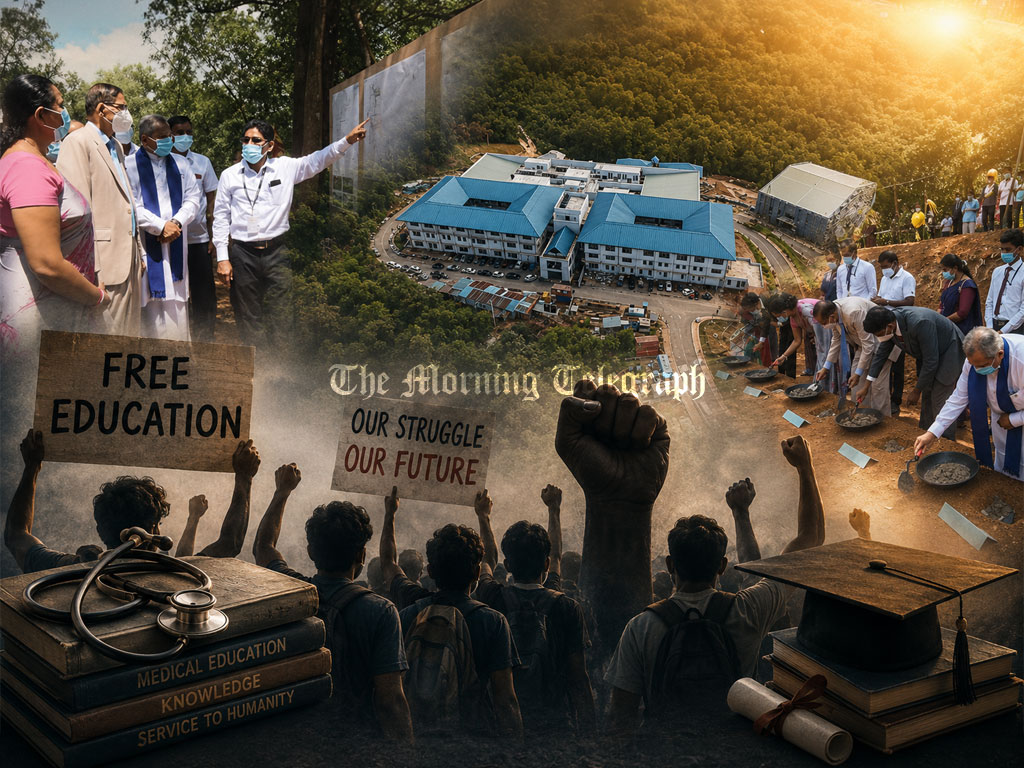
The official opening of the Sabaragamuwa Medical Faculty on July 4 marks a major milestone for Sri Lanka’s higher education and healthcare sectors. However, The Morning Telegraph believes the full history of this institution must be accurately recorded.
That history stretches from its earliest beginnings and political promises to the sustained struggles that ultimately helped bring the faculty to life. It includes politicians, university administrators, international funding and, according to student activists, years of sacrifice in defence of free education.
The opening should therefore be more than a ceremonial occasion. It should also be a moment to recognise every force that contributed to this achievement and ensure that no part of its history disappears from the public record.

From a 1990 Vision to a Medical Faculty
The seeds of the Sabaragamuwa Medical Faculty were planted in 1990. Then-President Ranasinghe Premadasa established Sabaragamuwa University and allocated 20 acres in Ratnapura New Town for a future medical faculty.
However, the vision remained unrealised for nearly two decades.
In 2015, during the Good Governance government, former Prime Minister Ranil Wickremesinghe revived the promise to Ratnapura. At a public meeting, he declared that he would work to secure a medical faculty for the city.
Former Minister Thalatha Athukorale recognised the importance of that commitment and pursued it with determination. Under the leadership of then-Higher Education Minister Lakshman Kiriella, work began moving forward.
In 2015, then-Vice Chancellor Professor Chandana Udawatta also committed himself to the effort.
Another crucial step came in 2017. Former Health Minister Rajitha Senaratne took the necessary measures to make Ratnapura General Hospital a teaching hospital. This was a critical requirement for establishing a medical faculty.
Former University Grants Commission Chairman Mohan de Silva also played a pivotal role in advancing the process. Meanwhile, Vice Chancellor Professor Sunil Shantha worked with considerable dedication throughout 2017 and 2018.
On January 17, 2019, the medical faculty was officially inaugurated with 75 students.
Then-Prime Minister Ranil Wickremesinghe, then-Higher Education Minister Rauff Hakeem, then-Health Minister Rajitha Senaratne and then-Justice Minister Thalatha Athukorale participated in the inauguration.
The Saudi Development Fund contributed US$50 million to the project. The Sri Lankan government allocated another Rs. 1,096 million.
Vice Chancellor Professor Sunil Shantha provided the concept paper and leadership. The University Grants Commission approved the course under the leadership of Professor Mohan de Silva, Professor Sampath Amaratunga and Professor Kapila Seneviratne.
The Student Movement’s Account of the Struggle
However, no complete account of this faculty can ignore the student movement and its own account of the struggle.
Student activists insist that the faculty was not simply a gift from any government. They argue that years of protests, sacrifice and sustained commitment to free education helped make it possible.
According to student activists, the SAITM opposition movement began in 2007 and intensified between 2015 and 2018. They describe this period as a defining chapter in the campaign for state medical education.
The Medical Faculty Student Action Committee and the Inter-University Student Federation claim they led continuous struggles against the privatisation and commercialisation of medical education.
According to their account, authorities stopped new student admissions to SAITM in 2016. In 2018, SAITM was completely closed through a special Act of Parliament.
Student activists say one of the central demands of their struggle was the establishment of new medical faculties at Sabaragamuwa, Moratuwa and Wayamba universities.
They also claim that medical students from eight faculties and five batches boycotted classes for ten months. Their demands included the closure of SAITM and the establishment of new state medical faculties.
According to the student movement, its perseverance contributed to SAITM’s closure in 2018 and the establishment of faculties at Sabaragamuwa, Moratuwa and Wayamba universities.
The activists maintain that the Sabaragamuwa Medical Faculty was secured for Sri Lankan students on January 5, 2019, following their persistent demands.


The Struggle Continued After the Faculty Opened
The student movement says its campaign did not end when the faculty opened in 2019.
According to activists, the faculty initially lacked a complete building complex, hostels and essential professor units required for the medical degree.
They say students continued campaigning for these facilities. According to their account, those demands have now finally borne fruit with the completion of the new complex, which will be handed over to student ownership on July 4.
The movement also says students paid a heavy price during the campaign.
Student activists point to the aftermath of the 2023 Maradana protests, when 22 students from Sabaragamuwa University were imprisoned. They say those cases remain unresolved.
They argue that the faculty represents an achievement built through sustained demands and sacrifices. These sacrifices, they say, included hundreds of students facing delays to their degrees.
A Note of Condemnation
Given this history, The Morning Telegraph joins the Medical Faculty Student Action Committee in strongly condemning the presence of Prime Minister and Education Minister Harini Amarasuriya at the opening of the faculty.
The student movement that fought for this faculty has condemned her presence, and we echo that sentiment.
Who Should Receive Credit for the Victory?
Student activists say many political forces, including the current government, are now attempting to claim credit for the new medical faculties.
They point to statements attributed to a former Vice Chancellor. According to their account, requests for a faculty existed from 1996, while plans were prepared around 2005. However, they say the actual work began only in 2018 and 2019.
The student movement argues that this momentum emerged directly from the campaign against SAITM and private medical colleges.
According to activists, previous governments otherwise had no intention of establishing new state medical faculties. They argue that the policy direction was instead aimed at strengthening SAITM and creating more private medical colleges based on a similar model.
The students maintain that their struggle defeated that effort.
Student activists say the hard work and sacrifices of the movement provided the main force behind the campaign. They again point to the student body of five batches across eight medical faculties, who boycotted classes for ten months.
They argue that some critics continue to place what they describe as hypocritical labels on forces opposing the privatisation and commercialisation of medical education.
However, the activists say the establishment of these faculties provides powerful evidence against those accusations.
In their view, powerful figures now tell their own versions of the story while burying the contribution of those who fought on the ground.
A Tribute to Those Who Refused to Give Up
The Sabaragamuwa Medical Faculty stands as a testament to the power of collective struggle, rather than simply the benevolence of any single government.
As the country celebrates this achievement, it must also honour the students, activists and ordinary citizens who helped make it possible. Their sacrifices should never disappear from the institution’s history.
Sri Lanka must pay tribute to all the forces that fought on the ground for the establishment of four new medical faculties over approximately eight years.
The Morning Telegraph extends its gratitude to everyone who contributed to this milestone. That recognition includes politicians who kept their promises and administrators who worked behind the scenes.
Above all, it includes the student movement that refused to give up.
The history of this institution belongs to everyone who contributed to its creation. Political decisions, administrative commitment, public funding and international support all played their part.
At the same time, the voices of those who protested, sacrificed their education and faced consequences for their activism must not be erased.
This editorial note represents our commitment to preserving the complete story of this victory. Those who truly earned their place in that history must never be forgotten.