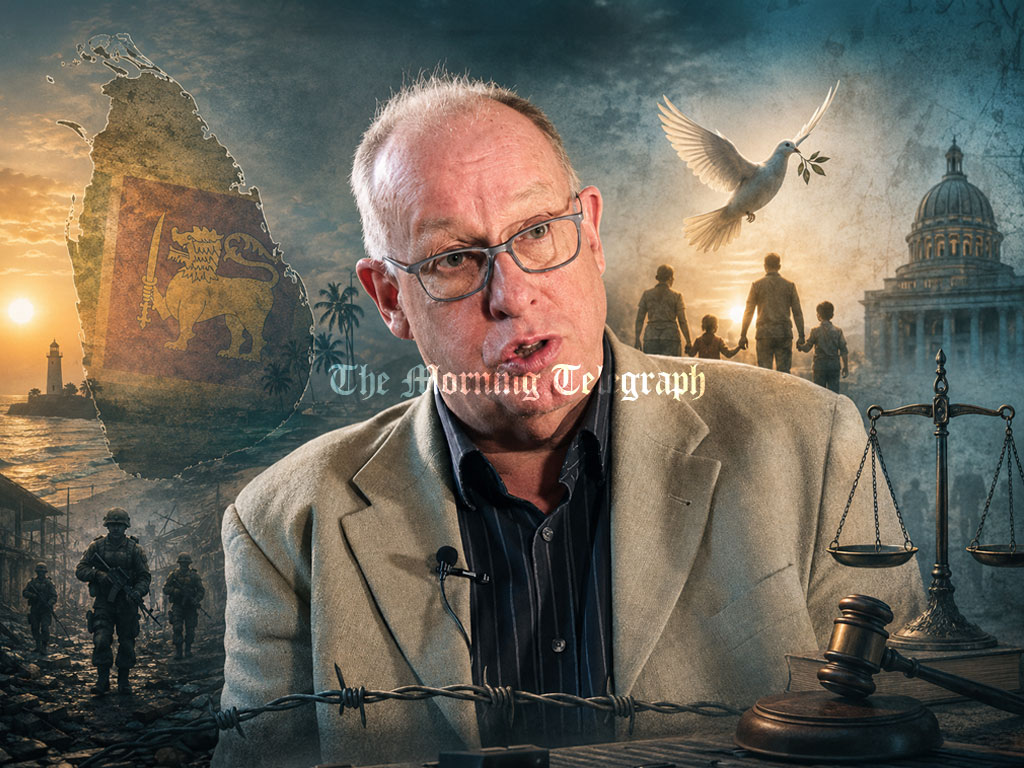
This article is an excerpt from an interview with Georg Frerks conducted by the Sri Lanka Guardian.
Sri Lanka post-war reconciliation remains stalled, says Georg Frerks, as unresolved conflict, justice and governance issues persist.
Sri Lanka post-war reconciliation remains trapped in missed opportunities, according to Professor Georg Frerks, who argues that military victory alone never resolves the political causes of war.
What happens when a country wins a war but fails to address the reasons that created the war in the first place?
Can a military victory over an armed movement create lasting peace if questions of identity, justice, political representation and memory remain unresolved?
Nearly two decades after the defeat of the Liberation Tigers of Tamil Eelam, should Sri Lanka be seen as a post-conflict success story, or as a country that has postponed its most difficult questions?
For Frerks, one of Europe’s most experienced scholars of conflict, peacebuilding and international intervention, the answer lies not only in how wars are fought. It also lies in how societies deal with the consequences once the guns fall silent.
Frerks was recently in Colombo as part of his regular visits to Sri Lanka. His visit also included a stop at his house in Trincomalee, a place that reflects his long personal and academic connection with the island.
His relationship with Sri Lanka began decades ago. Since the early 1980s, he has observed the island through political transformation, ethnic tension, violence, humanitarian crises, fragile hope and repeated disappointment.
His engagement has gone far beyond academic research. It has developed through people, landscapes, conflict, memory and the unresolved questions that continue to shape Sri Lanka.

A Scholar Who Traced Sri Lanka’s Conflict From Within
Frerks has examined Sri Lanka through several connected themes. These include the rise of Tamil militancy, the LTTE’s political evolution, governance under rebel control, humanitarian crises during war, international intervention, the 2004 tsunami and the post-war struggle for reconciliation.
His work has helped frame Sri Lanka not simply as a battlefield between the state and a separatist movement.
Instead, he sees it as a complex political struggle shaped by competing narratives, institutional failure, external influence and repeated missed chances.
Frerks says his interest in Sri Lanka came from his wider study of internal armed conflicts.
“Being a professor in conflict studies, worldwide we have seen a lot of movements, separatist movements or rebellions, fighting against, in a way, their own governments,” he says.
He describes these conflicts as intrastate wars involving “organised armed groups, armed non-state actors who are fighting their governments.”
Sri Lanka became an important case because it reflected many of these global patterns. Yet it also carried distinctive historical and political features.
“Because I was very familiar with Sri Lanka, it was quite natural for me to study the emergence of different militant groups in the beginning, during the 70s and 80s against the Sri Lankan government,” Frerks explains.
Several Tamil militant groups emerged during that period. However, the LTTE gradually became the dominant force.
Frerks’ research moved beyond military confrontation. It also examined the political and social structures around the movement.
“I followed to study how this whole situation emerged, both at a political and military level,” he says.
“But I also looked at the issue of governance, how the LTTE governed its own areas. And what that meant for the legitimacy of the movement among the population, but also towards the outside world.”
Governance, Legitimacy and the LTTE’s Political Project
This focus on governance is central to Frerks’ analysis.
He argues that the LTTE was not only a military organisation seeking separation. It also tried to create systems of authority and administration in areas under its control.
Therefore, questions of legitimacy, public acceptance and governance mattered almost as much as battlefield strength.
Frerks says the LTTE must be understood through both its capacity to mobilise support and the limits of its political project.
His research into the LTTE’s female wing reflects that complexity.
He does not explain women’s participation through one simple argument. Instead, he identifies several overlapping explanations. These include military necessity, ideological change and personal experiences of empowerment.
“I think there are two ways of looking at it,” he says.
“The LTTE started to mobilise and to recruit women, more sadly also children, when they needed the manpower to fight against the government. That is one thing.”
However, he says there was another dimension.
“There is an element of emancipation, one could say. At least according to certain sources, they also promoted a better position of women and equality in the whole traditional, very conservative Tamil society.”
Frerks says women’s participation in the LTTE reflected the needs of war. But it also reflected a social transformation promoted by the organisation.
“They were against the dowry system and the caste system. So, several traditional elements of Tamil society, they wanted to reform.”
That message appealed to some young women. Some saw the movement as a way to challenge traditional restrictions. Others sought escape from domestic violence.
“Some of these young girls also felt that they were empowered,” Frerks says.
“They were allowed to go on a bicycle, they were seen driving tractors, which was in the Jaffna society completely unheard of. Even going in trousers was something very new and shocking to many observers.”
Yet Frerks does not present this as a simple story of empowerment.
He also acknowledges coercion and war. Recruitment involved pressure, and in some cases, forced participation.
“Some were recruited by force, but many of them also joined voluntarily, because they wanted to take revenge. They had seen that their brothers were killed, maybe they were raped, they really felt an anger and wanted to join the LTTE.”
Why the LTTE Was Defeated
Frerks argues that the LTTE’s defeat resulted from several connected factors.
One of the most important was the transformation of the Sri Lankan state’s military capacity.
“First, I think important was that the government, through long years of trying and fighting, finally got its military act together,” he says.
“They got the weaponry, they got the intelligence, that they could in the end defeat the LTTE militarily.”
That transformation took decades.
Frerks says the Sri Lankan military in the early years of the conflict was not capable of defeating a highly organised insurgent force.
“The Sri Lankan army in the early 70s and 80s was not really a very serious matter still,” he says.
The state had to acquire military expertise, hardware, international assistance and improved intelligence before it could defeat the LTTE.
Frerks describes the LTTE as an unusually disciplined rebel movement.
“It was a very innovative, disciplined fighting force. Some people say, among the rebel movements in the world, one of the best organised ones, disciplined ones.”
The government’s military improvement was only one factor.
Frerks also points to the LTTE’s internal split, especially the defection of Vinayagamoorthy Muralitharan, known as Colonel Karuna.
“Karuna defected, and with him some four or five thousand cadres, and provided also very crucial intelligence to the government.”
The loss of Indian support was another decisive factor.
Frerks notes that India had initially helped Tamil militant groups develop.
“In the beginning they got a lot of support from India, training camps, weapons, you name it. Which has been very crucial for the LTTE and even some of the others to grow into a formidable fighting force.”
However, relations changed after the assassination of former Indian Prime Minister Rajiv Gandhi by an LTTE suicide bomber in 1991.
According to Frerks, that weakened the LTTE’s international position.
How International Support Rose and Fell
Frerks says the LTTE initially built an effective international strategy.
The organisation developed a sophisticated communication and political network abroad.
“The LTTE in the beginning was very clever in mobilising international support,” he says.
“They had, in a way, a good propaganda system, or if you want to call it public relations machinery.”
Through diaspora networks, political engagement and international media, the LTTE successfully presented its account of Tamil grievances.
“The idea that the Tamils were a suppressed minority was credibly transmitted to the outside world,” Frerks says.
“And the Tamil cause in that way got a lot of support diplomatically in international fora, in the UN, national parliaments, etc.”
However, sympathy gradually declined as more attention turned to LTTE abuses.
“After time, people realised that the LTTE also committed serious crimes against humanity,” he says.
“So that support gradually dissolved to a certain degree.”
Frerks also links the LTTE’s downfall to strategic choices made by its leadership.
He questions whether the internal decision-making structure allowed enough alternative thinking.
“We don’t know very much about the internal workings of the LTTE,” he says.
“Whether Prabhakaran was always well advised, whether he did take the proper decisions, you know. Not very much could happen without his consent, even to the largest detail.”
He says the concentration of power around Velupillai Prabhakaran may have limited the movement’s ability to adapt.
“He was isolated and hidden. So whether he had enough exposure to the outside world to make always the best decisions, I don’t know.”
Missed Political Settlements and the Cost of Maximalism
One of Frerks’ sharpest criticisms concerns political opportunities the LTTE rejected.
He argues that the organisation missed several chances for a settlement that could have delivered meaningful autonomy and rights to Tamil communities.
“I think they missed out several times,” he says.
“There were serious issues and negotiations going on. These concerned a devolved system, where there would be considerable rights to the provincial level, or to a merged or non-merged north-eastern entity, which in the end they rejected.”
According to Frerks, the LTTE’s maximal demands blocked compromise.
“Prabhakaran probably would have been better advised to come to a particular compromise, in which there were tangible results for his Tamil constituency.”
“But he was, in that sense, quite stubborn,” Frerks says.
“He wanted to have everything. And then, of course, it becomes difficult to come to a compromise.”
He argues that ordinary Tamil civilians ultimately gained less than they might have secured through negotiation.
“In the end, I think the Tamil constituents were left empty-handed. Well, at least they could have had one hand filled.”
Sri Lanka Post-War Reconciliation Remains Stalled
Seventeen years after the LTTE’s military defeat, Frerks sees Sri Lanka as a country that has not fully addressed the conflict’s unresolved issues.
He acknowledges that the end of the war removed a major source of violence. However, he argues that military victory did not automatically produce reconciliation.
“I feel, and I’m sorry to say that, there is an impasse,” he says.
“There is no tangible progress on any of the issues which were there at the start of the conflict, they are still lingering on.”
For Frerks, one central failure after the war was the state’s inability to act magnanimously towards defeated and affected communities.
“If you win a war, you have to be magnanimous,” he says.
“You have to give something to the defeated, otherwise they will develop feelings of revenge and grief.”
When asked whether Sri Lanka failed to do this, he is direct.
“I’m afraid that the government failed here.”
He says several issues could have been addressed without threatening the state.
“Issues like compensation, land issues could have been dealt with more quickly,” he says.
He also believes that greater transparency over missing persons could have helped rebuild trust.
“Irrespective of whether you want to put the people who were responsible before courts or in jail, at least you could give information. The affected people are desperate to know what happened.”
For Frerks, transitional justice remains one of the major unfinished tasks of Sri Lanka post-war reconciliation.
“Transitional justice is not there,” he says.
He also highlights the continuing military presence in the North and East as a factor affecting confidence among communities that experienced the war.
“The rather strong militarisation of the North after so many years,” he says, remains problematic.
Although he notes that the military presence has reduced compared with earlier years, he still believes “it’s still too blown up.”
The Island of Missed Opportunities
Frerks’ assessment of Sri Lanka’s wider political history is deeply critical.
He describes the country as one marked by repeated missed chances.
“The whole history of Sri Lanka gradually reads as a history of missed opportunities,” Frerks says.
“It missed the opportunity to become a wealthy country economically. In the early 50s Sri Lanka was seen as the economically most promising country in Asia. Now it’s nowhere.”
For him, the country’s decline cannot be explained by one event or one external factor.
Instead, he sees a combination of political choices, institutional weaknesses and unresolved conflicts.
“Some of these things could have been prevented by better policy, by taking opportunities when they were there.”
Yet Frerks does not present Sri Lanka as hopeless.
He says the country still has significant strengths.
“It is a very beautiful country. I think people are very resourceful. There are a lot of opportunities. But if the politics is not right, you can’t use that.”
A recurring theme in his analysis is the danger of simplistic explanations, especially those that blame outsiders entirely.
He acknowledges international influence. But he argues that the root causes of Sri Lanka’s conflict were mainly domestic.
“There is something like blame the outsider thing,” he says.
“The root causes, I think, of the problems are basically internal.”
At the same time, he says foreign involvement has played mixed roles.
“It is true there has been foreign intervention. Also intervention to the good.”
He points to development assistance as one example.
“If you see how much development aid Sri Lanka has got over the three, four decades, it is not only blame the foreigners. They also have really tried to help the government with economic development.”
Regarding India, the United States and other actors, Frerks says external influence existed. However, it should not become an excuse for avoiding domestic responsibility.
“There is certainly influence by different groups, governments. But I would not say that that can be seen as the most responsible factor for what happened in Sri Lanka. I think that’s really internal.”
Economic Failure, Tax Weakness and Inequality
Frerks explains Sri Lanka’s economic difficulties through both domestic and international factors.
He argues that inconsistent economic policy, weak taxation and unequal wealth distribution played major roles.
“I’m not sure whether Sri Lanka has followed a consistent economic development policy,” he says.
“Between the governments there were many changes all the time.”
He criticises excessive state spending and political patronage.
“If you have 100 ministers with their cars, their secretaries and their buildings and their pensions and so on, there should be much more frugality and limitations.”
For Frerks, taxation remains a major structural problem.
“Sri Lanka has a very weak tax base and generation of tax is very, very limited. I think the rich hardly pay any tax here.”
He also points to deep economic inequality.
“The wealth is very unequally divided,” he says.
“The poor have hardly any opportunity to accumulate something, to start a small business or whatever.”
However, he also recognises that the international economic system is unequal.
“There is an international system which is very unfair to the global South,” he says.
“So also on the world scale, there is a lot of inequity and unfairness.”
Religion, State and Secular Governance
Another major theme in Frerks’ analysis is the relationship between religion and the state.
Coming from a European academic tradition shaped by secular governance, he argues strongly for separating religious institutions from government.
“I was brought up in a tradition and in a country where we believe in secularism,” he says.
“Which means there should be a division between religion and state.”
He acknowledges the importance of Buddhism in Sri Lankan society. But he rejects the idea that this should translate into state preference.
“Buddhism is important in Sri Lanka, nobody denies that. But it doesn’t mean that the government of the country and the state needs to be Buddhist.”
For Frerks, the state should protect religious freedom rather than promote one religion.
“The government should guarantee the freedom of every religion to be practised,” he says.
“But I would say no special place for Muslims or for Buddhists or for Hindus. Let the government govern and let the religions practise religion.”
He believes this separation benefits both the state and religious communities.
“I cannot imagine why a religion should be happy that the government is close to them. They can be on their own. It’s a separate sphere of societal organisation.”
Human Security and Daily Vulnerability
Frerks’ broader theoretical work focuses on human security, vulnerability and agency in conflict.
He explains that human security emerged because traditional security thinking focused too narrowly on states and military threats.
“Human security is basically a concept which was introduced by the UNDP, the United Nations Development Programme, in 1994,” he says.
Traditional security focused on “the state against another state, against armies.”
Human security shifted attention towards ordinary people.
“For normal people, security is something else,” he says.
“They need work, they need food, they need hospitals, they need a clean environment.”
For Frerks, this idea matters deeply in conflict-affected societies.
Insecurity is not only created by armed violence.
“People are very often vulnerable. Not because India is the enemy or the Russians are the enemy, but daily life is so difficult.”
His discussion of civilian agency during war is also nuanced.
He rejects romantic ideas that ordinary people in conflict zones always possess meaningful freedom of choice.
“Agency means the opportunity to act, to do what you want to do, and to be able to exercise choices,” he says.
“Now, nobody has 100% agency. There are always constraints, but in a war these constraints are much more serious.”
During conflict, people may not be able to speak, move or challenge power freely.
“You may not even be able to go out on the streets. You may not be able to talk openly because you don’t know who is listening.”
War Wounds and Post-War Grievances
This understanding shapes Frerks’ view of post-war societies.
He distinguishes between wounds created by war and problems created by how society responds afterwards.
“A war in itself creates already a lot of wounds,” he says.
“People have lost relatives and possessions, they have made sacrifices. But there are also second-order problems, namely how you deal with the war after the war.”
Sri Lanka, he argues, illustrates this clearly.
“The post-war situation was not handled very deftly,” he says.
“And that creates new tensions, that creates new grievances and new resentment.”
For reconciliation to work, Frerks says political courage and institutional capacity are essential.
“You need political courage to do that. And you need also institutions that can deliver, not only talking shops, but really results.”
He rejects the idea that societies can simply forget difficult histories.
“It doesn’t happen like that,” he says.
“History is always present. And you have to deal with it, it doesn’t go away.”
Sri Lanka, he says, is shaped by competing historical narratives.
“Everybody can tell the stories of the Mahavamsa and the Kings Dutthagamini and Elara. Everybody knows what happened in 1952, 1956 and 1958, etc.. People don’t forget.”
However, he warns that historical memory can also be politically manipulated.
Different communities often carry different stories. Still, this should not prevent dialogue.
“Different groups will have their own storylines. But that doesn’t mean you cannot talk about it. They are not mutually exclusive.”
Peace Cannot Be Dropped From a Helicopter
Frerks is cautious about international peacebuilding.
He argues that outside actors can help, but they cannot create peace from outside.
“You cannot resolve a conflict or achieve stability from outside only,” he says.
“Outsiders can help. You can have mediators. You can even have some financial support to do certain things, to set up certain institutions or help to do certain investigations.”
But lasting peace must come from within society.
“Peace is not something you can drop from a helicopter,” he says.
“That has to be felt by people, that they want peace. And that they feel the peace is needed now. And that peace is also just and fair, not imposed.”
For this reason, Frerks rejects the idea of importing a ready-made reconciliation model from another country.
“I would not promote the idea that you have a supermarket of peace models and you choose one,” he says.
Countries can learn from each other. But Sri Lanka must develop its own approach.
“They have to make their own stew, so to say,” he explains.
“There can be good ingredients that you can think about. And you may even adopt them. But I don’t think that you can simply take a model from the shelf and then say this will work for Sri Lanka.”
Looking ahead, Frerks says Sri Lanka’s future depends largely on political choices.
“That depends very much on the wisdom, first of all, of your leaders and your politicians and also of the population.”
He warns that many of the country’s problems are self-created.
“Most of the problems in the world are man-made. They can only be resolved by man, by people.”
For him, Sri Lanka still has opportunities. But they cannot be postponed forever.
“If you never take the opportunity, it will only get worse.”
His message is urgent, but not hopeless.
Sri Lanka’s challenges are serious. Yet they are not unavoidable. The country’s future depends on whether leaders and citizens are ready to confront unresolved issues, build fair institutions and move beyond grievance politics.
“I believe that you need political courage, some wisdom,” Frerks says.
“Sri Lanka can get support from elsewhere to do this. But something needs to be done. If nothing happens, there will not be much progress, I am afraid.”