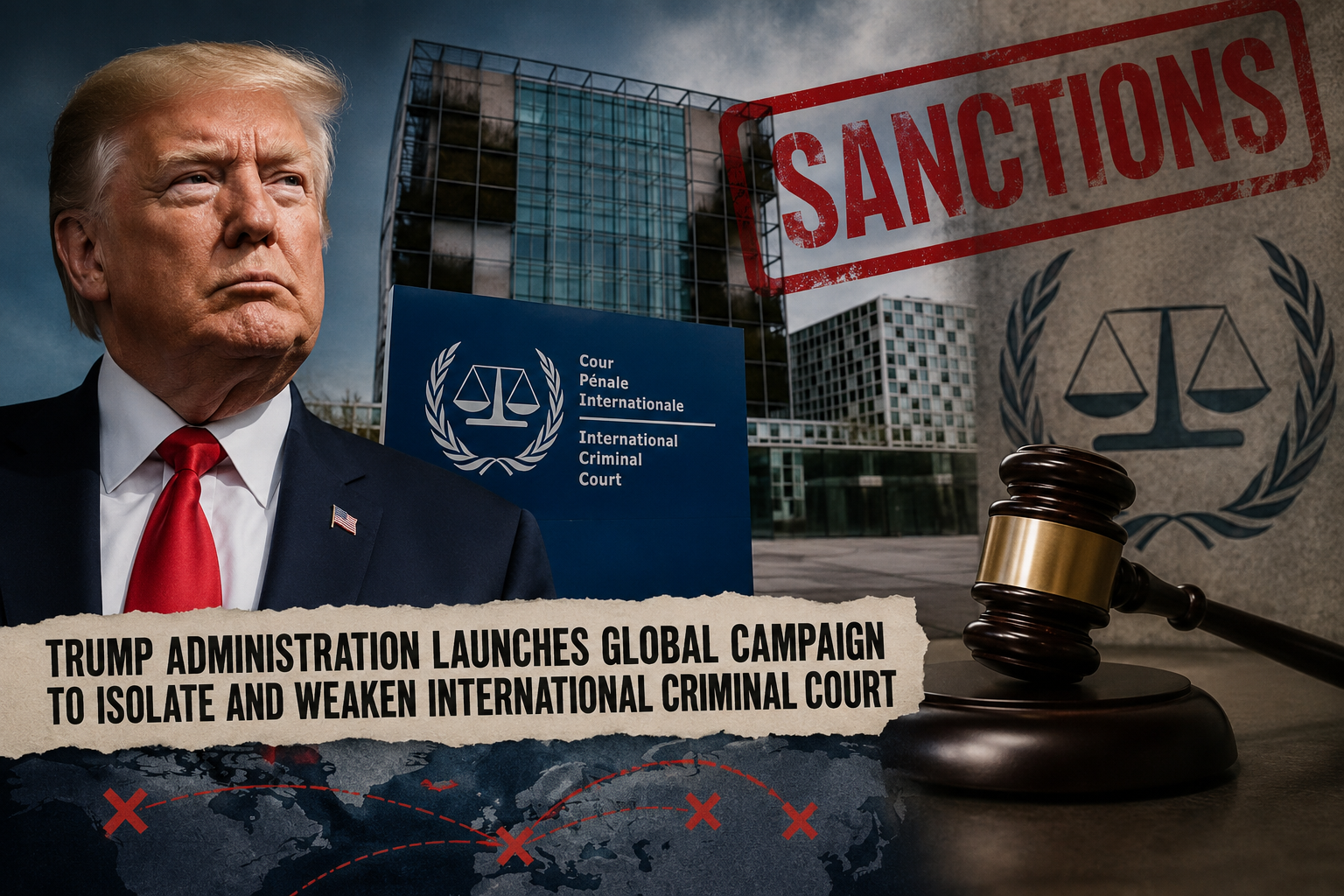
The Trump ICC campaign uses sanctions and diplomatic pressure to isolate the court and restrict investigations involving Americans and allies.
The Trump ICC campaign has entered a more aggressive phase, with the administration seeking to isolate the International Criminal Court and weaken its ability to operate worldwide.
US President Donald Trump cannot legally abolish the court. However, the measures under consideration could severely restrict its ability to investigate and prosecute allegations of genocide, crimes against humanity and war crimes.

The campaign marks a significant escalation in Washington’s long-running confrontation with the ICC, which the United States has never joined.
Reuters reported on July 13, 2026, that the administration is considering travel bans, visa revocations, further economic sanctions and diplomatic pressure against the court, its officials and organisations linked to its work.
US officials are also reportedly urging allied governments, especially countries that rely on American military aid or security partnerships, to reject the ICC’s authority and reconsider their support for the institution.

What the International Criminal Court does
The ICC is a permanent international court based in The Hague, Netherlands.
It prosecutes individuals rather than governments. Its mandate covers genocide, crimes against humanity, war crimes and the crime of aggression.
The court is designed to act as a last resort. It normally intervenes only when national authorities are unwilling or genuinely unable to carry out credible investigations or prosecutions.
The ICC does not replace national courts. Instead, it operates under the principle that governments hold the primary responsibility for prosecuting serious crimes.
The court also has no police force of its own.
It relies on member states to arrest suspects, provide evidence, protect witnesses and enforce judicial orders.
That dependence has always limited the court’s power. Suspects can remain beyond its reach when governments refuse to cooperate.
Even when judges issue an arrest warrant, the ICC depends on national authorities to detain the individual and transfer that person to The Hague.
American pressure could create another major obstacle. It may make it harder for the institution to obtain financial services, technology, legal support and international cooperation.
Sanctions could also affect organisations that gather evidence, assist victims or provide specialist advice to prosecutors.
Can Trump legally dismantle the ICC?
Trump has no legal authority to formally dissolve the International Criminal Court.
The court was created under the Rome Statute, an international treaty that entered into force in 2002. It has 125 member states, formally known as States Parties. Those countries jointly oversee the institution through the Assembly of States Parties.
Neither the United States nor any individual president can unilaterally terminate that treaty or close the court.
However, Washington holds enormous influence over international finance, banking, technology and diplomacy. Therefore, US sanctions can produce consequences far beyond American territory.
Banks, technology companies, consultants, researchers and other service providers may avoid assisting ICC personnel if they fear breaching US sanctions.
Companies may also withdraw services even when the legal position remains uncertain. For many international businesses, losing access to the American market or financial system would represent a far greater risk than ending cooperation with the court.
Trump may not be able to dismantle the institution through law. Nevertheless, his administration could make its daily operations considerably more difficult.
Washington rejects ICC authority over Americans
The confrontation intensified again on July 2, 2026, when the US Department of Justice informed the ICC that Washington would not cooperate with its investigations.
Acting Attorney General Todd Blanche wrote to the ICC president and rejected any claim that the court could exercise jurisdiction over American citizens.
The Justice Department said the United States had never consented to ICC jurisdiction. It also rejected the court’s position that it could exercise authority over Americans in certain circumstances.
The United States argues that because it never ratified the Rome Statute, the ICC cannot subject American citizens to its authority without Washington’s consent.
The court takes a different legal position.
Under the Rome Statute, the ICC may investigate alleged crimes committed on the territory of a member state. That principle can apply even when a suspected perpetrator comes from a country that has not joined the court.
That disagreement has remained central to tensions between Washington and The Hague for years.
Successive American administrations have expressed concern that ICC prosecutors could investigate US military personnel or officials over operations conducted overseas.
Rubio Leads Pressure on Allied Governments
The administration is now reportedly trying to transform its opposition into a wider diplomatic campaign.
According to Reuters, Secretary of State Marco Rubio is leading efforts to isolate the ICC internationally.
Possible measures include persuading allied governments to reject the court’s jurisdiction, sanctioning additional officials and organisations, and limiting the ability of ICC personnel to travel or conduct financial transactions.
Countries that rely heavily on US defence cooperation may face particularly intense pressure.
Washington could use military assistance, diplomatic relationships and security partnerships to encourage governments to distance themselves from the institution.
However, persuading large numbers of ICC members to abandon the court could prove difficult.
Many governments across Europe, Africa, Latin America and the Asia-Pacific continue to view the ICC as an important mechanism for prosecuting grave international crimes when national courts cannot or will not act.
A country cannot simply abolish the court by withdrawing its own support. The ICC would continue to exist as long as its remaining members maintained the treaty and financed its work.
However, the loss of political cooperation from influential states could still weaken investigations and make arrests considerably harder.