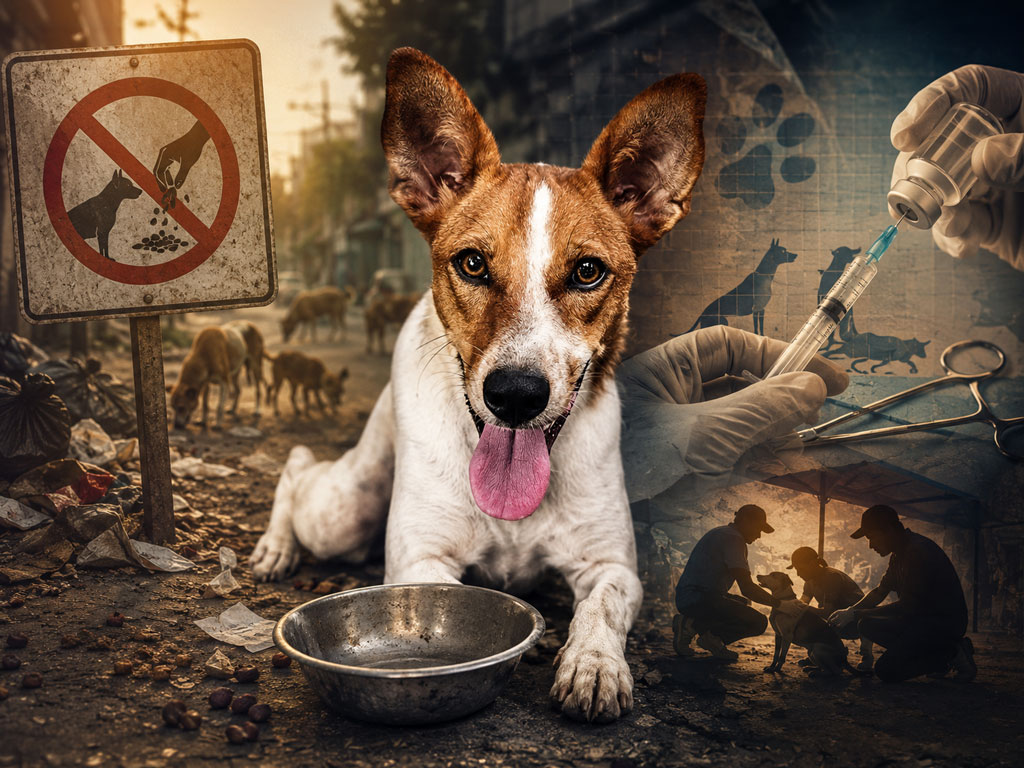
Sri Lanka rabies control faces criticism after a call not to feed street dogs, as advocates demand humane CNVR programmes and stronger enforcement.
The debate over Sri Lanka rabies control has intensified after the Director General of the Department of Animal Production and Health (DAPH) said street dogs should not be fed unless those feeding them accept responsibility for the animals.
The statement, presented as a measure to combat rabies, has triggered strong criticism from animal welfare advocates and members of the public.
In a rapidly urbanising country such as Sri Lanka, the street dog problem remains one of the most visible yet neglected crises. Dogs did not create this situation. Human abandonment, weak enforcement and poor management created and sustained it.
However, the Director General’s proposal appears to leave homeless dogs without food. That is not a credible solution. It reflects an inhumane approach that could deepen the crisis rather than resolve it.

Starvation Cannot Deliver Sri Lanka Rabies Control
Withholding food from homeless animals does not control their population. Scientific evidence has long shown that starvation is not an effective population-management method.
Hungry dogs search through rubbish for food, potentially spreading disease. Some may become more aggressive and increasingly feral. Others suffer prolonged, painful deaths.
A humane response requires proper population management. The internationally accepted approach is CNVR, meaning Catch, Neuter, Vaccinate and Return.
The World Health Organization (WHO) and the World Organisation for Animal Health (WOAH) recommend this method. CNVR stabilises dog populations without killing animals and supports efforts to control rabies.
Against that background, the Director General’s apparent theory that withholding food can solve the problem lacks a credible scientific foundation.
DAPH’s Legal Role and the Reality on the Ground
In Sri Lanka, responsibility for CNVR programmes legally rests with DAPH. The department’s annual performance indicators include dog sterilisation and rabies vaccination.
However, practical implementation remains far removed from that mandate.
DAPH is the principal state institution responsible for animal health, animal production and veterinary services. Its duties include protecting farm animals such as cattle, buffaloes, goats, pigs and poultry.
The department also monitors animal diseases, improves animal production, provides veterinary services and issues health certificates for animal imports and exports. In addition, it implements animal welfare programmes.
In practice, provincial and district veterinary offices organise mobile rabies vaccination clinics with local government bodies and animal welfare organisations.
These programmes provide free or subsidised vaccinations for dogs and cats. They also support CNVR activities.
Therefore, the Director General’s apparent failure to recognise the department’s own responsibilities is more than concerning. It exposes a serious contradiction between the institution’s mandate and its public position.
Rabies Figures Reveal an Implementation Failure
Sri Lanka’s street dog population reportedly exceeds two million. That is roughly one dog for every eight people. The country also records about 250,000 dog bites each year.
Sri Lanka reduced recorded rabies deaths from 377 in 1975 to 28 in 2013. However, progress has since stalled.
Authorities reported 20 rabies deaths in 2024 and 14 in 2025. Dog bites account for 99% of rabies deaths, according to the figures cited.
Importantly, the article’s central argument is that domestic dogs, rather than street dogs, cause most bites and rabies deaths.
Scientific recommendations indicate that effective population control requires sterilising at least 70% of the dog population annually. Sri Lanka’s present sterilisation rate remains well below that level.
The Government spends more than Rs. 5 billion each year on rabies control. Yet DAPH has reportedly failed to conduct mobile sterilisation clinics for years in many local authority areas.
Officials have cited “no budget, no vehicles, no veterinarians” as explanations. Such repeated shortages show how policy commitments fail when authorities do not provide adequate resources.
Veterinary Services Remain Fragmented and Uneven
The Government recently transferred the National Dog Sterilisation and Rabies Vaccination Programme from the Ministry of Health to DAPH.
Previously, the Health Ministry hired veterinarians because it did not employ its own. The transfer suggests official recognition that the existing arrangement had failed.
A wider shortage of veterinary resources further complicates the crisis.
As of April 1, 2026, Sri Lanka had 315 veterinarians, representing a 7.48% increase from 2023. Of that total, 300, or 95.24%, operated as sole proprietors. The remaining 15, or 4.76%, belonged to larger brands.
The Western Province had the highest number, with 139 veterinarians. The Central Province had 35, while the Southern Province had 32.
The average veterinary clinic survived for three years and eight months. These figures point to an uneven distribution of the limited resources that already exist.
Two Urgent Steps Toward a Humane Solution
No single department can solve this crisis alone. Sri Lanka needs two urgent measures.
First, authorities must enforce the law strictly. More than 60% of street dogs are reportedly former pets that owners abandoned, together with their offspring.
Abandoning an animal is described as a punishable offence under the Animal Welfare Act. However, authorities rarely enforce the law.
People who leave puppies in roadside boxes or throw animals from vehicles should face identification through CCTV and appropriate penalties. Local government bodies need the legal authority, equipment and technology to act.
Second, Sri Lanka must build a genuine partnership. DAPH, the Ministry of Health and local authorities should work with veterinarians and credible, non-corrupt animal welfare organisations.
Together, they must create a sustainable national management plan.
The 2022-2026 National Strategic Plan for Rabies Elimination supports this multi-stakeholder approach. Its proposals include permanent CNVR centres in every district, responsible pet ownership lessons in schools and stronger community awareness.
Rabies control responsibilities must also remain clear.
DAPH handles animal rabies vaccination, disease surveillance, veterinary services and animal population-control programmes.
The Ministry of Health treats people exposed to rabies through Post-Exposure Prophylaxis and manages the human-health response.
Local government bodies oversee community-level rabies control and street dog management.
Therefore, rabies vaccination and dog sterilisation fall within DAPH’s responsibilities, although implementation often requires cooperation with other public institutions and stakeholders.
Compassion Is the Ultimate Test
The Director General’s statement appears to shift shared institutional responsibility onto compassionate citizens who feed hungry animals.
That approach resembles washing one’s hands of responsibility, recalling Pilate in Chapter 27 of the Gospel of Matthew.
It also raises serious questions about the Director General’s understanding of his duties and suitability for office. Feeding a helpless animal remains a basic expression of human compassion.
Sri Lanka rabies control cannot succeed through starvation, neglect or blame. It requires vaccination, sterilisation, law enforcement, responsible ownership and coordinated public action.
The Director General’s statement should therefore face firm public condemnation. The country should instead reflect on the words attributed to one of India’s greatest leaders:
“The greatness of a nation and its moral progress can be judged by the way its animals are treated.”

(Note | Rita Janet Pereira)
Freelance journalist
madampagereetajenet@gmail.com
This article has been compiled by a freelance writer and the writer is responsible for the confidentiality of the facts, information, statistics and sources contained in the article.
SOURCE:- VINIVIDA.LK