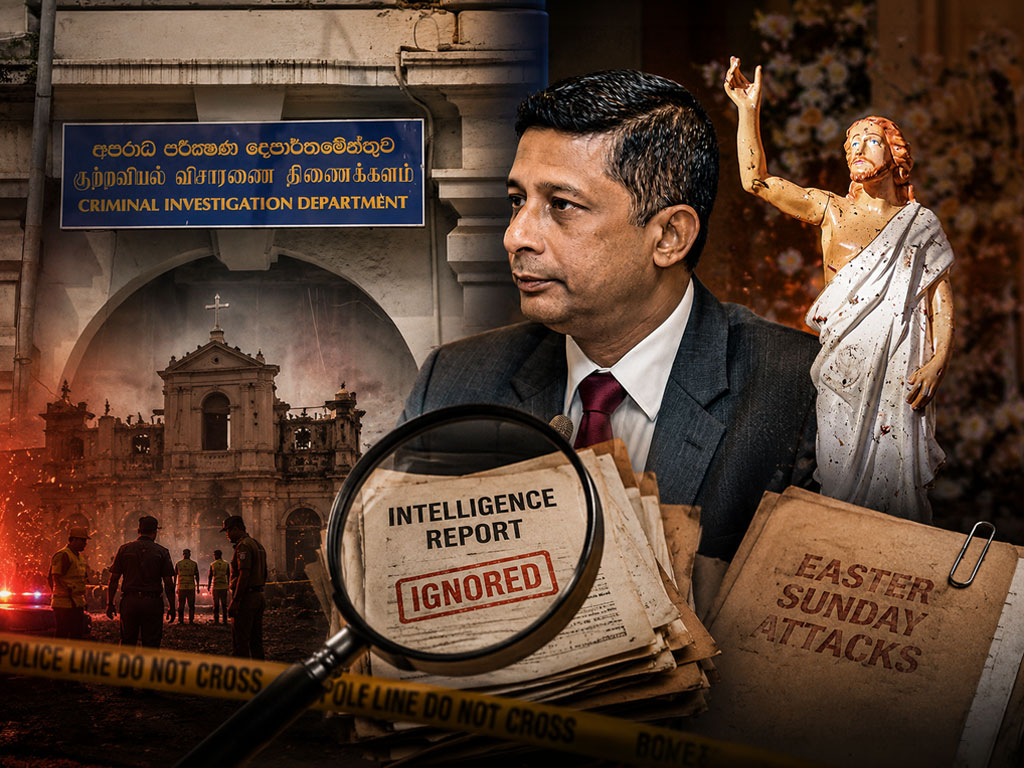
The Easter attack investigation returned to court as lawyers questioned the CID’s actions, intelligence failures and handling of pre-attack warnings.
The Easter attack investigation returned to the Court of Appeal on Thursday (17) as lawyers representing Major General (Retd.) Suresh Sallay challenged the Criminal Investigation Department’s handling of intelligence and investigative failures surrounding the 2019 Easter Sunday attacks.
The writ petition, filed by Sallay, questions the conduct of the CID during its investigation into the coordinated bombings.
Appearing before the Court of Appeal, President’s Counsel Sanjeeva Jayawardena referred to the Supreme Court’s landmark judgment on the Easter Sunday attacks. He argued that the Supreme Court had conclusively identified Zahran Hashim and his followers as the masterminds behind the attacks.

Jayawardena also referred to statements made by Senarath Mudiyanselage Konara Bandara, who served as the Officer-in-Charge of the Islamic Extremism Investigation Unit, commonly known as the Q Branch, within the Terrorist Investigation Division (TID) at the relevant time.
According to those statements, all available intelligence relating to Zahran and his associates had already been provided to the CID well before the attacks. Counsel argued that the tragedy occurred because authorities failed to act on that information.
Intelligence Reports Highlighted in Court
Quoting further from the Supreme Court judgment, Jayawardena submitted that between April 2016 and April 2019, former State Intelligence Service (SIS) Director Nilantha Jayawardena had forwarded 97 specific intelligence reports concerning Zahran Hashim and his network to the Inspector General of Police and the CID.
He further stated that the CID had also received a list of 129 individuals believed to be inclined towards ISIS ideology in January 2019.
Despite receiving that information, counsel argued that the CID failed to take meaningful legal action. He submitted that this omission attracted significant criticism during the proceedings.
Questions Over Delayed Intelligence Sharing
The Court also heard submissions regarding intelligence received from India’s Research and Analysis Wing (RAW).
According to counsel, a warning letter received on April 4 reached the office of then Senior Deputy Inspector General Ravi Seneviratne only on April 9.
However, he stated that the warning did not reach the Director of the CID until April 22, the day after the Easter Sunday attacks.
Jayawardena argued that the sequence reflected serious bureaucratic delays within the country’s security apparatus during a period of heightened threat.
Concerns Over Earlier Investigations
The petition also referred to investigations that were already underway before the attacks.
Counsel submitted that authorities had uncovered evidence linked to the destruction of Buddha statues in Mawanella and the discovery of explosives in Wanathawilluwa.
He argued that despite intelligence agencies identifying locations where suspects were allegedly hiding, the CID failed to respond effectively.
The submissions also questioned whether there was a legal and ethical conflict of interest in allowing officers who allegedly failed to act before the attacks to later investigate the same incident.
After considering the submissions and documentary material presented before it, the Court of Appeal directed that the writ petition be taken up again for further hearing on Tuesday, July 21.
Note: The submissions outlined above are allegations and legal arguments presented before the Court of Appeal. They remain subject to judicial determination and should not be interpreted as findings of fact unless and until the court rules accordingly.