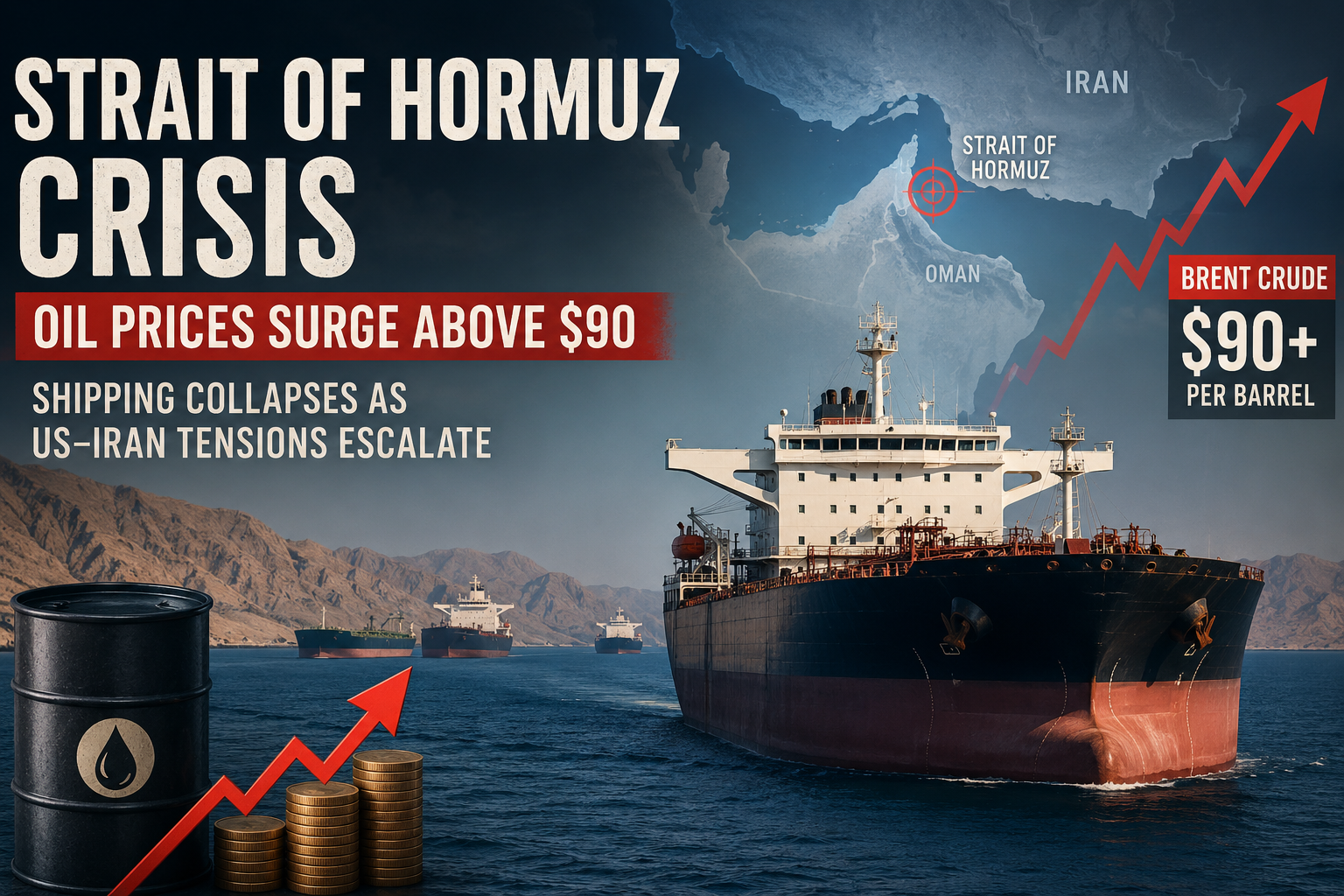
The Strait of Hormuz crisis has pushed oil above $90 as vessel traffic collapses, threatening fuel, freight and food prices worldwide.
The Strait of Hormuz crisis has pushed Brent crude above $90 a barrel as escalating US–Iran hostilities bring shipping through one of the world’s most important energy routes close to collapse.
Only four vessels crossed the narrow waterway on Sunday, according to maritime data cited by Reuters. Eight vessels made the journey the previous day, showing how quickly commercial traffic has declined.
The disruption goes far beyond another rise in global oil prices. It threatens to increase aviation costs, shipping charges, food prices and inflation across energy-importing economies.
Sri Lanka also faces direct exposure. Higher crude prices and freight charges could increase the country’s fuel import bill, raise electricity-generation costs and make imported goods more expensive.

Brent crude climbed above $90 as traders reacted to vessel attacks, military restrictions and fears that Gulf energy shipments could face prolonged disruption.
Financial Times market data showed Brent rising to about $90.25 a barrel after gaining more than 2%. The international benchmark has also climbed sharply during July as the conflict intensified.
US Blockade and Iranian Threats Deepen the Risk
The shipping collapse follows the United States’ decision to enforce a maritime blockade covering Iranian ports, oil terminals and coastal areas.
The US Navy-led Joint Maritime Information Center said the restrictions would apply to vessel traffic regardless of the ships’ flags. Enforcement began at 2000 GMT on July 14.
Iran has rejected Washington’s attempt to control maritime movement in the region. Iranian military authorities have also warned that they will confront vessels that fail to comply with Tehran’s navigation requirements.
The competing restrictions leave commercial operators in a dangerous position. A vessel could face interception, attack or detention depending on which side considers its voyage unauthorised.
Iran has also threatened further disruption to regional oil and gas exports if the US campaign continues.
Meanwhile, attacks on commercial vessels have increased concerns among insurers and shipping companies. Some operators have reportedly switched off public tracking systems, making the true number of vessels entering the waterway more difficult to determine.
The uncertainty can increase costs even before physical supplies decline. Insurers may raise war-risk premiums, while shipowners can demand higher fees or avoid Gulf routes altogether.
Energy cargoes could then remain trapped at export terminals while importing countries compete for supplies from other regions.
Fuel, Aviation and Food Prices Face Pressure
A sustained disruption would affect almost every sector linked to transport or energy.
Higher crude prices would first appear in the cost of petrol, diesel, kerosene and furnace oil. Governments that subsidise fuel could face larger budgetary pressures, while countries using market-based pricing may pass the increase to consumers.
Airlines would also face higher jet-fuel bills. Fuel ranks among the aviation industry’s largest operating expenses, meaning prolonged increases could lead to more expensive tickets, fuel surcharges or reduced services on weaker routes.
Shipping costs could rise at the same time. Tankers and cargo vessels may need additional insurance, security arrangements or longer alternative journeys.
Importers would eventually pass many of those expenses through supply chains. Food, fertiliser, medicines, machinery and consumer goods could all become more expensive.
The International Energy Agency has warned that global energy security would face serious risks if the strait remained restricted for several weeks. The agency’s executive director said the passage normally handles about one-fifth of global energy shipments.
Sri Lanka Faces a Larger Fuel and Import Bill
For Sri Lanka, the Strait of Hormuz crisis could place fresh pressure on an economy that relies heavily on imported fuel and internationally shipped goods.
A higher oil price immediately increases the foreign currency needed to purchase crude oil, diesel, petrol, aviation fuel and furnace oil. More expensive shipping and insurance can add further costs before those products reach Sri Lankan ports.
The consequences may extend to electricity bills. Sri Lanka generates much of its power from hydroelectricity, coal and renewable energy, but oil-fired thermal plants remain important when rainfall is weak or other generation becomes unavailable.
Official Ceylon Electricity Board data continues to record oil-based thermal power within the national generation mix. The Public Utilities Commission also considers liquid-fuel prices when evaluating electricity costs and tariff proposals.
In March, Sri Lanka raised electricity tariffs as rising energy costs placed pressure on the CEB. Reuters reported that the country was spending about $600 million to secure refined fuel for April while struggling to obtain crude oil and furnace oil supplies.
Further increases in oil and freight prices could therefore widen the national import bill and place pressure on foreign exchange reserves.
Transport charges could rise as diesel becomes more expensive. Businesses may then add those costs to food, construction materials and other essential products.
The Central Bank has already identified domestic energy-price adjustments linked to the Middle East conflict as a factor behind rising inflation. In May, it warned that headline inflation could remain above its 5% target in the period ahead.
The danger is not limited to whether oil remains above $90 for several days. The greater risk lies in a prolonged breakdown of predictable shipping through the strait.
If tankers cannot move safely, oil-producing states may struggle to release supplies even when production remains stable. Importing countries would then compete for fewer available cargoes while paying higher transport and insurance costs.
For Sri Lanka and other vulnerable economies, the outcome could be another imported inflation shock driven by events far beyond their control.
Restoring safe commercial passage through the Strait of Hormuz has therefore become an economic priority, not merely a military or diplomatic objective. Until vessel traffic recovers, every fresh attack or restriction risks sending the cost of energy, transport and essential goods even higher.