Peru earthquakes killed six people in Junín as vulnerable adobe homes collapsed, leaving 21 injured and hundreds needing shelter.
The Peru earthquakes that struck the central Junín region killed at least six people after vulnerable adobe homes collapsed across remote mountain communities.
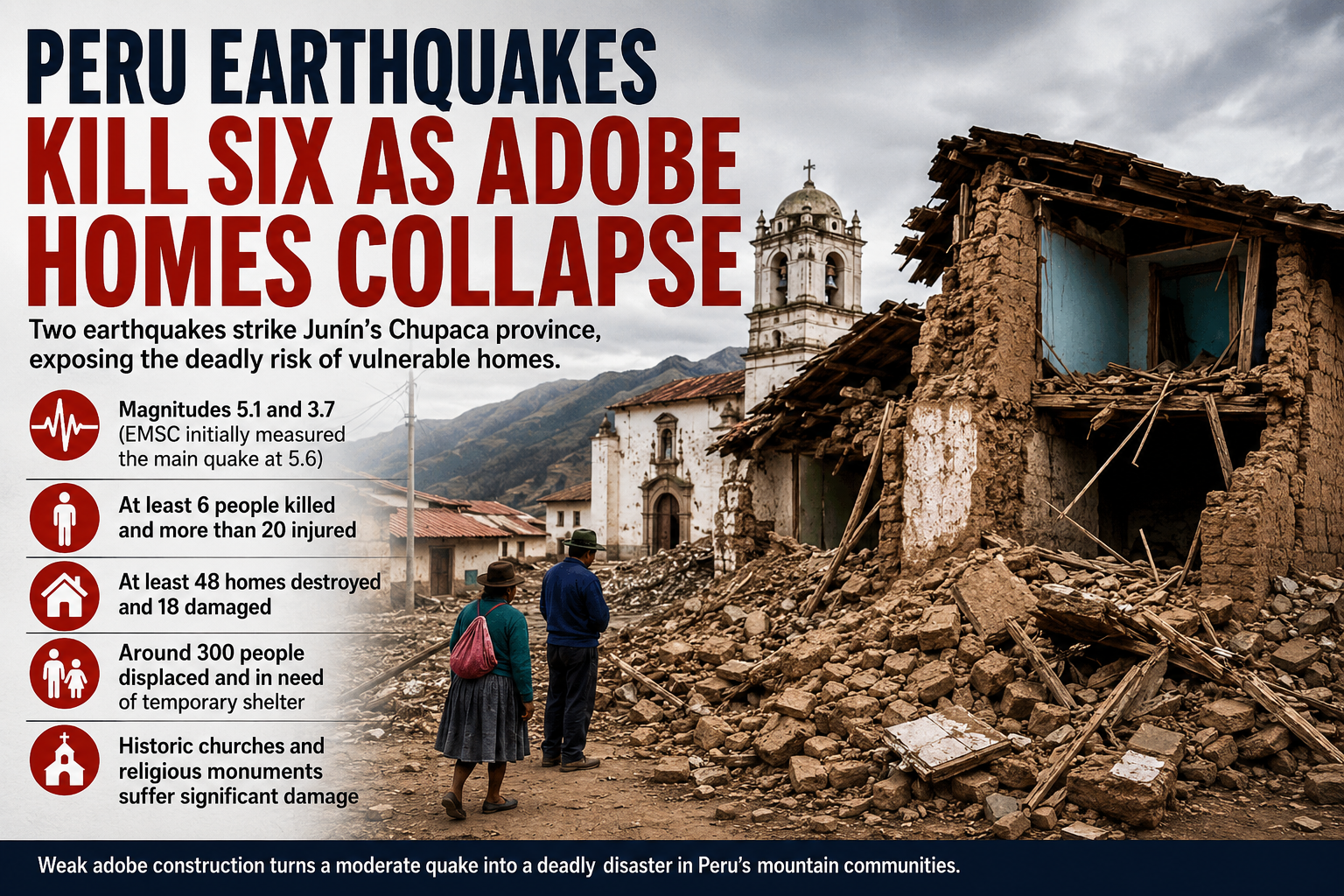
Two earthquakes hit Chupaca province on Saturday night, July 18, leaving at least 21 people injured. The tremors also destroyed dozens of homes and forced about 300 residents to seek temporary shelter.
Peru’s National Seismological Center recorded the earthquakes at magnitudes 5.1 and 3.7. The stronger tremor occurred at a depth of 24 kilometres, while the second struck at a depth of 18 kilometres.

However, the European-Mediterranean Seismological Centre initially measured the main earthquake at magnitude 5.6 and placed it at a depth of approximately 22 kilometres.
The difference between those preliminary measurements does not change the scale of the destruction. Although the main earthquake was moderate compared with Peru’s strongest seismic disasters, it proved deadly because many affected homes could not withstand the shaking.
Peru Earthquakes Destroy Vulnerable Adobe Homes
Preliminary assessments showed that at least 48 homes had been destroyed. Another 18 suffered damage, according to Luis Vásquez, head of Peru’s National Civil Defense Institute.
Around 300 people were affected and required tents or other forms of temporary shelter. Emergency teams arrived in the area early on Sunday to remove debris and search for anyone who might remain trapped.
The destruction was concentrated in rural communities where residents commonly build homes from adobe blocks. These structures use earth-based materials that are widely available and relatively inexpensive.
However, traditional adobe buildings can become extremely dangerous during earthquakes when they lack reinforcement. Heavy walls may crack, separate and collapse, leaving occupants little time to escape.
The disaster therefore exposed a wider housing problem. The earthquake itself was not exceptionally large, but it struck communities filled with structures that had limited resistance to lateral movement.
In several locations, walls and roofs collapsed almost completely. Families lost homes, household belongings and shelter within seconds.
The affected communities sit in a mountainous area about 300 kilometres east of Lima. Their location could also complicate efforts to deliver emergency equipment, shelter and building materials.
Emergency crews and firefighters began clearing rubble as authorities assessed the full scale of the damage. Officials remained concerned that the casualty figures could change as rescuers reached more affected locations.
Historic Religious Buildings Suffer Serious Damage
The earthquakes also damaged religious and cultural buildings that had stood in the region for centuries.
In Chongos Bajo, the historic Santiago de León church and convent suffered significant damage. Reports indicated that sections of the religious complex collapsed during the shaking.
Damage was also reported at the Cruz del Señor de Cani Cruz, a centuries-old religious monument recognised as part of Peru’s cultural heritage. Part of the roof of the area’s main church was also damaged.
These losses extend the disaster beyond destroyed homes. Historic churches in Peru’s mountain communities often serve as religious centres, cultural landmarks and gathering places for generations of residents.
Their construction, however, may include old masonry or adobe materials that remain highly vulnerable to earthquakes. Repairing them could require specialist conservation work as well as structural reinforcement.
The destruction highlights the difficult balance between preserving historic architecture and protecting communities in one of the world’s most seismically active countries.
Moderate Earthquake Produces Deadly Consequences
Peru sits along the Pacific Ring of Fire, where the movement of tectonic plates causes frequent earthquakes and volcanic activity.
Yet the number printed on a magnitude scale does not determine the human impact by itself. Depth, distance from populated areas, soil conditions and building quality can all influence the damage.
In Chupaca province, the shallow earthquakes struck close to communities containing homes built with heavy and brittle materials. As a result, a moderate seismic event caused fatal structural collapses.
The deaths therefore raise questions about whether more rural homes can be strengthened before another earthquake occurs.
Reinforcing adobe walls, improving roof connections and encouraging safer construction could reduce the danger. However, such work requires money, technical assistance and sustained public investment.
For displaced residents, the immediate priorities remain shelter, food, medical care and protection from cold mountain temperatures. Authorities must also determine which damaged homes remain safe and which require demolition.
The Peru earthquakes have left grieving families, injured residents and hundreds of people facing uncertainty. They have also delivered a stark warning: in vulnerable communities, even a moderate earthquake can become a deadly housing disaster.