Taiwan red terror warning from President Lai Ching-te highlights Beijing’s military pressure, new laws and campaign against the island.
The Taiwan red terror warning issued by President Lai Ching-te has placed renewed attention on Beijing’s growing military, legal and diplomatic pressure against the democratic island.
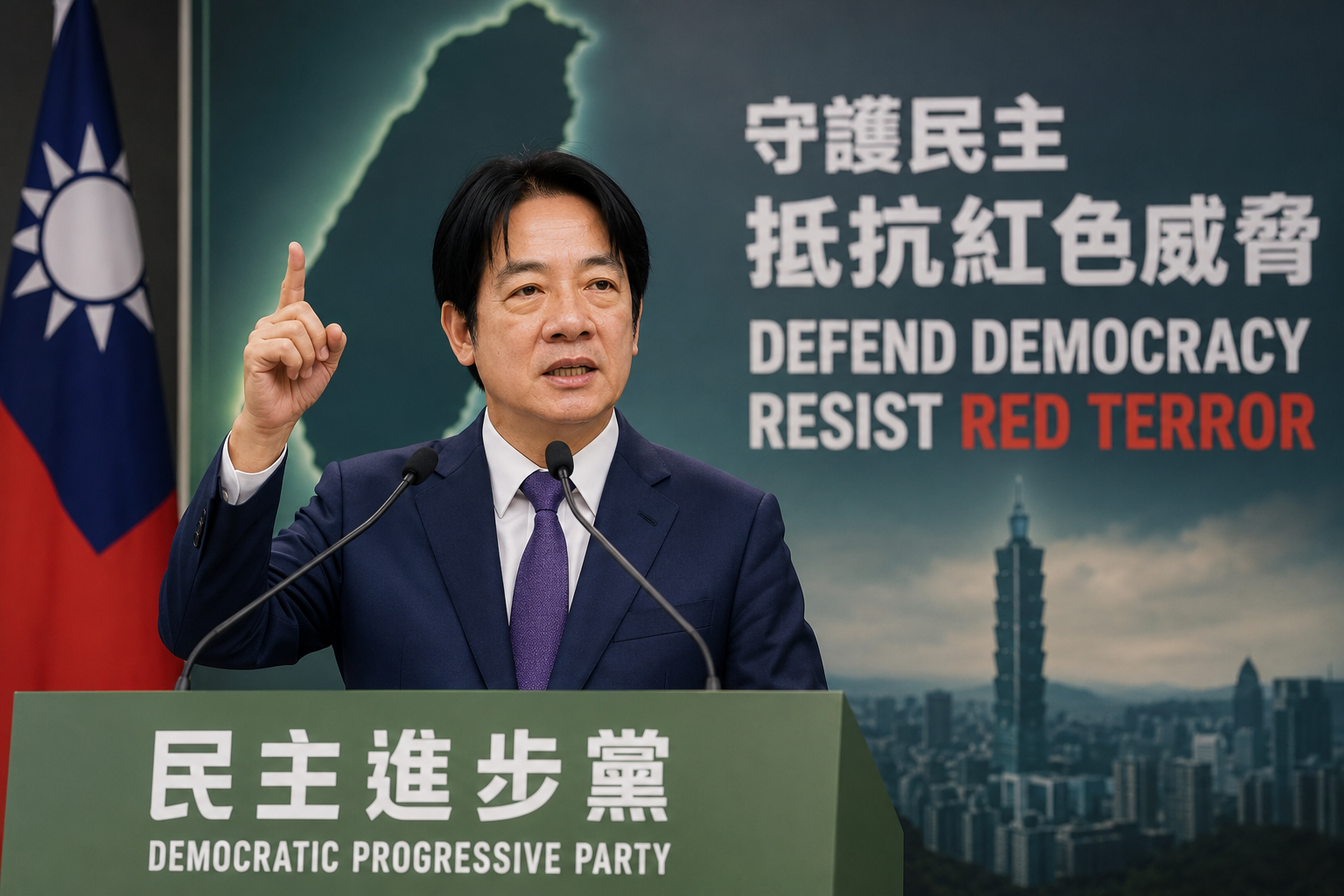
Speaking at the annual convention of Taiwan’s governing Democratic Progressive Party, Lai urged party members and the wider public to defend the island’s democratic system.
He said Taiwanese citizens must resist what he described as a campaign of “red terror” from Beijing.

Lai also declared that democratic Taiwan must never become “China’s Taiwan,” drawing a sharp distinction between Taiwan’s elected political system and the authoritarian government of the People’s Republic of China.
The president framed the confrontation as more than a dispute over territory. Instead, he presented it as a struggle over Taiwan’s political identity, democratic institutions and citizens’ right to determine their future.
China claims Taiwan as part of its territory. However, Beijing has never governed the island.
Taiwan operates with its own democratically elected government, military, currency and legal system. Lai said the island’s future must remain in the hands of its approximately 23 million residents.
Taiwan Red Terror Warning Targets Multiple Pressure Tactics
Lai used “red terror” to describe a broad campaign rather than a single military threat.
The phrase covers Beijing’s military activity around Taiwan, its diplomatic efforts to isolate the island and its attempts to use law and political pressure against supporters of Taiwanese sovereignty.
China regularly sends military aircraft and naval vessels near Taiwan. Beijing says these operations protect Chinese sovereignty and warn against moves towards formal independence.
Taiwan’s government views the activity as intimidation designed to exhaust its armed forces, weaken public confidence and gradually change conditions in the Taiwan Strait.
Beijing has also persuaded countries to end formal diplomatic relations with Taipei. In addition, China pressures international organisations, companies and sporting bodies to describe Taiwan using terms that support its “one China” position.
Lai told the convention that Taiwan had faced military threats, disinformation campaigns and diplomatic pressure throughout the Democratic Progressive Party’s decade in government.
However, he argued that Taiwan’s continued democratic development showed that democracy remained a source of strength rather than weakness.
China strongly rejects Lai’s position. Chinese officials describe him as a separatist who threatens peace across the Taiwan Strait.
Beijing has refused to hold talks with Lai’s administration, despite repeated calls from Taipei for dialogue. China insists that Taiwan’s leaders must accept that the island and mainland China belong to one country before meaningful discussions can begin.
Why China’s New Ethnic-Unity Law Matters
Lai’s warning also focused on China’s Law on Promoting Ethnic Unity and Progress.
China’s National People’s Congress adopted the legislation in March 2026. It took effect on July 1.
Beijing says the law promotes social stability and strengthens a shared sense of national identity among China’s recognised ethnic groups.
However, critics argue that it could strengthen government efforts to assimilate ethnic minorities and restrict distinct languages, cultures and political identities.
One of the most controversial provisions concerns conduct outside China. The legislation allows Chinese authorities to pursue legal responsibility against overseas organisations or individuals accused of undermining ethnic unity or encouraging separatism.
Chinese officials maintain that the extraterritorial provision follows international practice and protects national security.
However, Taiwanese officials, civic organisations and legal experts fear Beijing could use the law against Taiwanese politicians, activists, journalists or citizens who reject China’s sovereignty claims.
Lai suggested that the legislation could extend Beijing’s campaign beyond its territory and create new legal risks for Taiwanese people travelling or working abroad.
The concern does not mean Chinese authorities could automatically enforce the law in Taiwan or another sovereign jurisdiction.
However, individuals named or investigated under Chinese law could face arrest or questioning if they enter mainland China or territories where Chinese law operates. They could also encounter difficulties when travelling through countries that maintain close law-enforcement cooperation with Beijing.
What Does Beijing’s “Red Terror” Mean for Ordinary Taiwanese?
For ordinary Taiwanese, the immediate effect of the dispute may appear more psychological and political than physical.
Military drills and aircraft activity can increase fears of conflict. However, legal and diplomatic pressure may affect people in less visible ways.
Taiwanese travellers may need to consider whether political statements, social media posts or involvement in civic organisations could attract attention from Chinese authorities.
Businesses also face pressure over how they identify Taiwan on websites, documents and products. International organisations often require Taiwanese participants to compete or attend events under names accepted by Beijing.
Meanwhile, disinformation campaigns can deepen divisions inside Taiwan. Competing claims about war, sovereignty and relations with China may shape elections and weaken trust in public institutions.
Lai urged the DPP to remain united and persuade citizens that Taiwan could protect its democracy without closing the door to peaceful engagement.
He also spoke in Taiwanese rather than Mandarin during the address, reinforcing the cultural and political identity he sought to defend.
Cross-Strait Tensions Could Enter a More Dangerous Phase
The speech is unlikely to change Beijing’s refusal to engage with Lai.
Instead, China could respond through military exercises, diplomatic statements, trade restrictions or new legal measures targeting alleged separatism.
However, Lai’s remarks also show that Taipei intends to challenge Beijing’s pressure publicly rather than soften its language in hopes of restarting negotiations.
That approach could reassure supporters who want a strong defence of Taiwan’s sovereignty. At the same time, critics may argue that increasingly confrontational language risks provoking a stronger response from China.
The wider danger lies in the combination of military pressure and legal escalation.
Military activity creates a risk of accidents or miscalculation near the Taiwan Strait. Meanwhile, laws claiming authority over people outside China could extend the dispute into international travel, business and diplomacy.
Lai presented the choice in direct terms. Taiwan could either protect its democratic institutions or allow Beijing’s pressure to reshape its identity and future.
His Taiwan red terror warning therefore carried a message beyond the DPP convention. It signalled that Taiwan’s government sees China’s campaign as a sustained challenge to everyday democratic life, not only a distant threat of invasion.
For Lai, resisting that pressure means defending the principle that Taiwan’s people must decide their own political future.
For Beijing, however, any rejection of eventual unification remains unacceptable.
That unresolved divide means the Taiwan Strait will remain one of the world’s most dangerous political and military flashpoints.