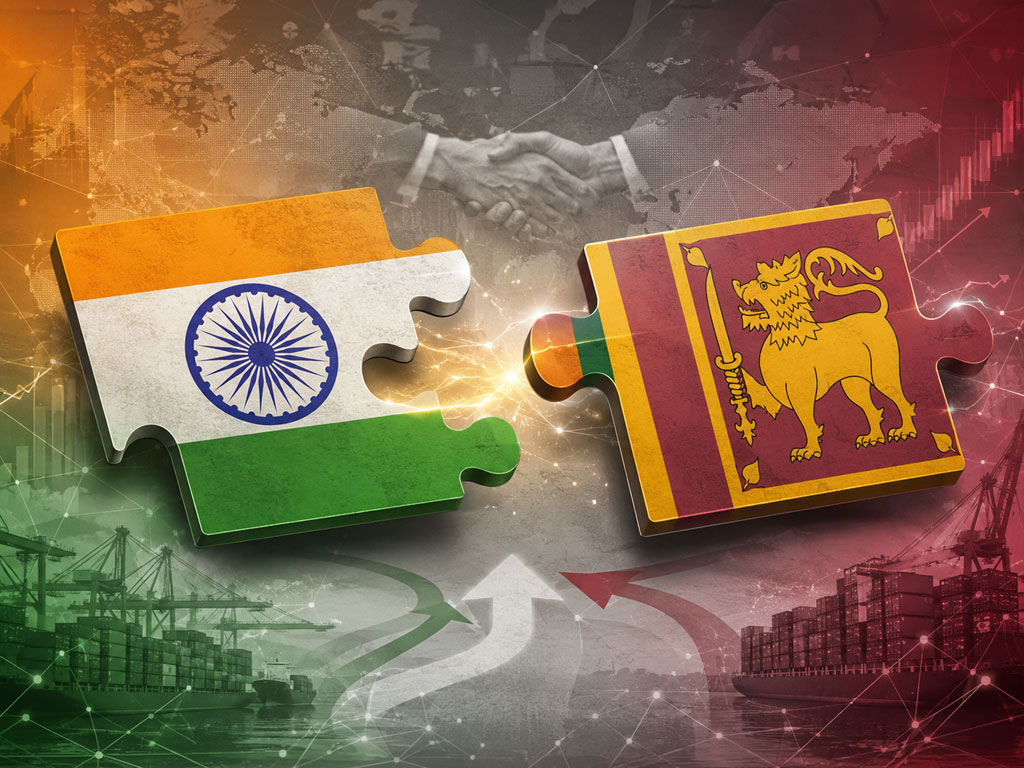
Sri Lanka India ETCA returns to the spotlight as Colombo weighs investment, services access and domestic safeguards in deeper ties with India.
The Sri Lanka India ETCA debate has returned to the national agenda, reviving old concerns over jobs and sovereignty alongside fresh promises of investment and growth.
Nearly a decade after protests and political resistance made the proposed Economic and Technology Cooperation Agreement one of Sri Lanka’s most controversial economic reforms, officials are again arguing for deeper integration with India.
President’s Special Envoy for Foreign Investment Hanif Yusoof brought the issue back into focus at the “India Calling” forum in Colombo.
He argued that the existing Indo-Sri Lanka Free Trade Agreement belongs to an earlier era and no longer reflects a global economy driven by services, technology, logistics, digital trade and integrated supply chains.
The current FTA was signed on December 28, 1998 and entered into force on March 1, 2000. It remains Sri Lanka’s first bilateral free trade agreement.
Yusoof’s argument was therefore straightforward. Sri Lanka should move beyond a trade relationship centred mainly on goods and embrace broader economic cooperation with India.
Get Breaking News First
on WhatsApp

Sri Lanka India ETCA Revives Old Political Fears
The proposal inevitably brings back memories of the opposition that surrounded ETCA during earlier negotiations.
Professional organisations, trade groups and sections of civil society raised concerns about Sri Lanka’s ability to negotiate on equal terms with a much larger economy.
Engineers, medical professionals and other groups also feared that liberalising services could expose Sri Lankan workers to greater competition from Indian professionals.
The Institution of Engineers Sri Lanka recorded major professional protests against ETCA in 2016, including a rally attended by thousands of professionals.
Those concerns centred heavily on employment, professional recognition and the possibility of Indian workers entering Sri Lanka’s comparatively small labour market.
However, officials involved in later negotiations have said unrestricted movement of individual professionals was not envisaged under the proposed framework.
The political problem has always extended beyond the contents of the agreement itself.
Public uncertainty over negotiating texts allowed competing claims, fears and political narratives to dominate discussion.
That means transparency will remain critical if the Government intends to move the Sri Lanka India ETCA process forward.
Supporters See India as a Bigger Economic Opportunity
Supporters argue that Sri Lanka should reassess ETCA against the country’s post-crisis economic needs.
Yusoof said a modern partnership could allow Sri Lankan manufacturers, technology firms, service providers and professionals to participate more deeply in Indian value chains.
He also argued that closer integration could attract more Indian investment if Sri Lanka combines its geographical position with skilled labour, competitive infrastructure and predictable regulation.
India and Sri Lanka have already completed 14 rounds of ETCA negotiations, with the latest round held in Colombo from July 24 to 26, 2024. Official Indian information says negotiations cover broader economic, trade, investment and technology cooperation.
Recent bilateral discussions have also focused on updating economic ties, infrastructure and wider trade cooperation.
For Sri Lanka, the potential attraction is significant.
Deeper access to India could help expand opportunities in manufacturing, logistics, digital services, tourism, energy and professional services.
But access to a larger market does not automatically guarantee benefits.
Safeguards Will Decide Whether ETCA Works
The economic outcome will depend heavily on the final negotiated structure.
Sri Lanka will need clear protections for sensitive industries and transparent rules governing professional qualifications.
Negotiators must also address market access, investment protection, dispute settlement, services and reciprocity.
Without such safeguards, deeper integration could reinforce existing economic asymmetries instead of reducing them.
At the “India Calling” forum, Yusoof also challenged Sri Lanka’s protectionist mindset.
He argued that national interest should not simply mean shielding established interests from competition. Instead, economic policy should focus on creating wider opportunities for businesses and citizens.
That position is likely to appeal to export-oriented industries and companies looking toward India.
However, domestic sectors that fear increased competition will continue demanding stronger safeguards before supporting liberalisation.
The Sri Lanka India ETCA debate therefore reaches far beyond tariffs or trade statistics.
It is a test of whether Sri Lanka can pursue economic integration while maintaining public confidence and protecting legitimate domestic interests.
If the Government publishes clear negotiating positions, consults affected industries and defines safeguards before implementation, ETCA could become a platform for stronger regional competitiveness.
If transparency again gives way to uncertainty, however, the political mistrust that surrounded the agreement in the past could once more overshadow its economic promise.