Sri Lanka foreign policy faces fresh questions over India, China, bottom trawling, Tamil politics, investment pressure and BRICS engagement.
The Sri Lanka foreign policy debate has entered an uncomfortable new phase as India, China, fisheries disputes, Tamil political demands and BRICS expose the limits of Colombo’s strategic independence.
What exactly did India choose to emphasise after Foreign Secretary Vikram Misri’s August 5 visit to Colombo? More importantly, what did it leave unsaid?
India’s official account highlighted development cooperation, reconstruction, energy, digitalisation, trade and economic links. It also confirmed that Misri discussed political reconciliation and urged Sri Lanka to hold Provincial Council elections at the earliest.
Those issues matter. However, they raise a larger question.
Is Sri Lanka pursuing an independent foreign policy, or has it simply become more skilled at balancing demands from larger powers without openly challenging them?
Get
Breaking News
First
on WhatsApp
Follow The Morning Telegraph for instant alerts, top stories and exclusive updates delivered straight to your phone.

Sri Lanka Foreign Policy and the Fisheries Contradiction
The fisheries dispute provides one of the clearest examples.
India regularly raises the detention of fishermen and fishing vessels, emphasising livelihoods and humanitarian treatment.
Those concerns are legitimate. Fishermen should be treated humanely, and economically vulnerable families should not become collateral damage in bilateral disputes.
But there is another side.
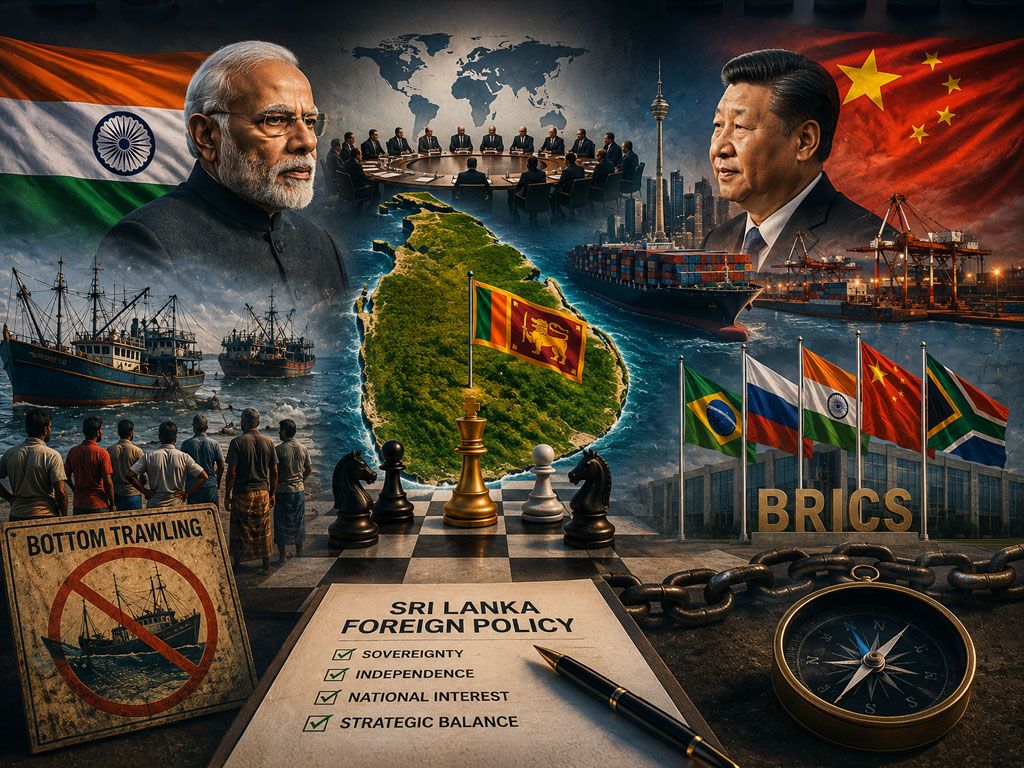
Bottom trawling has long been at the centre of tension between fishing communities in northern Sri Lanka and mechanised vessels operating from India.
India’s own Foreign Secretary acknowledged during President Dissanayake’s December 2024 visit that bottom trawling is a harmful practice and should not be used.
That makes the omission important.
If vessels repeatedly enter disputed or Sri Lankan waters while allegedly using destructive fishing methods, the issue cannot be reduced to a simple narrative of fishermen being detained.
It involves maritime jurisdiction, marine resources and the survival of northern Sri Lankan fishing communities.
If New Delhi expects Colombo to respond quickly when Indian fishermen and vessels are detained, Colombo should be equally willing to demand effective action against practices that damage Sri Lankan fishing grounds.
A genuine partnership requires both conversations.
Provincial Councils and the Limits of Diplomatic Persuasion
Then comes the politically sensitive Provincial Council issue.
During Misri’s visit, India again urged Sri Lanka to conduct Provincial Council elections and implement constitutional provisions connected to the aspirations of the Tamil population. India’s Foreign Ministry publicly confirmed that position.
India has historical, political and cultural reasons for taking an interest in Tamil issues.
But Sri Lanka also has the right to ask where diplomatic engagement ends and external political pressure begins.
Constitutional arrangements and elections ultimately belong to Sri Lanka’s democratic institutions.
There is an obvious contradiction if sovereignty becomes absolute when regional security matters concern India, but becomes flexible when New Delhi wants a particular political outcome in Sri Lanka.
This does not mean Colombo should reject Indian concerns.
It means the relationship should work in both directions.
If India expects candid discussions about reconciliation and Provincial Councils, Sri Lanka must be equally candid about bottom trawling, maritime incursions and threats to northern livelihoods.
Foreign Investment Becomes the Bigger Battlefield
The most consequential struggle may not be diplomatic at all.
It may be economic.
Sri Lanka needs foreign direct investment, export growth, infrastructure and access to international capital. Yet its strategic position in the Indian Ocean means major investment proposals rarely exist outside geopolitics.
India wants influence.
China wants influence.
The United States and other major powers have their own strategic calculations.
Each describes its relationship with Sri Lanka in terms of partnership, stability and development. But every major state also acts according to its own national interest.
Sri Lanka’s challenge is therefore not merely attracting money.
It is attracting capital without allowing strategic competition to determine which projects proceed, which investors face resistance and which relationships Colombo is expected to prioritise.
That becomes especially dangerous if bureaucratic delays combine with geopolitical pressure.
Investors require predictable regulation, quick decisions and confidence that commercial projects will not become casualties of competition between larger states.
China and India Must Face the Same Scrutiny
China deserves examination in this debate.
Beijing has built substantial economic links with Sri Lanka through infrastructure, investment, diplomacy and development projects.
Such engagement inevitably creates influence.
But India cannot reasonably demand scrutiny of Chinese influence while treating its own political, security, economic and cultural reach as somehow different in principle.
Both relationships deserve examination.
Allegations that foreign governments cultivate journalists, political actors or influential institutions should be investigated on evidence rather than repeated as partisan claims.
The standard must also remain consistent.
If Chinese funding, diplomatic access or communications strategies can influence public narratives, Indian influence deserves exactly the same scrutiny.
Sri Lankan journalists should not become unofficial advocates for Beijing or New Delhi.
The purpose of an independent press is to question both.
BRICS Creates Another Test for Sri Lanka Foreign Policy
BRICS makes the contradiction even sharper.
India formally holds the 2026 BRICS chairship, and New Delhi has already hosted meetings of BRICS foreign ministers and sherpas under its presidency.
The official BRICS India 2026 platform confirms India’s leadership of the grouping this year.
Sri Lanka has previously shown interest in closer relations with BRICS and the New Development Bank as part of efforts to diversify its international partnerships.
That makes President Anura Kumara Dissanayake’s future participation particularly interesting.
At present, however, an official invitation for Dissanayake to attend the 2026 BRICS leaders’ summit could not be independently confirmed from the available official sources.
That uncertainty itself makes the issue worth watching.
If Sri Lanka seeks greater BRICS engagement, India should have no reason to view that ambition as incompatible with close bilateral relations.
At the same time, Colombo should avoid pretending that BRICS represents freedom from geopolitical pressure.
India and China are themselves central BRICS powers. The New Development Bank was established by BRICS members and continues to finance infrastructure and sustainable development projects across participating and emerging economies.
Moving towards BRICS therefore does not mean escaping geopolitical influence.
It merely changes the room in which that influence operates.
Colombo Must Refuse to Become Anyone’s Prize
Sri Lanka does not need to choose India over China.
Nor should it choose China over India.
India has provided substantial economic and development assistance. China has financed major infrastructure and investment.
Both relationships can benefit Sri Lanka.
But neither country should define Sri Lanka’s national interest.
Colombo’s strategic independence will ultimately depend on whether it can accept investment without surrendering policy, maintain friendships without accepting political instructions and defend its own fishermen, laws and constitutional processes without unnecessarily turning neighbours into enemies.
The real question is therefore not whether India or China eventually “wins” Sri Lanka.
It is whether Sri Lanka possesses the political maturity to make sure nobody does.
SOURCE:- SRI LANKA GUARDIAN