By Dwayne Ferreira.
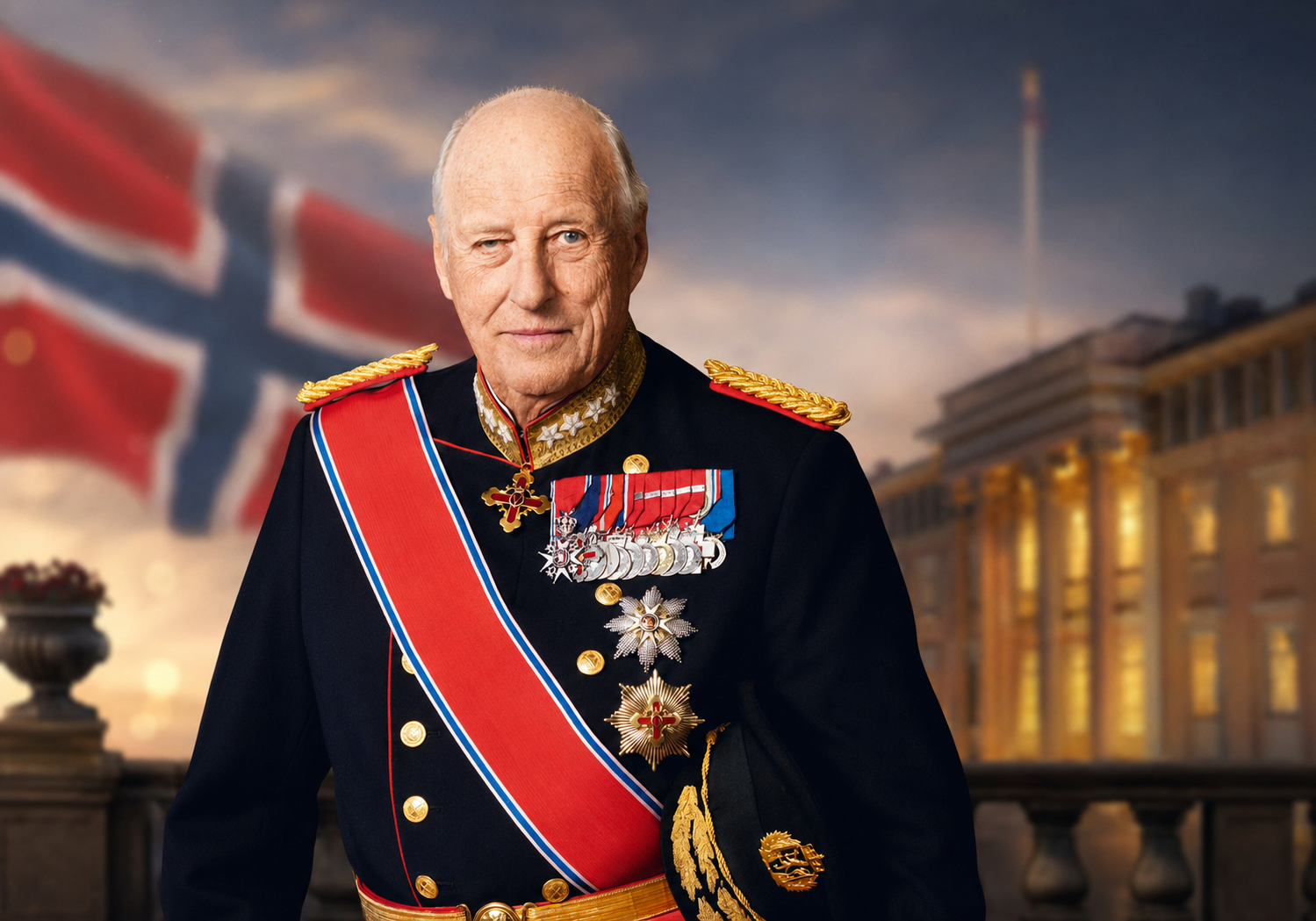
King Harald V of Norway has died aged 89 after more than 35 years on the throne, with his son Haakon succeeding him as King Haakon VIII.
King Harald V dies aged 89, bringing to an end one of the longest and most defining reigns in modern Norwegian history and beginning a new chapter for the Scandinavian monarchy.
The Norwegian Royal Court announced on Friday that King Harald died peacefully at Oslo University Hospital Rikshospitalet at 6:35 a.m. on August 28, 2026.
His death ends a reign stretching back more than 35 years to January 1991 and has triggered a period of national mourning in Norway.
His son, 53-year-old Crown Prince Haakon, immediately succeeded him to the throne and becomes King Haakon VIII.

King Harald’s Health Had Deteriorated
The King’s death followed a serious deterioration in his health.
Harald had been admitted to hospital earlier in August and was being treated for complications associated with haemolytic anaemia. He subsequently developed a bacterial bloodstream infection.
On August 27, the Royal Court announced that his condition had become “very serious”, while members of the Royal Family gathered around him and official royal engagements were cancelled.
King Harald had faced several health problems during his later years and had undergone the implantation of a pacemaker in 2024.
Despite his declining health, he repeatedly resisted suggestions that he might abdicate.
For Harald, the crown was a lifelong responsibility.
More Than Three Decades as Norway’s King
Harald became king on January 17, 1991, following the death of his father, King Olav V.
Four days later, he formally swore his constitutional oath before the Norwegian parliament.
Like his father and grandfather, Harald adopted the royal motto:
“We give our all for Norway.”
His duties were primarily constitutional, ceremonial and representative, but over more than three decades he became one of Norway’s most recognisable symbols of national continuity.
The King was particularly visible during moments of national tragedy.
Following the devastating terrorist attacks of July 22, 2011, Harald helped articulate the grief of a traumatised nation and became an important figure in Norway’s public response to the killings.
Over time, he also developed a reputation as a monarch willing to speak about tolerance, diversity and an increasingly modern Norwegian identity.
Prime Minister Jonas Gahr Støre paid tribute following the King’s death, describing him as a figure who helped unite Norway and encouraged Norwegians to believe in themselves.
A Prince Born Into a Changing Europe
Harald was born on February 21, 1937, at Skaugum in Asker.
His birth was historically significant. He was the first prince born in Norway in 567 years, and, under the succession rules that existed at the time, his arrival secured the continuation of the royal line.
His childhood was quickly disrupted by war.
When Nazi Germany invaded Norway in April 1940, the Royal Family fled Oslo. Harald eventually spent part of the Second World War outside Norway before returning after liberation.
Those experiences formed part of a life that spanned enormous changes in Norway, from the trauma of wartime occupation to the emergence of one of the world’s most prosperous and stable democracies.
His Marriage to Sonja Changed Royal Tradition
Harald’s personal life also helped reshape Norway’s monarchy.
For nine years he maintained a relationship with Sonja Haraldsen, who was not of royal or aristocratic birth.
At the time, there was considerable resistance to the idea that Norway’s future king could marry a commoner.
King Olav V eventually gave his approval, and Harald married Sonja at Oslo Cathedral on August 29, 1968.
The marriage ultimately became one of the defining partnerships of the modern Norwegian monarchy.
When Harald became king in 1991, Sonja became Norway’s first queen in 53 years.
They had two children, Princess Märtha Louise and Crown Prince Haakon.
King Haakon VIII Begins a New Reign
Harald’s death means Norway now enters its first royal transition in more than three decades.
Under Norway’s constitutional system, the succession is automatic. Haakon became king upon his father’s death rather than through a later coronation.
The new King Haakon VIII inherits a monarchy that remains deeply embedded in Norway’s national identity, but he also takes the throne at a complicated moment for the Royal Family.
Recent controversies involving members of the wider royal household have placed the institution under greater public scrutiny, meaning the new king will face an early challenge in preserving the public confidence his father enjoyed for much of his reign.
Nevertheless, Haakon has spent decades preparing for the role and had already increasingly represented the monarch as his father’s health deteriorated.
Norway Mourns
Tributes began appearing rapidly following confirmation of Harald’s death.
Sweden’s King Carl XVI Gustaf remembered Harald as a valued friend of both his family and Sweden, while leaders in Norway praised the late monarch’s devotion to public service.
For Norwegians, however, the loss is likely to be more personal.
King Harald occupied the throne for an entire generation.
He stood on the palace balcony during national celebrations, travelled across Norway, represented the country overseas and appeared alongside ordinary Norwegians through periods of celebration, tragedy and enormous social change.
His reign began in 1991 with the death of a much-loved father.
It ends 35 years later with Harald himself having become much the same figure: a familiar, enduring symbol of Norway.
King Harald V was 89.