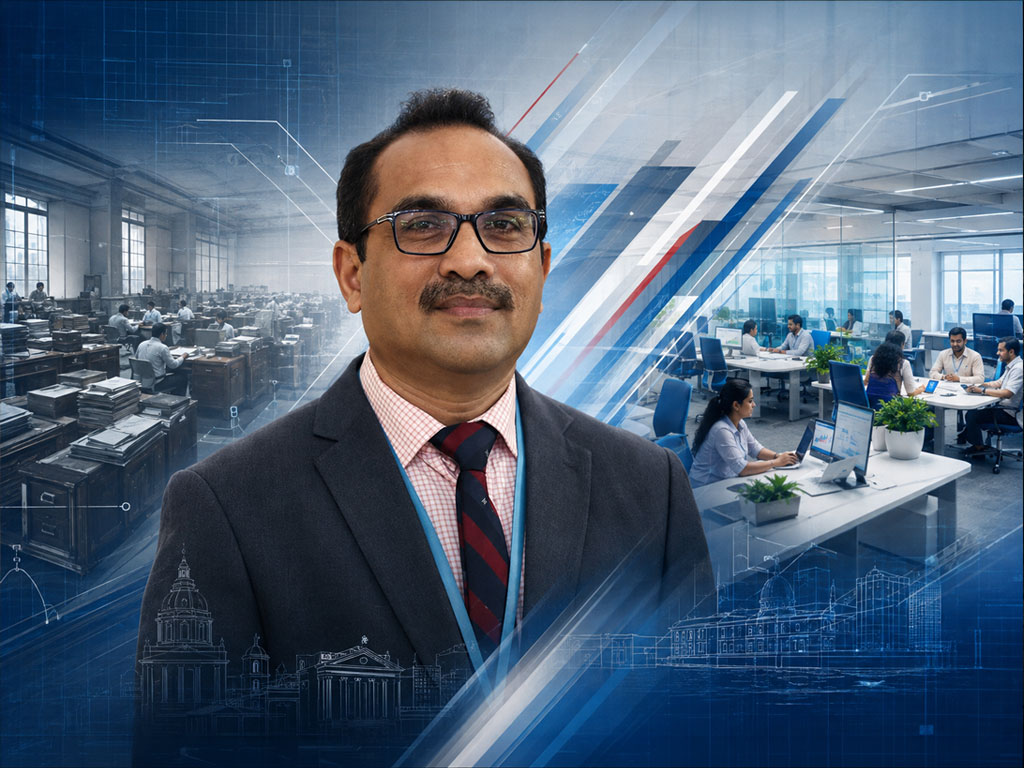
Sri Lanka public sector reform should replace oversized offices with workstations and centralise scattered institutions, Minister Bimal Ratnayake says.
Sri Lanka public sector reform must move away from oversized offices and bureaucratic traditions that use workspace to display status, Minister Bimal Ratnayake has said.
The Minister of Transport, Highways, Ports and Civil Aviation said public servants should quickly leave behind the traditional bureaucratic mindset.
He argued that an office should not become a place for officials to demonstrate power, position or personal ego.
Ratnayake said the public sector should also move away from what he described as a dark, enclosed office culture resembling prison cells.
Instead, he wants state institutions to adopt more open workstation-style environments that encourage officials to work together as teams.

Sri Lanka Public Sector Reform Targets Oversized Offices
Commenting on unnecessary expenditure and the use of public resources, Ratnayake said even his current ministerial office at the Highways Ministry is unnecessarily large.
“We need to come out of that old system of offices that are enclosed by walls, dark, like prison cells. If you take the office I currently occupy at the Highways Ministry, it’s about the size of a tennis court. Creating such spaces should be banned.”
He said office size should not become a symbol of authority or personal importance.
“Office space is not something to show off one’s ego, to display one’s position. If we truly have the qualifications, a small office is enough. We don’t need anyone to build a personality from an office…”
The Minister also criticised the practice of using expensive furniture simply to decorate offices or reinforce official status.
“There are about five chairs in our room. An ordinary person could build a house with the cost of one chair.”
Ratnayake said the Government did not need that type of office culture.
“So we don’t have that kind of mental illness. We have nothing to gain from chairs, office space, or that glorification.”
He said he intended to examine a return to workstation-style offices that would make collaboration easier.
“I definitely intend to look at moving back to a workstation model, where we can work as a team easily.”
Scattered State Institutions Could Be Centralised
Ratnayake also highlighted another administrative problem: institutions belonging to the same ministry are often scattered across several locations.
He said that arrangement has complicated administration and made it harder to deliver public services efficiently.
“We have now made a decision that state institutions should be brought to one place.”
Referring to his own ministry, he said several offices operate from different locations.
“If you take our ministry, it is scattered in places like Ramya, Suramya, Suba. I think I don’t even properly know where all of them are located.”
Accordingly, Ratnayake said future policy would seek to bring related institutions together on one premises.
The objective is to reduce costs while improving coordination and administrative efficiency across the state sector.
Workstation Model Proposed for a Modern Public Service
The proposed Sri Lanka public sector reform also reflects a broader shift towards open-plan and collaborative working environments.
Many developed and developing countries have already moved away from traditional offices divided into individual enclosed rooms.
Open office arrangements can allow officials to communicate more quickly and work more closely across teams.
They can also reduce some costs associated with office maintenance, electricity consumption and the rental of multiple buildings.
Governance and management analysts have argued that changes to office design can support wider efforts to use public resources more productively.
Such reforms could also help reduce unnecessary hierarchical barriers and support a more citizen-focused public service.
For Ratnayake, however, the immediate message is simpler.
State offices should be designed around the work that public servants need to perform, rather than around the status of the officials occupying them.
The broader Sri Lanka public sector reform agenda, he argues, should therefore combine lower costs, modern workplaces, centralised institutions and stronger teamwork across Government.