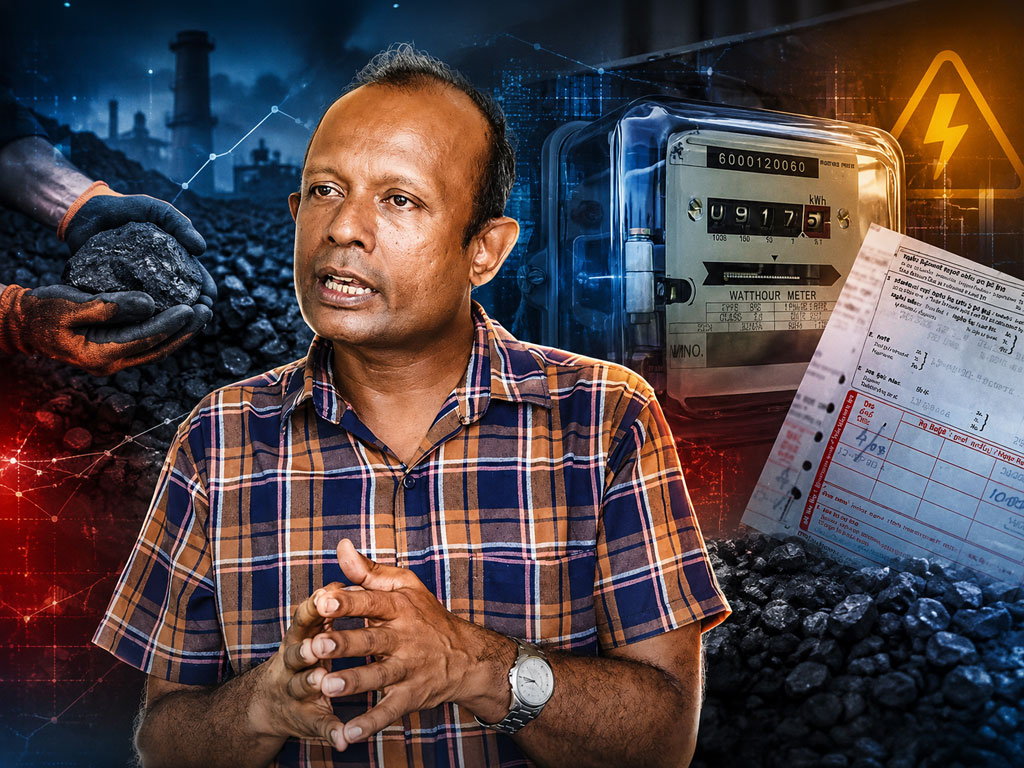
Sri Lanka electricity tariffs face fresh scrutiny as the FSP asks the PUCSL to investigate coal, fuel pricing, solar policy and power costs.
Sri Lanka electricity tariffs could rise again amid mounting pressure in the energy sector, prompting the Frontline Socialist Party to demand an urgent investigation by regulators.
The party handed a letter to the Public Utilities Commission of Sri Lanka on September 2, urging it not to approve another tariff increase without first examining several alleged irregularities.
A delegation including FSP Education Secretary Pubudu Jayagoda formally presented the letter to the PUCSL Chairman.
The party argues that the conditions now being used to justify another electricity tariff increase are not accidental. Instead, it claims they stem from management failures and possible irregularities within the energy sector.

Sri Lanka Electricity Tariffs and the Coal Crisis
The FSP claims coal imported for 2026 has been below the required standard, reducing the expected electricity generation capacity.
It also alleges that problems in the coal tender process have caused stocks to decline faster than expected.
According to the party, Sri Lanka is now facing a shortage equivalent to roughly two coal shipments.
The FSP also raised concerns over government policy towards rooftop solar power.
It claimed that recent steps discouraging rooftop solar installations have weakened the public’s ability to offset electricity shortages through renewable energy.
The party further warned that any deficit in electricity generation could force the system to rely more heavily on fuel-based power.
At the same time, it said the fuel subsidy provided for electricity generation is due to be removed from this month.
The party also noted that the Ceylon Petroleum Corporation has significantly increased the prices of naphtha and furnace oil supplied for electricity generation.
According to the FSP, these developments could ultimately be used to justify a proposal for higher tariffs through the System Control Company before it reaches the PUCSL.
Rising Inflation Adds Pressure on Consumers
The FSP also linked the electricity issue to the wider cost-of-living crisis.
It noted that inflation had remained in the 5% to 7% range since April before rising to 8% in August.
The party argued that household income has not increased at the same pace.
Against that background, it said another increase in Sri Lanka electricity tariffs would place a major additional burden on consumers.
The FSP therefore called on the PUCSL, which has a legal responsibility to protect electricity consumers, to investigate the circumstances before approving any new tariff revision.
Seven Requests Submitted to the PUCSL
The party presented seven specific requests to the Commission.
- Audit fuel-based electricity generation costs
The FSP asked the PUCSL to conduct a full audit of recent figures used to calculate the cost of producing electricity using fuel.
It said some of the statistics presented in relation to fuel-based generation appear questionable and require closer scrutiny.
- Prevent coal-related losses being passed to consumers
The party noted that the Commission had previously decided not to pass losses caused by substandard coal onto consumers.
It therefore asked the regulator to determine whether those costs are indirectly being recovered through higher fuel-based generation expenses.
- Investigate naphtha and furnace oil prices
The FSP called for an examination of the recent increases in prices charged by the Ceylon Petroleum Corporation for naphtha and furnace oil.
It asked the Commission to determine whether those increases are justified.
- Extend the fuel subsidy
The party requested that the PUCSL urge the government to extend the existing fuel subsidy for electricity generation for several more months.
It argued that withdrawing the subsidy now could place further upward pressure on power costs.
- Investigate the coal shortage
The FSP asked the regulator to establish why coal stocks have been depleted so quickly.
It also wants an investigation into how a shortage of around two shiploads of coal developed.
- Probe possible corruption behind solar policy
The party called for an inquiry into whether bribery, corruption or other improper influence played any role in decisions that it says discouraged rooftop solar power.
This remains an allegation raised by the FSP and has not been established as fact.
- Report on the public consultation process
Finally, the party asked the PUCSL to issue a progress report on the public consultation process relating to the cost of generating electricity using fuel.
The FSP maintains that consumers should not be asked to absorb the cost of failures elsewhere in the energy system without a full investigation.
It has therefore urged the Commission to examine the coal supply situation, fuel pricing, solar policy and generation costs before allowing any further increase in Sri Lanka electricity tariffs.
The party’s position is that the government and regulators must first establish whether the financial pressures facing the power sector result from genuine unavoidable costs or from failures that should not be passed on to the public.