
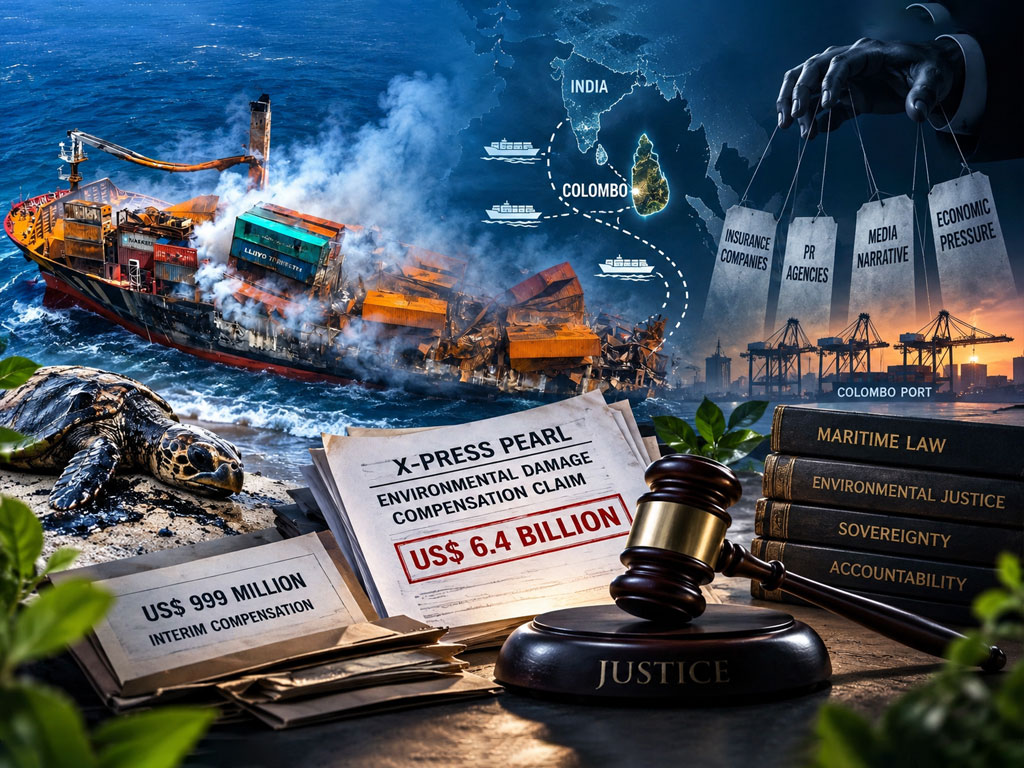
X-Press Pearl compensation comes under renewed scrutiny amid claims that insurers are using economic risk arguments to pressure Sri Lanka.
The X-Press Pearl compensation battle has entered a contentious new phase, amid allegations that international insurers are using economic-risk arguments to influence Sri Lankan public opinion.
A series of articles concerning the X-Press Pearl disaster appeared simultaneously last Friday in the Daily FT and Lankadeepa newspapers.
This commentary argues that the publications should not be viewed merely as ordinary newspaper reporting. Instead, it alleges that they reflect a sophisticated psychological and ideological campaign by international insurance interests.
The argument also claims that industry experts such as Sean Van Dort, and their professional expertise, are being used to provide credibility to this narrative, whether knowingly or unknowingly.
From the perspective of global political economy and capital behaviour, the central concern is what the author views as an attempt to create a theoretical crisis. In simple terms, the argument seeks to convince the victim, Sri Lanka, that demanding justice could itself become the source of its economic destruction.

Economic Risk and the X-Press Pearl Compensation Debate
The central argument attributed to Van Dort is that prolonging the X-Press Pearl compensation case could weaken international shipping companies’ confidence in Colombo Port.
According to that argument, Sri Lanka could consequently risk losing transshipment business to India’s port system, which has a capacity of 25 million TEU.
At first glance, this appears to be a logical warning driven by concern for Sri Lanka’s economy.
However, this commentary interprets the argument differently. It contends that the underlying message resembles pressure from international insurers rather than a straightforward economic assessment.
The total compensation claimed as due to Sri Lanka is approximately US$6.4 billion, according to the article.
It further alleges that international insurance companies seeking to avoid this enormous financial liability are spending millions of dollars through leading public relations and advertising agencies in Sri Lanka.
The alleged objective is to promote a narrative through national newspapers that delays in resolving environmental compensation could damage Sri Lanka’s future economy.
The commentary claims influential professionals such as Van Dort are being used, knowingly or otherwise, to give academic and professional legitimacy to that narrative.
These claims concerning insurers, PR agencies and individuals are allegations advanced by the author and are not presented here as independently established facts.

The Vanished Billion: How Sri Lanka’s Judiciary and State Are Failing the MV X-Press Pearl Victims
MV X-Press Pearl compensation remains stalled as victims await justice amid court delays, a weakened commission and a judicial tenure controversy.
The Morning Telegraph • September 11, 2026 • 7 min readAllegations of Obstruction Surround Compensation Process
The commentary argues that the alleged media campaign does not operate in isolation.
It claims parallel obstruction has taken place within Sri Lanka’s legal and institutional framework. According to the article, the process has faced delays to the point that even interim compensation of US$999 million has not been recovered.
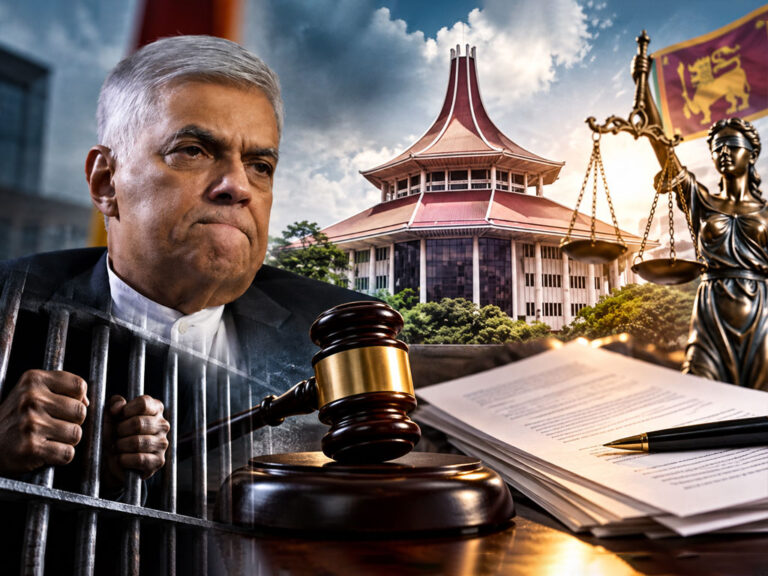
The article also refers to a complaint submitted to the Bribery Commission against three Supreme Court judges.
It argues that this complaint raises questions over whether the delays stem only from administrative sluggishness or whether deliberate obstruction may also be involved. The existence of a complaint itself does not establish wrongdoing by those named or implicated.
The broader allegation is that insurance companies and their local agents create delays and then point to the resulting “uncertainty” as an economic danger.
According to this interpretation, rising insurance premiums then become another pressure point. The ultimate objective, the commentary alleges, is to push the government towards a rapid settlement for substantially less compensation.
Maritime Law, Trade and Sri Lanka’s Sovereignty
The article rejects the argument that pursuing X-Press Pearl compensation makes Sri Lanka an object of ridicule within international commerce.
Instead, it argues that Sri Lanka’s weakness lies in failing to maintain a state apparatus capable of securing compensation for damage through scientific assessment and international law.
Ships do not call at Colombo solely because of Sri Lanka’s geographical location. However, maritime navigation also does not depend solely on insurance premiums arising from one environmental case.
Route efficiency, operating costs and time are also important factors, the commentary argues.
From this perspective, pursuing a legitimate legal claim is not necessarily what creates business risk. The greater danger, it argues, would be a state surrendering its legal sovereignty to pressure or influence from multinational companies.
The article therefore rejects the characterization of the dispute as simply “an environmental crisis becoming an economic crisis.”
Instead, it portrays the real struggle as an alleged attempt by global insurance capital to influence Sri Lanka’s intellectual, media and legal institutions while reducing exposure to a US$6.4 billion compensation claim.
Finally, it challenges the statement that “just as environmental damage has a price, uncertainty also has a price.”
The commentary interprets that language as pressure directed at the Sri Lankan government by international insurance interests.
It argues that policymakers should not respond by accepting what it considers an inadequate settlement. Instead, Sri Lanka should pursue every available avenue under international law to secure compensation supported by proper scientific and legal assessments.
In the author’s view, genuine economic security requires the state to defend its legal rights while resisting any external pressure surrounding the X-Press Pearl compensation process.


Follow ghe Court proceedings of MEC Elena in Kerala . So many people have written various, blaming SLPA, etc. Ship owner brought in an unseaworthy ship to SL.