By Roy Denish.
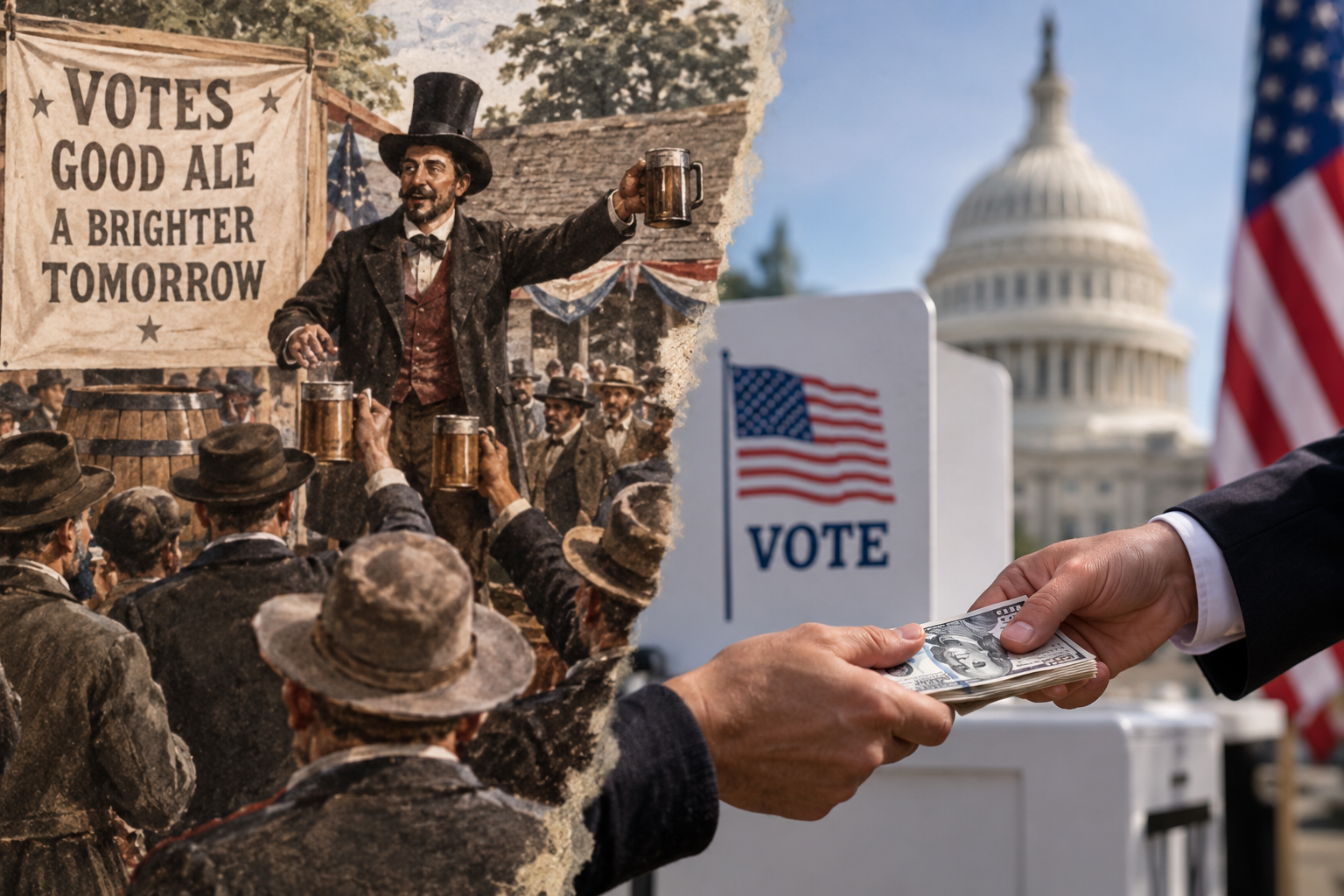
Vote buying in American politics has evolved from cash and liquor at elections to modern disputes over financial promises and public policy.
The intersection of public policy, electoral strategy, and direct financial incentives has long been a feature of American political history. From the institutionalised spoils system of the 19th century to contemporary debates surrounding economic populism, political figures have frequently sought to use state resources, regulatory relief, or financial proposals to attract voter support and influence electoral outcomes.
Recent political manoeuvres — including proposals for direct financial payouts linked to particular electoral outcomes — have reignited academic and public debate over campaign practices, political ethics, and the evolving legal and normative boundaries of modern democracy.

To properly evaluate such strategies, it is necessary to examine the historical precedents of political patronage and consider how contemporary proposals fit within the broader evolution of American governance.
Historically, the American political landscape included forms of voter influence that were considerably more explicit than those typically associated with modern campaigns.
Historical Precedents of Electoral Inducements
During the colonial era and the early decades of the republic, elections often doubled as community gatherings during which candidates supplied food and alcohol, practices sometimes associated with the phrase “booze and the ballot” in an effort to encourage attendance and win political support.
For a significant period in American history, voting also lacked the level of privacy associated with the modern secret ballot. Citizens sometimes declared their preferences aloud or deposited distinctive, colour-coded party tickets in publicly accessible ballot containers.
Such visibility made it possible for those attempting to buy votes to verify whether voters had supported the candidate or party they had been encouraged to back.
In some areas, these transactional practices reportedly became deeply entrenched. Investigations in places such as Adams County, Ohio, during the early 20th century documented widespread allegations of vote buying, illustrating the extent to which financial incentives had, at times, permeated local electoral politics.
The Evolution Towards Policy-Driven Politics
As the United States developed a larger welfare state, centralised taxation systems, and increasingly complex mechanisms of economic redistribution, the nature of political campaigning changed.
Modern politicians rarely distribute cash or commodities directly to individual voters in exchange for electoral support. Instead, campaigns typically propose changes to taxation, public spending, welfare programmes, subsidies, and other forms of economic policy.
Nevertheless, political opponents have frequently accused one another of attempting to “bribe” the electorate through generous financial promises.
Presidential candidates and political parties have, for example, sometimes attributed their rivals’ electoral success to promises of government-backed benefits aimed at particular groups.
Political scientists and legal scholars, however, generally distinguish between broad public policy proposals and direct transactional bribery. Proposing changes to taxation, pensions, healthcare, welfare, or other public programmes as part of an electoral platform is ordinarily regarded as part of democratic political competition rather than an individual exchange of money for votes.
The Grey Areas of Modern Campaign Strategy
Despite established legal frameworks governing campaign finance, bribery, and official corruption, modern political strategies can still raise difficult questions about democratic norms.
Proposals promising financial benefits linked closely to legislative or electoral outcomes may test the boundaries of public perception and political ethics.
Supporters of such initiatives may describe them as legitimate economic measures intended to benefit broad sections of the population. Critics, by contrast, may characterise them as transactional appeals designed to encourage political support by appealing directly to voters’ financial interests.
Drawing a definitive legal line between political rhetoric, broad economic promises, and improper electoral inducements can be difficult, particularly when the proposed benefit applies to a wide section of the population rather than to specifically identified voters.
As a result, the distinction between conventional policy-based campaigning and improper electoral influence continues to generate legal, political, and academic debate.
Credit: The Conversation