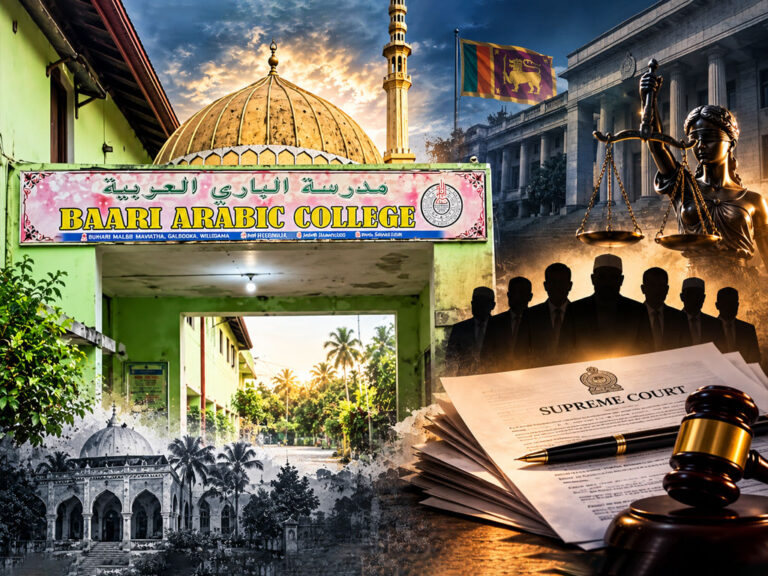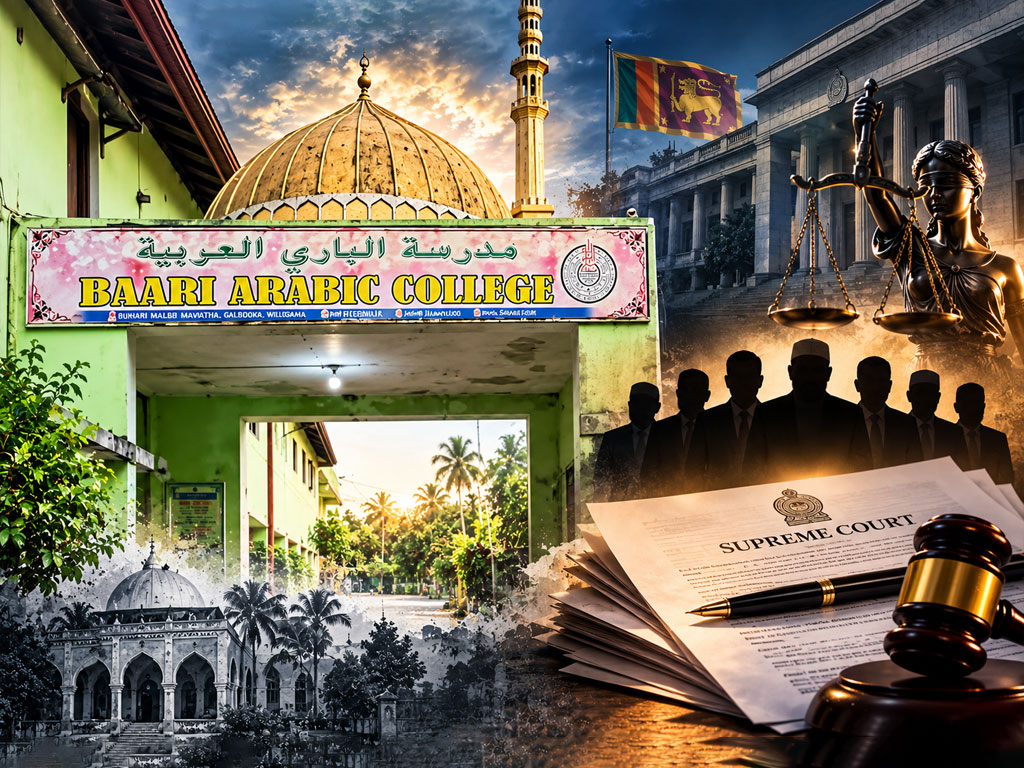
The Weligama mosque trustee dispute involves seven disputed appointments, pending court proceedings and allegations of bribery and political influence.
- Seven special trustee appointments are being challenged amid a longstanding dispute over the administration of Bukhari Mosque and Bari Madrasa.
- The complainants cite earlier Wakf Board and tribunal decisions, pending Supreme Court proceedings and an alleged bribery recording.
WELIGAMA — The reported appointment of seven special trustees to administer the historic Bukhari Mosque and Bari Madrasa in Galbokka, Weligama, has prompted allegations of procedural irregularities, political interference and disregard for earlier judicial and tribunal decisions.
A report published by HariDeshayaLk challenges the actions attributed to the Wakf Board of Sri Lanka and the Department of Muslim Religious and Cultural Affairs, arguing that the appointments interfere with a trusteeship dispute that has been contested for decades.
Those opposing the appointments maintain that the customary authority of the Aroosiyyathul Quadiriyya Thareeqah’s spiritual leadership to nominate trustees has been recognised in previous proceedings.
They also claim that an application for Special Leave to Appeal concerning the dispute remains pending before the Supreme Court.
The existence and current status of that application, including whether any interim order restrains further administrative action, require confirmation from the relevant court records.

Supreme Court Proceedings and the Contempt Allegation
The dispute includes Court of Appeal Case No. CA/WKF/02/2024, arising from litigation concerning the appointment of trustees to the mosque and madrasa.
A judgment delivered on August 7, 2026, dismissed an appeal in that case following a preliminary objection concerning the procedural requirements for appealing interlocutory orders.
The complainants contend that appointing a new administrative body while further proceedings are reportedly being pursued before the Supreme Court could prejudice the parties’ legal positions.
Their central argument is that the Wakf Board should have exercised restraint rather than introducing a new trusteeship arrangement before the judicial process was concluded.
The original report characterises the appointments as contempt of court. That remains a legal allegation, not an established judicial finding.
A pending application for Special Leave to Appeal does not, by itself, establish that every related administrative action is prohibited. Whether the appointments contravene an existing court order or otherwise amount to contempt depends on the applicable law, the orders in force and the circumstances of the decision.
Three Decades of Wakf Board and Tribunal Proceedings
Those challenging the appointments rely on several earlier proceedings which they say established the customary method of selecting trustees.
The report identifies the following decisions:
- WB/2873/97 and WT/125/2000: The complainants say these proceedings recognised the spiritual leader’s customary authority to nominate trustees and that subsequent challenges were dismissed.
- WT/180/2009: Cited as reaffirming the principle of res judicata, under which matters finally determined by a competent tribunal cannot ordinarily be relitigated between the relevant parties.
- WB/9500/2023: The report states that the Wakf Board considered itself functus officio, meaning that it had exhausted its authority to decide the particular matter.
- WT/301/2024: The report attributes the following statement to the Wakf Tribunal: “The litigation between the contesting parties on this issue in these two cases has been concluded in this matter finally and forever.”
These case references and the quoted passage require comparison with certified decisions before their precise legal effect can be established.
The complainants argue that the earlier determinations prevent the Wakf Board from introducing a different trusteeship arrangement without a lawful basis.
However, the scope of any earlier final determination must be considered alongside the Wakf Board’s continuing statutory responsibilities under the Muslim Mosques and Charitable Trusts or Wakfs Act, No. 51 of 1956, as amended.
Sri Lankan case law recognises that the Wakf Board can exercise powers concerning trustee appointments, including special trustees in appropriate circumstances. Whether those powers were lawfully exercised in Weligama remains a separate question.
Alleged Rs. 15 Million Payment Raises Further Questions
The HariDeshayaLk report also refers to a voice recording reportedly circulated by social media activist Mohamed Ismath.
According to the report, the recording contains statements attributed to Mohamed Kowzer Hajjiar Ahmad, identified as the sixth petitioner in Court of Appeal Case No. CA/WKF/02/2024.
The report alleges that the speaker discussed spending approximately Rs. 15 million to obtain internal documents, described as “Volume 1”, and influence the dispute.
One statement attributed to the recording is:
“Lanjam kudukka vendiya edathula lanjam kuduthom.”
The report translates the Tamil statement as: “We gave bribes where bribes had to be given.”
The recording’s authenticity, the speaker’s identity, the circumstances in which the statement was made and the accuracy of the translation have not been independently established.
Nor does the supplied material identify verified recipients of any alleged payments or provide financial records demonstrating that money changed hands.
Consequently, the recording cannot be treated as proof that Ahmad, any public official or any other individual committed bribery.
The allegations nevertheless raise matters that could be examined by the Commission to Investigate Allegations of Bribery or Corruption (CIABOC), subject to the availability of admissible evidence.
Questions Over the Timing of Trustee Appointments
The report states that the previous trustees’ three-year term expired on September 20, 2026.
It alleges that the Wakf Board subsequently moved to appoint seven special trustees without issuing the required notice or providing affected parties an adequate opportunity to be heard.
Specific allegations concerning the administrative process include:
1. Absence of notice or inquiry: The complainants claim that the previous trustees were not given an appropriate opportunity to respond before the new appointments were made.
2. After-hours preparation: Wakf Board Chairman Marshad Barry and Department Director Mohamed Nawas are alleged to have arranged the appointment documents outside normal working hours.
3. Rapid implementation: The report claims that the appointment documents were dispatched to Weligama the following morning.
These accounts have not been independently verified against the Wakf Board’s minutes, appointment instruments, correspondence or other official records.
An expedited administrative decision is not inherently unlawful. The relevant questions are whether the Board possessed the necessary authority, complied with applicable procedures and respected any binding judicial directions.
Allegations of Political Involvement
The report further alleges that Matara District parliamentarian and Deputy Minister Arkam Ilyas influenced the appointments through former Wakf Board member Hammad Rifak.
No documentary evidence establishing such intervention is included in the supplied material.
The allegation therefore requires independent verification and responses from the individuals concerned.
Similarly, the roles attributed to Marshad Barry and Mohamed Nawas in preparing and issuing the appointments must be established through official records rather than inferred from the timing described by the complainants.
Political involvement, if alleged, must also be distinguished from proof of improper influence or an unlawful administrative decision.
Legal Accountability and Outstanding Questions
The dispute now centres on three questions concerning the legality and circumstances of the reported appointments:
1. Statutory authority: Which provisions of the Wakfs Act were relied upon to appoint the seven special trustees, and how do they interact with earlier tribunal decisions concerning the mosque?
2. Judicial proceedings: What is the current status of the reported Supreme Court application, and were any interim orders or other binding directions in force when the appointments were made?
3. Corruption allegations: Has the recording attributed to a litigant been authenticated, and have any complaints or investigations been initiated concerning the alleged Rs. 15 million expenditure?
Answers would require the relevant appointment instruments, certified tribunal and court records, authenticated evidence and responses from the Wakf Board, the Department and the individuals named.
The longstanding trusteeship dispute concerns both the administration of an important religious institution and the application of statutory authority to established religious customs.
Until the relevant records and competing accounts are examined, the legality of the seven reported appointments and the allegations surrounding them remain unresolved.
SOURCE:- HARI DESHAYA