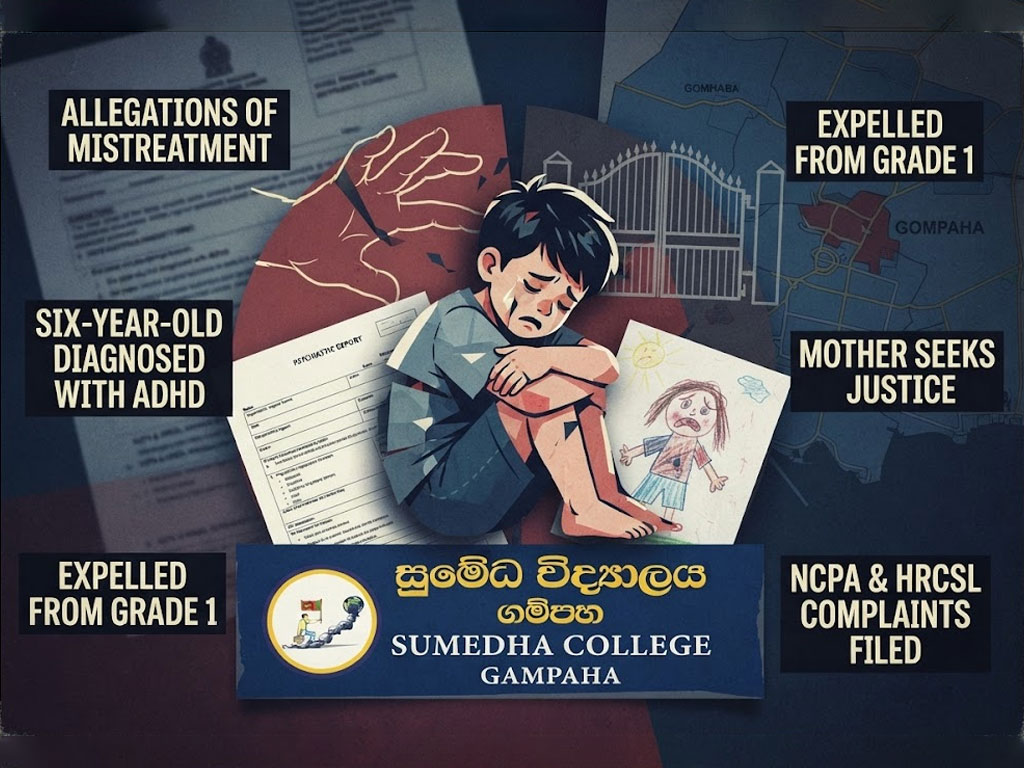
A mother alleges abuse and expulsion of her six-year-old son at Sumedha College in Gampaha and seeks action from child protection authorities.
Mother Alleges Abuse and Expulsion of Six-Year-Old at Sumedha
- Family alleges physical and psychological mistreatment of a Grade 1 pupil diagnosed with ADHD.
- Complaints reportedly submitted to child protection, human rights and education authorities.
GAMPAHA — The mother of a six-year-old boy diagnosed with Attention Deficit Hyperactivity Disorder (ADHD) has accused Sumedha College in Gampaha of removing her son from school after he allegedly suffered physical and psychological mistreatment by his class teacher.
The family claims the child, who requires additional educational support, was subjected to inappropriate disciplinary treatment despite medical recommendations concerning his condition.
According to the mother’s account, the experience caused considerable distress, reflected in psychiatric assessments and drawings she says the child produced following the alleged incidents.
The parents further allege that the school administration removed their son without adequate notice or a fair inquiry into their complaints.
These allegations have not been established by a court or an independent investigation. The teacher and school administration must be afforded an opportunity to respond.

Mother’s Account of Alleged Classroom Mistreatment
The mother has reportedly presented psychiatric reports and drawings made by her son as supporting material in her complaints.
She believes the drawings reflect the fear and emotional distress he experienced at school. Their clinical significance, however, would require assessment by appropriately qualified professionals.
At the centre of the complaint are allegations that the class teacher subjected the child to physical punishment and psychological intimidation despite his need for patience, appropriate classroom support and consideration of his ADHD diagnosis.
The family also questions the school’s decision to remove him rather than investigate the alleged mistreatment and consider arrangements that would allow him to continue his education.
Responsibility for those decisions rests with the relevant school authorities, whose explanation has not been established in the material available.
Questions Directed at Sumedha College’s Administration
The original complaint also raises concerns about the governance of Sumedha College and identifies Dr. Wilfred Wijesinghe as one of three doctors reportedly involved in its administration.
It describes Wijesinghe as a son-in-law of the founder of Nawaloka and questions whether the professional backgrounds of those overseeing the institution have been reflected in its handling of the child’s circumstances.
These reported relationships and administrative responsibilities have not been independently established for this article. Nor is there verified evidence that any individual used professional, business or political influence to obstruct an investigation.
The relevant questions concern how the child’s complaint was handled, whether appropriate procedures were followed before his removal and what safeguards were available to a pupil requiring additional educational support.
Sri Lankan Law and Protection Against Corporal Punishment
The allegations also bring attention to Sri Lanka’s legal and administrative protections against cruelty and inappropriate punishment in educational settings.
Three provisions are particularly relevant:
- Ministry of Education Circular No. 12/2016: Sets out guidance against corporal punishment and promotes disciplinary methods that do not subject children to physical or psychological harm. Its application to the particular institution and circumstances requires examination.
- Section 308A of the Penal Code: Provides for criminal liability where a person responsible for a child wilfully subjects that child to treatment meeting the statutory requirements for cruelty, including conduct likely to cause suffering or injury to health.
- Article 11 of the Constitution: Protects individuals against torture and cruel, inhuman or degrading treatment or punishment. Sri Lanka’s Supreme Court has addressed corporal punishment in schools through fundamental rights proceedings.
These protections establish the legal context for assessing allegations of mistreatment. They do not, by themselves, establish that the teacher or school administration committed an offence in this case.
Complaints to Child Protection and Human Rights Authorities
The mother reportedly lodged complaints with the National Child Protection Authority (NCPA), Human Rights Commission of Sri Lanka (HRCSL), Ministry of Education and Probation Department.
She is seeking an impartial investigation into the alleged mistreatment, the school’s decision to remove her son and the responsibilities of those involved.
Her account also questions whether the relevant authorities have responded adequately to the complaints and supporting material.
The available information does not establish whether the NCPA or other agencies have opened inquiries, summoned individuals or taken steps that have not yet been publicly disclosed. An absence of publicly reported action should not be treated as proof that the complaints have been ignored.
The family is calling for the child’s welfare and educational future to be protected while the allegations are independently examined.
Any investigation would need to assess the medical material, the circumstances surrounding the child’s drawings, the teacher’s account, the school’s disciplinary procedures and the reasons for his removal.
Its findings would determine whether further educational, administrative or legal action is warranted.