
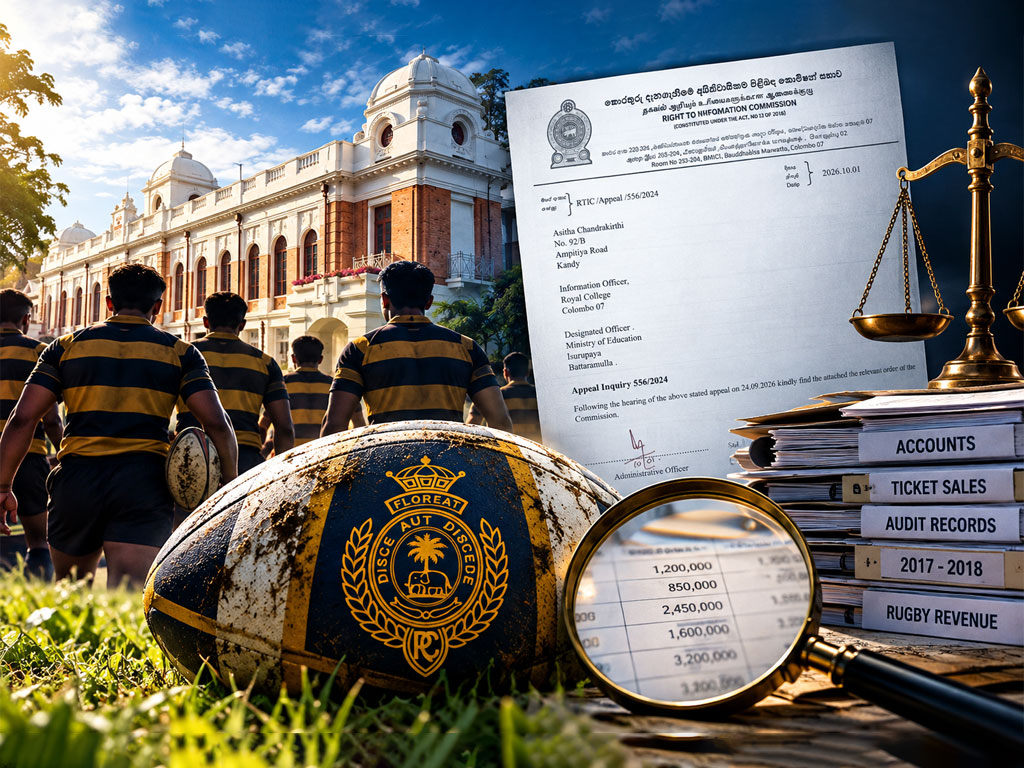
Royal College RTI ruling orders disclosure of financial records linked to disputed rugby ticket proceeds from the 2017 and 2018 seasons.
For seven long years, millions of rupees generated by the blood, sweat, and tackles of schoolboy rugby players remained locked away in a financial shadow zone. Today, in what is being hailed as a historic blow against institutional opacity in Sri Lankan public education, the Right to Information Commission (RTIC) has shattered the silence. In a landmark verdict (Appeal No. RTIC/Appeal/556/2024), the Commission has ordered Royal College, Colombo 07, to immediately hand over hidden accounting records detailing an alleged multi-million rupee fraud involving short-banked match ticket sales. The ruling delivers a stinging rebuke to school authorities who insisted that their elite alumni body operated beyond the reach of state audit laws.

7 Years, 2 Seasons, Rs. 17.6 Million
The controversy traces back to the First XV rugby seasons of 2017 and 2018 at the Royal College Sports Complex. According to official RTI filings and surrounding litigation, ticket sale proceeds exceeding Rs. 10 million (with total unrecovered sums evaluated at roughly Rs. 17.6 million) failed to reach school accounts. Instead of receiving prompt payments at the end of each season, the school allowed an influential sub-committee, the Rugby Match Organizing Committee (RMOC), to hold onto student-earned revenues for over seven years.
When a distinguished alumnus filed a statutory RTI request on February 6, 2024, asking for basic audited statements, interest calculations, and official Ministry correspondence, both Royal College and the Ministry of Education met the request with complete radio silence.
The “Private Shield” Defense Collapses
Faced with an appeal before the RTIC, Royal College deployed a high-powered legal defense, claiming that the Royal College Union (RCU) is an independent, private alumni body outside school governance, making its accounts confidential. School officials went so far as to argue that the Principal’s position as President of the Union was “purely ceremonial”.
The Commission completely dismantled this narrative:
● The Principal is No Bystander: The RTIC pointed out that under the Union’s own constitution and Ministry Circular 54/2023, the Principal presides directly over the Finance Committee, holding active veto and approval power over all financial dealings.
● Public Land, Public Money: The Commission ruled that when an alumni group uses state school facilities to monetize student athletics, it functions as an arm of the public authority. It cannot collect public money and then claim “private immunity”.
● Public Interest Overrides Secrecy: Rebutting arguments that pending court cases against a former official protected the files, the Commission declared under Section 5(4) that exposing potential financial mismanagement of public funds completely overrides generic confidentiality claims.
An Ultimatum With Criminal Consequences
The RTIC has given Royal College a strict 30-day ultimatum to surrender certified copies of all income, expenditure, and audit files free of charge. In an extraordinary warning, the Commission noted that any failure or refusal to comply will trigger immediate criminal prosecution of both the Information Officer and the Public Authority under Section 39 of the RTI Act in the Colombo Magistrate’s Court.
The Domino Effect Across Sri Lankan Schools
This decision sends shockwaves far beyond Reid Avenue. For decades, Big Matches, rugby tournaments, and carnival fundraisers at premier schools across the island have operated through un-audited alumni sub-committees handling hundreds of millions of rupees in cash, ticket sales, and corporate sponsorships. The Ministry of Education itself admitted during proceedings that it “does not routinely audit” past pupils’ association accounts.
The RTIC’s ruling effectively closes this massive regulatory loophole. The message from the Commission is clear: alumni clout ends where public accountability begins. School sports revenues belong to the institution and its students, not to unaccountable committees operating behind closed doors.




At long last, transperancy ordered from Royal college. Better late than never, but we’ll believe it when we SEE IT.
Some “big” people may possibly be feeling a trifle nervous these days.? 🙂