By Roy Denish.
Pakistan salt smuggling via Sri Lanka is under investigation after Indian authorities uncovered 7,311 tonnes of cargo and arrested four suspects.
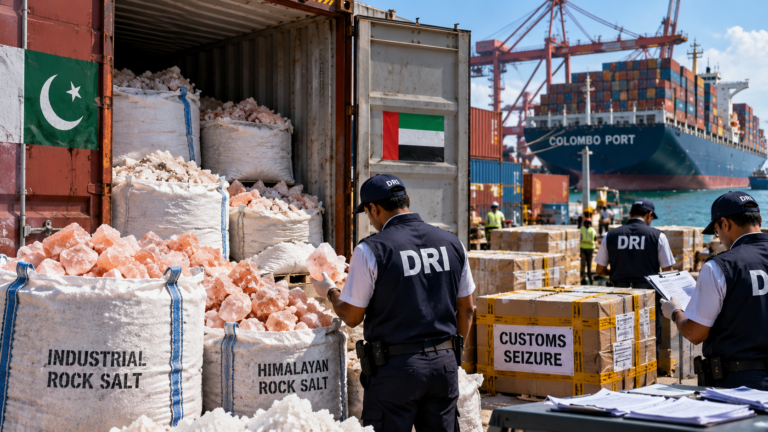
NEW DELHI – India’s Directorate of Revenue Intelligence (DRI) has uncovered an alleged transnational smuggling operation involving 7,311 metric tonnes of Pakistan-origin industrial and Himalayan rock salt routed through Sri Lanka, with four people arrested following a coordinated investigation.
The operation, codenamed Deep Manifest, identified 295 shipping containers with an estimated market value of ₹30 crore, equivalent to approximately 300 million Indian rupees.
According to a statement issued by India’s Ministry of Finance on 14 October 2026, the shipments were routed through Colombo Port and accompanied by allegedly fabricated certificates of origin and invoices issued by entities based in the United Arab Emirates.

Investigators suspect the documentation was intended to conceal the goods’ Pakistani origin and circumvent India’s prohibition on direct and indirect imports from Pakistan.
The investigation has identified commercial entities connected to Pakistan, the UAE, Sri Lanka and India, although the precise involvement and legal responsibility of each participant remain subject to investigation.
Investigation Spanned Eight Indian Locations
Acting on intelligence, DRI officers conducted searches between 26 September and 11 October 2026 at premises in Gandhidham, Adipur, Veraval, Panipat, Pune, Patiala, Delhi and Mumbai.
Investigators established that nine importers had brought in the 295 containers through the Indian ports of Mundra and Kandla since March 2026.
The suspected consignments included industrial salt and Himalayan rock salt, products whose importation was prohibited because of their Pakistani origin rather than because salt itself is generally illegal to trade.
Of the containers identified, five carrying approximately 140 metric tonnes of salt were seized at Kandla Port.
The seized goods were valued at ₹24.41 lakh, or approximately 2.44 million Indian rupees.
Authorities also seized ₹20.96 lakh, approximately 2.10 million Indian rupees, in suspected sales proceeds held in importers’ bank accounts.
These amounts differ from the figures in the original submitted account and have been corrected to match the Indian government’s official statement.
Colombo Shipping Documents Reveal Origin
One of the investigation’s most important findings concerns the apparent inconsistency between documents used during different stages of the shipments.
According to the DRI, bills of lading covering the Pakistan-to-Sri Lanka leg and customs declarations submitted to Sri Lanka Customs identified Pakistan as the country of origin and India as the final destination.
However, certificates of origin presented by importers to Indian authorities were allegedly fabricated to disguise the goods’ true source.
The use of Colombo as a transshipment point raises questions about the role of intermediaries and the extent to which trading firms used legitimate shipping infrastructure to circumvent import restrictions.
The Indian investigation does not, by itself, establish wrongdoing by Sri Lanka Customs, Colombo Port authorities or other legitimate service providers that handled the cargo.
Any such finding would require separate evidence concerning knowledge, intent and participation.
Four Arrested Under Customs Act
The DRI said four people had been arrested under India’s Customs Act, 1962.
Those arrested include two proprietors or partners of importing firms, a customs broker’s G-card holder and the owner of a Dubai-based supplier.
Investigators allege that the Dubai-based businessman had also established and operated an importing firm under his father’s name.
The accused remain entitled to the presumption of innocence, and the arrests do not constitute convictions.
The operation follows an earlier DRI investigation in which more than 362,000 kilograms of Pakistan-origin dry dates, packed in 13 containers, were seized from a Mumbai-based importing firm in September.
India imposed its prohibition on direct and indirect imports and transit of Pakistan-origin goods in May 2025, following the April 2025 Pahalgam terrorist attack.
The latest investigation demonstrates how third-country shipping routes, altered trade documentation and intermediary businesses can be used in attempts to evade import restrictions.
For Sri Lanka, the findings also highlight the importance of maintaining confidence in Colombo’s position as a major regional transshipment hub while investigators determine whether any businesses operating through the island knowingly participated in the alleged scheme.