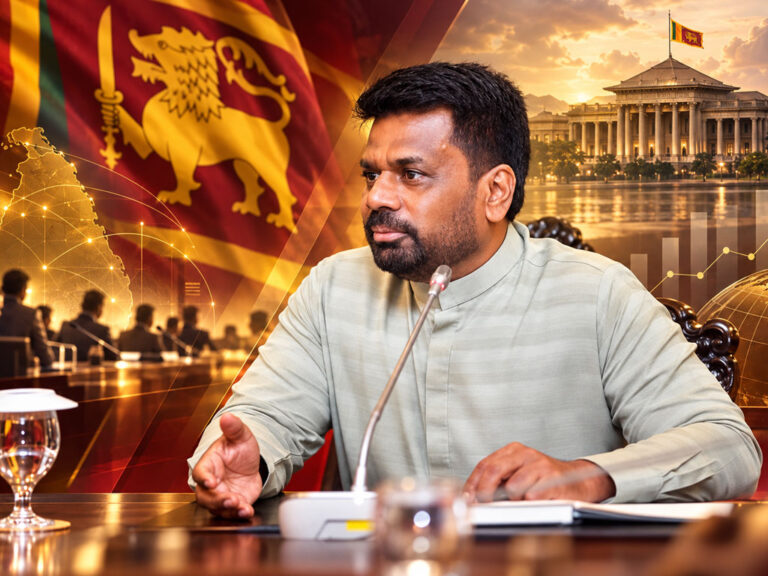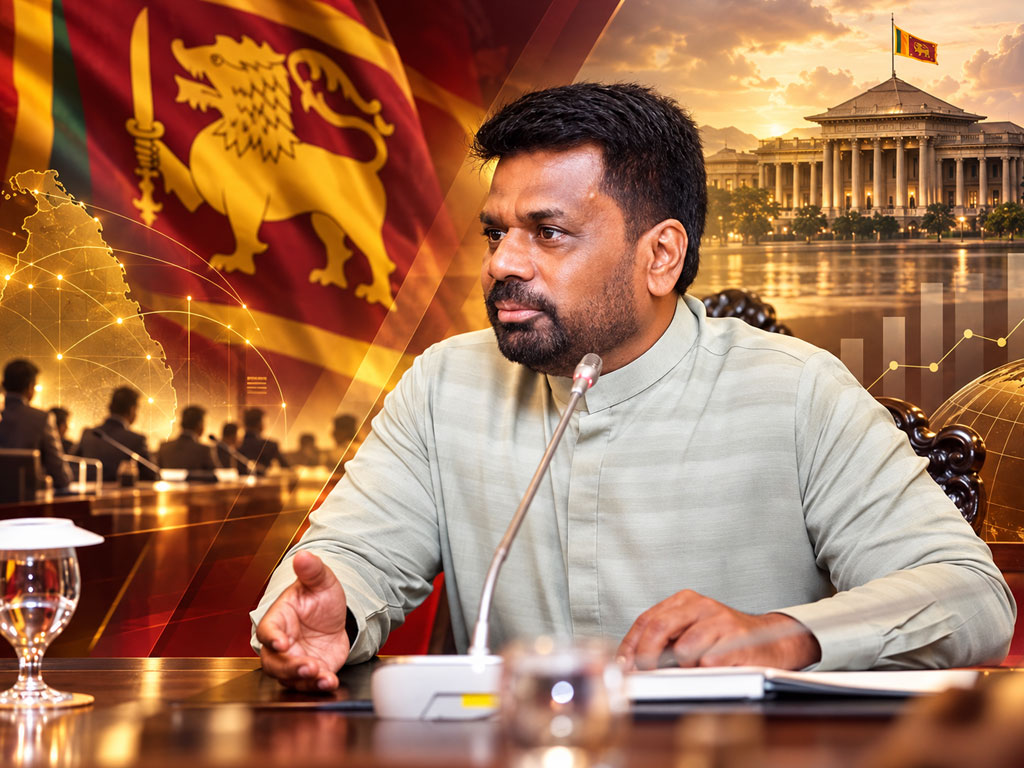
COLOMBO — Anura Kumara Dissanayake outlines the Government’s plans for rural development, public investment, energy, ports, tourism and technology while leaving open the possibility of a new agreement with the International Monetary Fund.
President Anura Kumara Dissanayake recently made an important revelation regarding Sri Lanka’s future economic policy, the upcoming programme with the International Monetary Fund (IMF), and the country’s development direction. He was speaking at an economic summit organised by the Ceylon Chamber of Commerce at the Shangri-La Hotel in Colombo. The summit was held under the theme “Positioning Sri Lanka in a Changing Global Economy: Resilience, Reforms, and the Future of Economic Policy.”
Extensive discussion took place on attracting foreign direct investment (FDI), expanding exports, and exploring opportunities to promote sustainable economic growth. The main objective of the summit was to showcase Sri Lanka’s investment potential to the international community and to strengthen public-private sector cooperation in support of the country’s long-term economic development.
A large number of public and private sector representatives, policymakers, business leaders, and international investors participated in the event. The questions raised by economic sector experts and the President’s detailed answers to them are given below.

Question:
A special programme is being implemented to strengthen the rural economy and eradicate poverty. Also, nearly 5 million people are receiving Aswesuma benefits. How will this group be connected to the economic flow?
Answer:
Our main challenge is eradicating rural poverty. According to a recently presented World Bank report, rural poverty remains at 16.9%. This is not something that can be completed in a year or two, like building a building or a road. It requires a targeted, continuous programme with a plan.
In any country, there is a vulnerable social group that the government must look after. They cannot be excluded. Not everyone will become a participant in the economic flow. That social group must be looked after through some social safety net. The problem we have now is that this social group is very large. The failure to create new economic opportunities for the rural population is a main reason for that.
The rural population has only a very limited number of economic opportunities: agriculture, the fisheries industry, or running a small retail shop. Therefore, the first challenge in eliminating poverty is to create new economic opportunities for them. For a long time, our agriculture existed as a subsistence-level economy rather than a commercial one. Therefore, while ensuring food security, new economic opportunities must be created.
The lack of capital, new technology, and markets was a major obstacle when they themselves tried to create economic opportunities. Therefore, it is our responsibility to fulfil those needs. We have already started an interest-free loan scheme for rural entrepreneurs who lack capital. Through that loan scheme, nearly Rs. 18 billion has already been provided, and new entrepreneurs have been created.
New technology must also be adapted to this. In addition, the wealth generated by the government must be made to flow to the rural people. For that, we follow two strategies. Mainly, a rural development pathway is necessary. For that, Rs. 35 billion has been allocated in this year’s budget for the development of small tanks and canals.
Nearly Rs. 100 billion has been directed to the rural people, including Rs. 25 billion for the Janashakthi rural programme and Rs. 24 billion for rural roads through the Road Development Authority. Our economic strategy is to engage in a development process while keeping villagers in their own villages.
Accordingly, through the 2027 budget, greater attention has been focused on creating a rapid communication system and a developed road network between the village and the city. Solutions to rural poverty must be sought through such programmes. This is not something that will be answered tomorrow simply by seeking solutions today. It is a long-term programme with a continuous plan. We have already started it.
Question:
How do we reduce the time taken for project approvals for investments?
Answer:
Through the upcoming budget, we have planned a capital expenditure of Rs. 2 trillion. This is a very large increase compared to the past. Of the capital expenditure allocated by the government in 2023, 64% was spent, and 54% in 2024. But in 2025, when elections and natural disasters took place, we were able to increase it to 76%.
There was a mentality in our country that the state machinery is constantly involved in corruption. Laws that were brought in step by step in the past, on the grounds that they would prevent it, have now created a situation in which nothing can be done quickly. The old system was designed only for purchasing goods. But today we do not buy only goods. We buy solutions through software systems. However, such a system is not within our procurement process.
Therefore, we expect to identify those special fields and introduce a new procurement procedure. Also, under the previous system, procurement work begins after the budget is passed and allocations are made. Often, by the time these procurement activities are completed, the months of August and September have arrived. But now we have solved that.
Tenders can be called and suppliers selected as soon as the Secretary to the Treasury certifies that funds have been allocated. An example is the Kurunegala-Galewela expressway. Accordingly, we expect to award the relevant tender by around January.
We must also move to an electronic procurement process. In addition, we are taking steps to retain persons with specialised skills within the public service under a special salary scale. It is through that that capital expenditure can be brought up to a value close to 100%.
Question:
Recently there was discussion about customs laws, labour laws, public-private partnership laws, and state enterprise management laws, was there not?
Answer:
The law relating to State-Owned Enterprises (SOEs) will be submitted to the Cabinet in about two weeks. Thereafter, it can be gazetted quickly. The public-private partnership law has now been prepared by the Legal Draftsman’s Department and referred to the Attorney General. Its future work can proceed on the Attorney General’s recommendations.
Our labour laws are divided into about 12 statutes of various forms. A bill has already been prepared for that. Although it will take some time, it will be reviewed again very soon. Also, regarding the Customs Ordinance, we have been able to reach agreement after a long time on the views presented by the Chamber of Commerce and the Customs Department.
The most appropriate proposal is to amend the Customs Ordinance. I think the proposals for that have now been sent to the Legal Draftsman’s Department. They will prepare and present it quickly. Most likely, all these bills can be passed in Parliament in January and February.
Question:
Regarding the tourism industry, we are talking about implementing promotional programmes in regional countries. Are you saying our procurement process affects that? Can funds not be allocated for that?
Answer:
Yes. How do we buy a promotional plan? According to our procurement method, a table can be bought. But what is a promotional advertising programme? It is an idea. How do we buy an idea? Accordingly, our procurement method must change.
Someone can say that this was done in the past. How was it done? By selecting one institution as good, the other institution was not selected. Who measures this? From where? Efforts have now been under way for about a year and a half for these promotional activities. The Tourism Authority says that tenders will be called in January.
In addition, the Authority has started a small-scale promotional project in five countries. In addition to that, there is also a proposal presented by business organisations engaged in the tourism sector. We are also looking into that. If they bring a certain percentage more tourists than the number they bring this time, funds will be allocated to the Sri Lanka Tourism Authority in the upcoming budget to make a payment for the tourists brought beyond that target.
Question:
The government has focused special attention on renewable energy. It also appears that steps are being taken to increase battery storage capacity. We believe that the private sector as well as rooftop solar systems should be connected to this. Can amendments to the payment mechanism be expected in the future? Also, what is the thinking on developing the transmission network?
Answer:
The Sri Lankan government expects to establish a high-power transmission system from Kilinochchi to Habarana with the support of the Asian Development Bank. In addition, several other transmission systems, such as Puttalam-Wariyapola and Habarana-Veyangoda, have been identified. We have planned to construct them through the private sector.
All the transmission systems in Sri Lanka so far were constructed by the Ceylon Electricity Board. We expect to invite private investment for those transmission systems. Four grid lines have already been selected for that. We will tender them very soon. Then the private sector can connect to the transmission system.
When we focus on the energy sector, we pay attention to the stability and continuity of energy as well as the cost incurred for it. Our energy policy is built on these two factors. The stable feed-in tariff system is not a tender method. There, we buy electricity at a value introduced by the Public Utilities Commission.
But that method is wrong when considering the second strategy of reducing the cost of purchasing energy. By going through an open competitive tender procedure rather than buying at a fixed value, we can obtain it more profitably. For example, when we took over the government, there was a wind power project in Mannar. We had agreed to take one unit at US cents 8.22.
We informed them that we were prepared to pay less than 5 cents if they discussed with the company. But they did not come to that amount, so the agreement fell through. Then we called two tenders of 50 megawatts each. The first 50 megawatts we received at US cents 3.96. The 50 megawatts in the second tender we received at US cents 3.74. It is this competitiveness that brings us greater profit.
There was an opinion that our government is against renewable energy. When we took over the government, the total solar capacity was 1,400 megawatts. But within these two years, 1,500 new megawatts have been generated. We have entered into agreements for another 1,100 megawatts. Accordingly, under our government, 2,600 new megawatts will be generated from solar power.
The other side of renewable energy is that it consumes a large amount of space. There is a question as to whether a small country like ours should devote that much land. That is why, following the idea of floating solar panel systems in reservoirs, a 5-megawatt project was started in the Ibbankatuwa tank. Of the 1,000-acre reservoir, we used only about 10 acres. That is 1%. There, our land is not submerged.
Now we have started the Randenigala project. We expect to move towards floating solar panel systems in several selected reservoirs such as Moragahakanda, Samanalawewa, and Chandrikawewa. In solar power, since the generation capacity increases during the daytime, we must store it for nighttime use. For that, we have now called a tender of 160 megawatts.
We also tendered 250 megawatts of batteries. It is now being evaluated. According to information received so far, I am happy to state that through this 250-megawatt tender, a decrease of about 10% in prices can be seen relative to the first 160 megawatts. Next, we expect to tender another 150 megawatts to existing solar energy owners.
At present, 69% of the total generation capacity is renewable capacity. For the past four days, we have not used a single litre of diesel for electricity generation. Therefore, this journey towards the renewable energy sector is very successful. Our expectation is to supply energy at a fair price as well as a continuous energy supply.
Question:
In a country like Singapore, port revenue contributes about 7%-8% to the Gross Domestic Product. But why is it still at a level of 2%-3% in Sri Lanka?
Answer:
An important milestone in our economic strategy is the port. Currently, the East Terminal owned by the Ports Authority handles only about 0.5 million containers. But the East Terminal has the capacity to handle 3.2 million containers. Day by day, we are not getting maximum use of this resource.
I do not believe that the task of handling the East Terminal can be done by the government alone. Therefore, the Cabinet has decided to form a company for management while retaining ownership of the terminal with the government, and to offer its shares to private investors. Several globally powerful shipping companies are in discussion for the management of the East Terminal.
Next is the second phase of the West Terminal. Its breakwater must be constructed. It now costs $1.4 billion. If the breakwater of the West Terminal is built at that cost, 3.2 million containers can be operated there as well. Provisions will be allocated in the upcoming budget for the preliminary studies.
The Asian Development Bank is already preparing the feasibility study report. It is planned to provide an interim report by this December and the full report by next April. Accordingly, we expect to develop the terminal system.
Next, is the port only about exchanging containers? The port can be developed as a logistics centre. Tenders for that have raised major problems for a long time. Now all those problems have ended and agreement has been reached with the companies to complete it by paying the relevant compensation.
Construction work is under way on a 150-acre yard in Kerawalapitiya to minimise container congestion within the port. There is also a problem regarding the tax charged when supplying oil to ships (bunkering). We are also considering that, and we expect to provide relief in the upcoming budget.
Question:
Although about 17,000 people join annually from state and private universities in new industries such as big data and AI, the lack of sufficient jobs is a major problem. How do we take the technology sector forward?
Answer:
The real problem is at what level this skilled workforce we create is. They are at the middle level. It is there that the job crisis has arisen. If we move to a higher level than that, job opportunities will expand further. Job opportunities are expanding greatly from the public sector as well. When it comes to the business sector, domestic industries also have a need for skilled people.
We have focused attention on establishing an Artificial Intelligence (AI) centre in the Wijerama area. We expect to establish it together with Singapore. I believe the relevant Cabinet paper can be approved next week. It is our belief that solutions to the current crises should be sought by raising this skill further.
Also, our special attention is focused on creating international opportunities by further expanding online working patterns through institutions such as BPOs. Answers can be obtained through that. Even degree courses must go to a higher level than this. Although the information technology sector has developed greatly, we have failed to create graduates with the skills we need. Therefore, our information technology sector must be taken up another two or three levels.
Question:
Mr. President, along with the Middle East crisis, a subsidy is currently being provided for diesel. If this war drags on for two years or so, will this subsidy continue to be provided? Or do we move towards a targeted economic stimulus?
Answer:
After the Middle East war began, our main challenge was to maintain a continuous supply of energy, including fuel, electricity, and gas. While social unrest was being created in many countries of the world, we successfully ensured that continuity. No indicator can predict how long this war will drag on.
It is because the economy and social life of our country, which is rising again after a massive economic crisis and business collapse, cannot bear another massive shock that we provided a structural relief package. As a result, we were able to achieve an economic growth rate of 5.2% in the first quarter.
In the first five months, we spent Rs. 60 billion to provide a subsidy of Rs. 100 per litre of diesel and Rs. 20 per litre of petrol. As the situation escalated again, a subsidy of Rs. 70 per litre of diesel will be provided until October, November, and December, and Rs. 41 billion will be spent for that.
This subsidy should go to targeted people such as farmers using tractors or bread distributors. But due to weaknesses in a direct data system, we had to provide an overall subsidy. In the future, we will take steps to prepare a methodology to provide the subsidy only to the targeted people after discussions with telephone companies.
Although we invited competitiveness, private companies are not acting to provide fuel at the price offered by the Ceylon Petroleum Corporation. When the Corporation is making a profit of Rs. 28 billion and is preparing to provide a portion of that profit to the people as relief, private companies are keeping the oil in storage and limiting distribution. It is not fair to load a price difference of Rs. 132 per litre of diesel onto the people.
Question:
The government has reached the final six months of the International Monetary Fund (IMF) programme. After debt restructuring, entering this programme has provided many benefits. But what is the government’s thinking regarding entering a new IMF programme in the future?
Answer:
Although we have risen in the rankings, foreign reserves still need to be developed to the expected level. If these factors can be completed, we can move forward. However, in the face of the uncertainty existing in the world, the fuel import cost has risen considerably. Last year, the fuel import cost was $4,042 million. But in the first eight months of this year alone, it has risen to $4,082 million.
According to this trend, about $6 billion will be spent on fuel by the end of the year, and that is a massive challenge the economy will have to bear. The main objective of the four-year Extended Fund Facility (EFF) programme with the International Monetary Fund (IMF) was to achieve economic stability. That stability has now been successfully achieved.
The next step is to move towards economic growth while protecting that stability. If a new agreement can be entered into for that growth, we are ready for it. Because there was no major contradiction between the government’s economic vision and the IMF agreements, we were able to successfully complete the four years of the programme without conflict.
A group of economic sector experts, including those from the Ministry of Finance and the Central Bank Governor, are already discussing how the future programme should be structured. A suitable decision is to be reached within the remaining six months, taking external economic shocks into consideration as well.
Question:
Here there are a large number of foreign investors, local and foreign ambassadors, our business community, Chamber of Commerce members, and state officials. What is your final message to us?
Answer:
Building the necessary transparency in the country is our first step. Secondly, the introduction of the necessary rules and regulations for investment and business security has reached a considerable final stage. We are also developing the infrastructure necessary for investment. The tasks entrusted to the government are creating transparency, imposing rules and regulations, and developing infrastructure. Therefore, we do our part; you do your part.
There was some doubt and questioning in the recent past regarding the removal of the Simplified Value Added Tax (S-VAT). However, a leakage of Rs. 10 billion per month was occurring through S-VAT, and it has been possible to successfully control it.
Our aim is to create a strong domestic business group and a group of entrepreneurs capable of successfully connecting with foreign investments and large international companies in Sri Lanka. Our budget has also focused on that. Especially if you go to rural areas, we are prepared to provide a concessionary methodology for land and certain services.
Also, new economic opportunities are being created as infrastructure develops in many fields, including ports, the renewable energy sector, Port City, and the tourism industry. Invest without any fear. We provide the necessary security and confidence for that. That is my final request to you.
The President’s remarks gave investors a clearer picture of the government’s readiness to connect the country’s economy with modern global trends such as digitalisation, artificial intelligence, port development, and renewable energy. However, as a society, it is essential to engage in a deeper critique of the current economic trajectory.
In particular, although the government is hopeful of moving towards economic growth by successfully concluding the upcoming discussions with the International Monetary Fund, this is a sensitive moment to critically consider whether it should in fact continue further with the IMF programme. This is because, under the strict conditions of that programme, the entire population is already suffering immensely from an enormous tax burden and cost of living.
Therefore, going beyond mere statistics on economic stability, the massive challenge before the government is to establish a domestic economic system truly suited to the country by transforming our traditional consumption patterns and subsistence traditions for the better. The current government, which came to power with a massive mandate, must now take the necessary bold steps to create a new economic pathway that lightens the tax burden on the oppressed people and matches the country’s real capabilities, rather than being confined solely to traditional global financial agendas.