By Roshan Jayasinghe
A reflection on the body we can study, the life we can witness, and the mystery that still moves through both.
The more I look at my life, and at the lives around me, the more I feel that we know a great deal, and yet still stand before something not fully within our grasp.
We know the body in many ways. We know it through biology, medicine, and simple observation. We know that it is made of organs, nerves, blood, bone, breath, chemistry, and electrical signaling. We know that heredity shapes physical form. We know why children resemble parents, why siblings share features, and why identical twins can look remarkably alike. On that level, there is clearly an order. The body follows patterns. Nature carries continuity.

But when I look more carefully, I notice that even where the body seems to repeat itself, inward life does not.
Two people may look alike and still not think alike. They may not feel the world in the same way. They may not carry the same emotional tone, the same sensitivity, or the same response to what they experience. Even identical twins, however similar in appearance, do not seem to live inwardly as exact copies of one another. Something already begins to differ. Something personal. Something interior. Something that physical resemblance alone does not fully explain.
I have seen many instances of this in life, twins, siblings, and others raised under near-identical conditions, often within the same home, with the same parents and much the same outward environment. And yet, even there, they do not meet life in the same way. One may move with openness, another with caution. One may trust easily, another remain guarded. One may seem at ease in the world, while another moves through it more vigilantly. It has often made me feel that there are limits to what external conditions alone can explain.
Then life begins shaping us in its own way. The home we grow up in, the love we receive or do not receive, the safety or fear around us, the peace or instability, the nourishment or lack of it, the culture, the traumas, the repeated daily experiences, all of it leaves a mark. All of it plays a part in how we think, how we feel, how our nervous system settles or struggles, and how we come to meet the world. None of us grows untouched by what surrounds us.
And what affects the mind does not stay there quietly. It moves into the body too. We know this already from life itself. Stress can disturb sleep. Fear can change breathing. Grief can take the strength out of a person. Long periods of instability can wear the body down in many ways. And the opposite is true as well. Safety, steadiness, affection, and inner ease can help the body settle, regulate, and function better.
But the body does not only receive. In its own quiet way, it also tells us things. Sometimes pain comes and there is no clear outward reason for it, and it feels as though the body is carrying something the mind has not fully faced. Sometimes deep tiredness feels like more than tiredness, as though something in us has gone too long without being seen. And then there are those other moments, a good sleep, real rest, the presence of someone we trust, when the body begins to soften on its own. That softening says something too. The body carries burden, memory, and relief in ways we are still learning to understand.
So we are not shaped by heredity alone. We are shaped by the meeting of body, environment, thought, and feeling, all moving together. And the body is not just sitting there taking it all in. It is part of the conversation the whole time.
All this, to me, already says something important.
A person is not just a body, even though the body matters. A person is not just their genetics, even though heredity matters. A person is not just their environment, even though life leaves deep marks on all of us. A human being feels more like a meeting place of many influences, many conditions, many experiences, and even with all that, each one still comes into the world carrying something distinctly their own.
I notice this in life, in myself and in others, all the time.
Some people carry calm into a room. Some carry unrest. Some seem softened by what they have lived through. Others seem tightened by it. Two people may pass through similar events and yet be shaped inwardly in very different ways. One becomes gentler. Another more guarded. One grows in understanding. Another becomes more burdened. One finds a deeper balance. Another continues in struggle. These are not small differences. They tell us that each life carries a singular inward quality.
Science can take us a long way here, and that matters. It helps us understand how deeply the body and mind are connected. It helps us understand heredity, trauma, physiology, and what lived experience does to a person. But even with all that, there still comes a point where explanation does not feel like the whole of it.
We know a great deal about the body itself, yet far less about the full nature of the life that finds expression through it.
To me, that is not a rejection of knowledge. It is simply an acknowledgment of its boundary.
And even where knowledge grows, mastery does not fully follow. Life still moves through variables, conditions, and turns that remain beyond complete control.
We can say many true things about the body. We can describe how it functions, how it develops, how heredity works through it, how the nervous system responds, and how emotional life and outer conditions affect physical health. We can even say, in medical terms, when the body has come to its end. But when we ask what this life fully is that moves through us, or what becomes of it when the body can no longer hold it, we are no longer speaking from the same kind of certainty.
And I think that edge is important.
Because it invites us to inquire, not just conclude.
It asks us to look at ourselves more carefully, and to look at one another more carefully too. To notice what in us is inherited, what in us has been shaped by life, what in us has been conditioned by experience, and what in us still stands before mystery. Not just to collect information, but to wake up a little more through what we are seeing.
Most of us, if we look honestly enough, have already witnessed some part of this in ourselves.
That is really where I am writing from.
Not from final answers, but from attention.
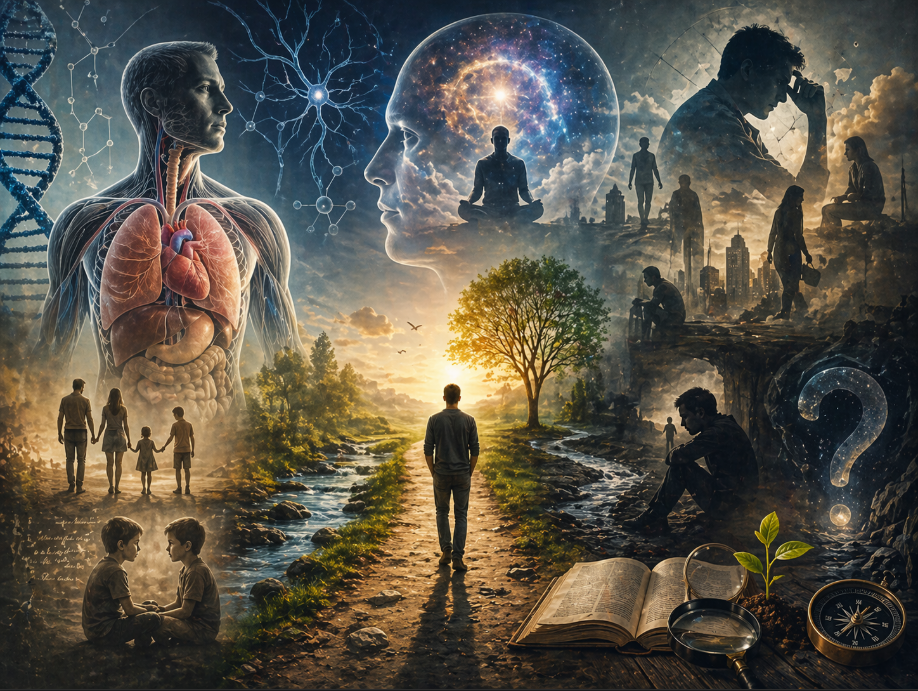
I am looking at the body and recognizing its intelligence. I am looking at heredity and seeing its order. I am looking at environment and seeing its shaping power. I am looking at the way inner life affects bodily life, and the way bodily life, in turn, shapes what we feel and know. And I am also looking at the strange uniqueness of each person and feeling that something about us remains larger than our explanations.
In the deeper sense, life feels less like something fixed and more like a river in motion. A river is shaped by everything it moves through, the land, the weather, the depth, the obstacles, the season. It keeps going, yet no two moments in its movement are ever exactly the same. I feel human life is much like that. We are shaped by heredity, environment, memory, experience, thought, and feeling, yet still part of a larger movement whose full beginning and ending we do not completely know.
That does not weaken knowledge. It gives it the right posture.
So I leave this here not as a conclusion, but as an invitation.
To notice more carefully. To look at ourselves and others with greater honesty. To see how much of us is shaped, how much of us is inherited, how much of us is influenced, and how much of us still stands before the unknown. And from there, not to force an answer too quickly, but to allow each of us the dignity of seeing what is true for ourselves through careful observation.
There is joy in knowing. There is also joy in discovering how much more there is to understand.
And this may be one of the better ways to live as human beings: not only collecting facts, but becoming more conscious through what we observe, what we question, and what we are humble enough not to pretend we already know.
This body we can study.
This life we can witness.
And this mystery, we may continue to explore with sincerity and some joy.
Author’s Note
I write these reflections not as final answers, but as part of a sincere and constructive inquiry into human life. My hope is that through honest observation, thoughtful reading, and shared reflection, we may continue to deepen our understanding together. I would be genuinely happy to hear from readers who feel moved to participate in this self-inquiry, and I warmly welcome such reflections through the comments field, should one wish to join.
About the Author
Roshan Jayasinghe is a writer and observer of human systems. His work explores the gap between man made constructs and lived humanity, with a focus on how economics, trade and everyday choices intersect with questions of fairness, responsibility and inner alignment. Through essays for publications in The Morning Telegraph, he aims to remind readers that they are not passengers in a fixed machine, but active custodians of a shared world.