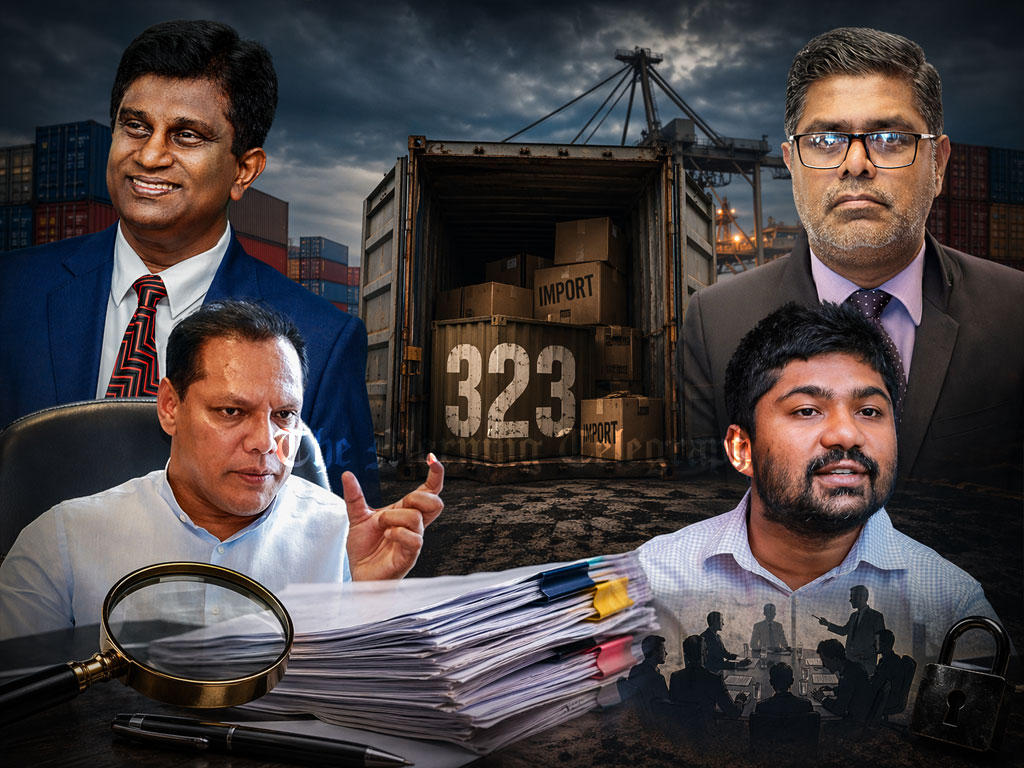
A high-stakes parliamentary investigation into the mysterious release of 323 containers spirals into controversy as the government uses its majority to reject key witness testimony, raising serious concerns over transparency and accountability.
The proceedings of the Special Parliamentary Select Committee appointed to investigate the controversial case of 323 containers that allegedly left the Colombo Port without physical inspection have taken a dramatic and contentious turn, with tensions rising sharply between government and opposition members.
A proposal put forward by opposition representatives within the committee to summon four key witnesses connected to the incident was rejected today following a majority vote by government MPs, intensifying concerns about the direction and credibility of the inquiry.

Opposition members Ajith P. Perera, Dayasiri Jayasekara, Mujibur Rahuman and D. V. Chanaka formally requested that the committee call several high-profile individuals believed to be directly linked to the matter under investigation. The list of proposed witnesses included key political and administrative figures connected to finance and port operations during the relevant period.
The individuals named in the request included Anura Kumara Dissanayake in his capacity as Minister of Finance, Planning and Economic Development, Bimal Ratnayake as the Minister responsible for Ports at the time, Janitha Ruwan Kodithuwakku as the Deputy Minister overseeing Ports during the same timeframe, and the Secretary to the Ministry of Finance, Planning and Economic Development, who was expected to present official reports relating to the Customs Department.
Despite the significance of these figures to the case, the proposal was voted down, highlighting the imbalance within the committee structure. The Select Committee consists of eight members representing the government and only four representing the opposition, effectively giving the ruling side decisive control over key decisions.
Opposition MPs have strongly criticized this move, alleging that the government has used its numerical advantage to block efforts aimed at uncovering the full truth behind what is being described as a large-scale irregularity involving port operations and customs procedures.
They argue that without hearing directly from the ministers and senior officials responsible at the time, it would be impossible to produce a credible and comprehensive report on the incident. The refusal to call witnesses, they claim, undermines the integrity of the entire investigative process.
Questions are now being raised about how a meaningful inquiry can proceed in the absence of testimony from those who held authority over the relevant sectors during the period in question. The opposition insists that accountability cannot be achieved without direct examination of those in positions of responsibility.
The Special Parliamentary Select Committee is currently operating under the chairmanship of Hon. Harshana Nanayakkara. However, the decision to reject the motion to summon witnesses has sparked intense debate about the transparency, independence, and future direction of the committee’s proceedings.
As the investigation continues, the controversy surrounding the 323 containers has evolved into a broader political and governance issue, placing scrutiny not only on the incident itself but also on the mechanisms of parliamentary oversight and accountability in Sri Lanka.