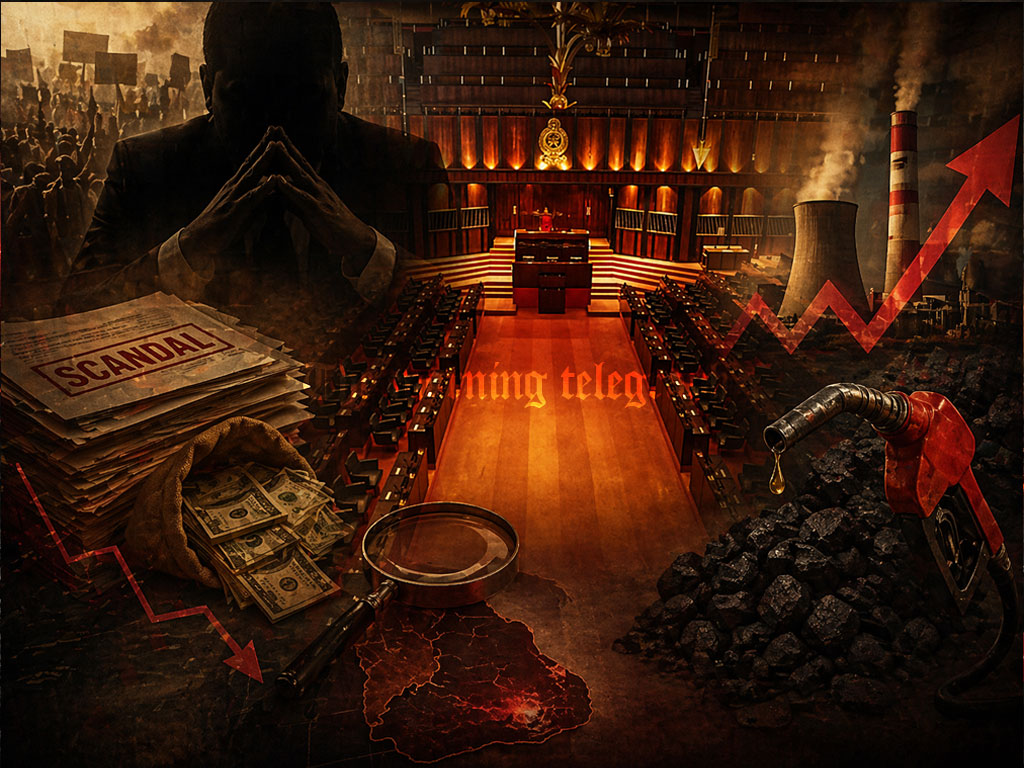
A united political front accuses the government of systemic failure, financial scandals, and collapsing public trust, calling for immediate resignation and a fresh mandate from the people.
The United Opposition has intensified pressure on the current administration, urging the entire Cabinet to accept responsibility for a series of major financial scandals and governance failures, step down collectively, and call for an immediate general election. According to opposition leaders, only a fresh mandate from the people can restore credibility, accountability, and stability to Sri Lanka’s political and economic landscape.

This strong demand was made during a joint media briefing held in Colombo, where representatives from the Sri Lanka Freedom Party, the United National Party, Sarvajana Balaya, and several other political groups came together to present a unified stance. The coalition highlighted recent controversies, including the alleged $2.5 million Treasury hacking incident, the coal procurement scandal, and fuel related irregularities, describing them as evidence of deep rooted governance failures.
Former Minister G. L. Peiris, addressing the media, pointed out that the scale and complexity of the coal procurement fraud indicate that such actions could not have been carried out by a single individual. He stressed that decisions of this magnitude require collective Cabinet involvement and oversight, thereby placing responsibility on the entire government. According to him, these incidents reflect not only administrative lapses but also a broader pattern of incompetence that has eroded confidence in leadership.
Peiris further emphasized that the alleged breach involving the banking system and public funds has dealt a severe blow to Sri Lanka’s fragile economy. The loss of trust in financial institutions, he warned, could have long term consequences, particularly in a country striving to rebuild investor confidence and stabilize its economic outlook. He described the situation as a critical moment that demands accountability at the highest level.
Adding to the criticism, former Minister Patali Champika Ranawaka raised concerns about the possibility of organized financial misconduct linked to influential entities. He suggested that multiple actors may be involved in money laundering activities and called for a comprehensive investigation led by the Central Bank to uncover the full extent of the issue. He noted that the integrity of Sri Lanka’s financial system and its international credit standing are at risk if such allegations are not addressed transparently.
Ranawaka also warned of an impending energy crisis that could further complicate the country’s recovery efforts. He explained that the importation of substandard coal has already disrupted electricity generation, forcing thermal power plants to operate at higher capacity. This, in turn, increases fuel consumption and places additional strain on national resources. If corrective action is not taken promptly, he cautioned, Sri Lanka could face severe fuel shortages and power disruptions in the near future.
The opposition’s call for a general election reflects a growing belief that the current administration has lost its ability to govern effectively. By linking financial scandals, energy sector challenges, and declining public trust, opposition leaders are attempting to build a case for political change. They argue that only a new government, chosen through a transparent electoral process, can address the mounting challenges and restore confidence in state institutions.
As the political climate grows increasingly tense, the government now faces a critical test of leadership and accountability. Whether it chooses to respond to these demands or continue defending its position will likely shape the country’s immediate future. For many observers, the unfolding situation represents more than a political dispute, it is a defining moment for governance, transparency, and public trust in Sri Lanka.