
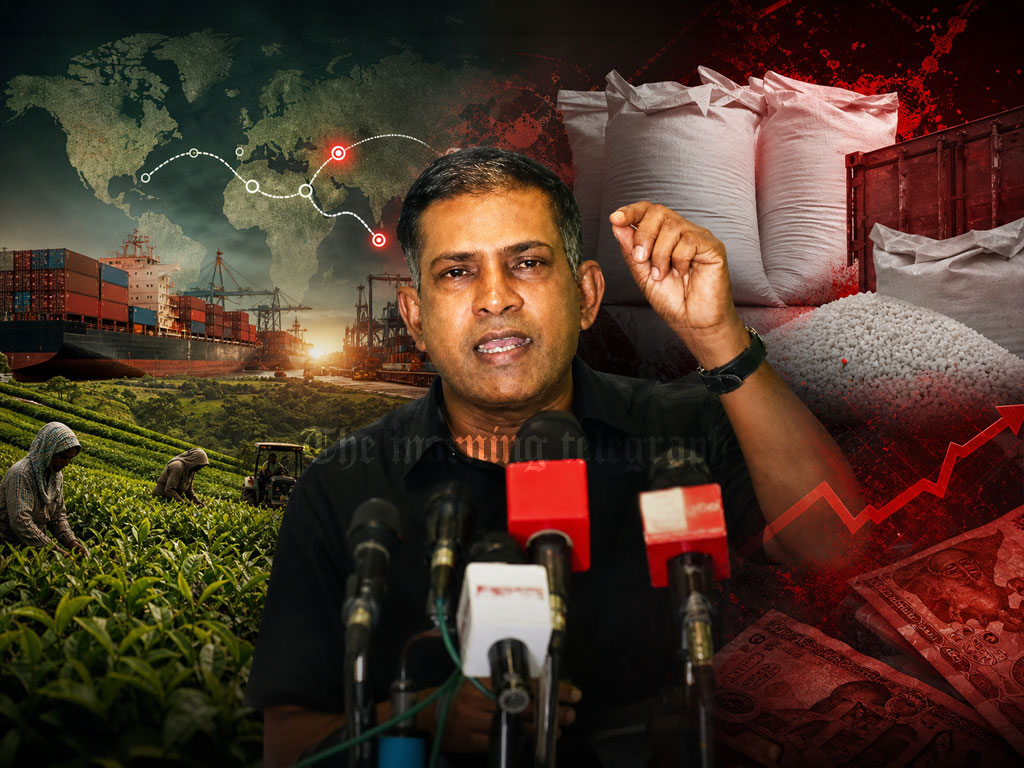
Rs. 80 billion fertilizer scam allegations emerge as farmers claim cheaper Kazakhstan urea is ignored for costly Oman-linked imports.
Rs. 80 billion fertilizer scam allegations have been raised by the National Farmers’ Union, accusing the government of wasting massive public funds through costly fertilizer purchases.
The Union claims that fertilizer available at much lower prices in the world market is being ignored, while the government continues to buy at higher prices by citing the war situation in the Middle East.
Speaking at a media briefing, National Farmers’ Union Chairman Anuradha Tennakoon alleged that although fertilizer prices in countries such as Russia and Kazakhstan remain at very low levels, the government is deliberately arranging purchases from the Middle East region at significantly higher prices.

According to data presented by Tennakoon, a metric ton of fertilizer in Kazakhstan costs between $220 and $320. He said a Kazakh company has offered to supply fertilizer at $290 per metric ton, including delivery and unloading at the Colombo port.
However, he alleged that the government purchases the same metric ton from Middle Eastern countries, especially Oman, at a price between $700 and $800.
This means the government spends an excess of more than $500 per metric ton, he claimed.
Tennakoon said this practice is causing serious waste of the country’s money at a time when farmers are already under pressure from high production costs.
He stated that when Sri Lanka imports the required 100,000 metric tons of urea for a cultivation season, the country suffers a loss of $50 million, or around Rs. 16 billion, based on the excess cost of $500 per ton.
If the same method continues when importing the annual urea requirement of 500,000 metric tons, the total loss to the country would be $500 million, or Rs. 80 billion, according to the National Farmers’ Union.
Tennakoon further stated that if fertilizer is imported from Kazakhstan at $290, a sack, or hundredweight, of urea fertilizer could be provided to farmers for less than Rs. 7,000.
However, he said importing fertilizer at $800 deprives farmers of that concession and pushes up agricultural production costs.
This raises concerns about whether Sri Lankan farmers are being forced to pay more because cheaper international options are not being considered.
Tennakoon also raised another serious suspicion. He questioned whether fertilizer that can be obtained from Kazakhstan for a couple of hundred dollars is being brought to Oman, repacked there, and then supplied to Sri Lanka at a much higher price.
He said that although the government is aware of such international mafias, it is problematic that no action is being taken against them.
It was also revealed that proposals and documents from relevant companies regarding low-cost fertilizer imports from Kazakhstan have already been submitted to responsible institutions, including the Presidential Secretariat.
However, Tennakoon alleged that the authorities have shown no sensitivity toward the matter.
The National Farmers’ Union questioned whether there is financial fraud behind the failure of officials and political authorities to move away from traditional procurement methods and examine new alternatives.
The Union further emphasized that the country’s agriculture sector and farmers have been pushed into a severe crisis due to this situation.
What happens next could be critical, as the Union is calling for an immediate scientific and transparent investigation to uncover the truth and provide relief to farmers.





If you have the information,
Pls lodge a complain at Bribery Commission.
Because media can not do anything. They will report and forget.
You are in right position to hold the culprits responsible to bring to justice.