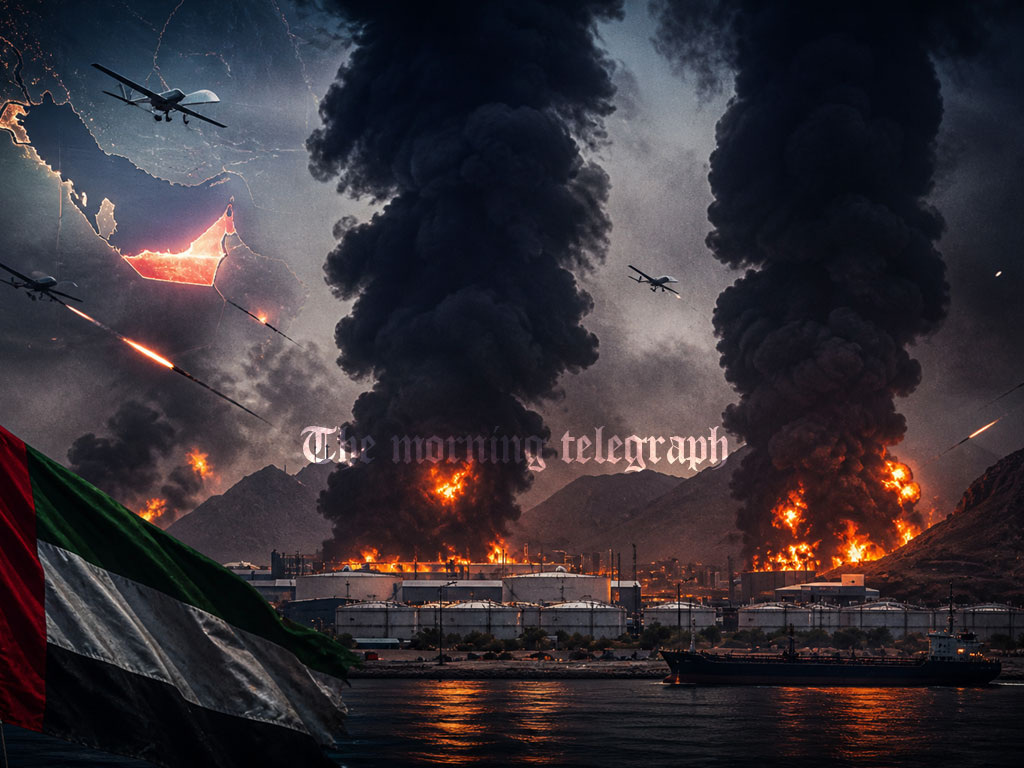
Iran missile attack on UAE targets Fujairah oil complex, with drones, ships, air defences and Gulf security fears escalating.
Iran missile attack claims have pushed the Middle East crisis into a more dangerous phase, with reports saying the United Arab Emirates has come under a major wave of missiles and drones.
A short while ago, Iran reportedly launched a large-scale missile and drone attack targeting the UAE, plunging the Gulf region into another period of severe tension.

The development has caused deep concern among Sri Lankans as well, since many Sri Lankan workers, families, and friends are based in the UAE, including in major cities such as Dubai and Abu Dhabi.
According to the reported details, Iran’s attack involved a large number of ballistic missiles and drones.
The UAE Ministry of Defence has stated that its air defence systems were activated and that the majority of the incoming attacks were destroyed in the air.
However, despite the interception efforts, several drone strikes reportedly hit the Fujairah oil storage complex, one of the world’s most important oil storage facilities.
Following the strike, a massive fire is reported to have broken out in the area.
Analysts say the attack is not an ordinary military exchange, but a serious blow aimed directly at global energy supply routes and oil storage infrastructure.
Oil loading operations in the area have reportedly been temporarily suspended due to the incident.
This raises concerns about the wider impact on oil markets, shipping routes, and energy security, especially at a time when the Gulf region is already under intense geopolitical pressure.
The crisis has deepened further after reports that two ships belonging to South Korea and the United Arab Emirates were also affected by the attacks.
Following the severe attacks on the UAE, South Korea has urgently moved to send a shipment of advanced Cheongung II air defence missile systems to the UAE using C-17 transport aircraft.
The UAE is now being drawn directly into the wider conflict involving America, Israel, and Iran.
These attacks have also raised serious questions about the security of some of the world’s busiest and most internationally connected cities, including Dubai and Abu Dhabi.
However, questions remain over how far this conflict could spread and whether the latest escalation will trigger a wider regional or global confrontation.
What happens next could be critical, especially for foreign workers, including Sri Lankans in the UAE, as security risks, air defence alerts, shipping disruptions, and energy market shocks continue to grow.