Sri Maha Bodhi tile work in Anuradhapura sparks outrage as critics warn a 2,200-year-old living heritage may be placed in danger.
Sri Maha Bodhi tile work in Anuradhapura has triggered deep concern, anger, and disbelief as Sri Lanka watches two disturbing controversies unfold on sacred ground.
One controversy involves a monk accused of a grave crime.
The other involves the possible destruction of a living heritage that has survived for more than 2,200 years.
Both matters are serious.
But only one could leave behind damage that no court, no apology, and no political statement can ever repair.
While the public is consumed by allegations surrounding Atamasthanadhipathi Pallegama Hemarathana Thero, a quieter but potentially historic tragedy is unfolding around the Sri Maha Bodhi.

This is not merely about tiles.
This is about whether Sri Lanka still understands the meaning of sacred responsibility.
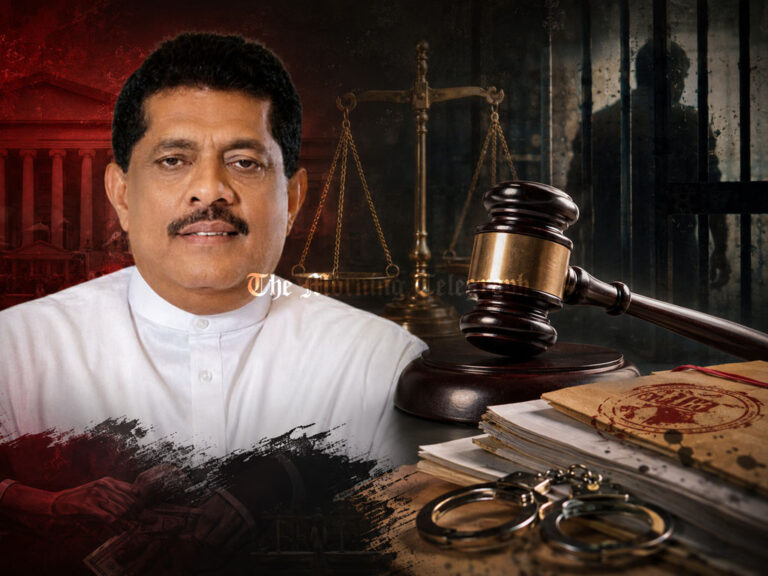
On one side are the legal proceedings involving Pallegama Hemarathana Thero.
He stands accused of a heinous crime against a minor.
If he is guilty, the law must act firmly, fearlessly, and without mercy.
There can be no softness, no religious cover, and no institutional excuse for crimes against children.
But while that case must be handled by the courts, the nation must not allow outrage over one individual to blind it to another danger happening in plain sight.
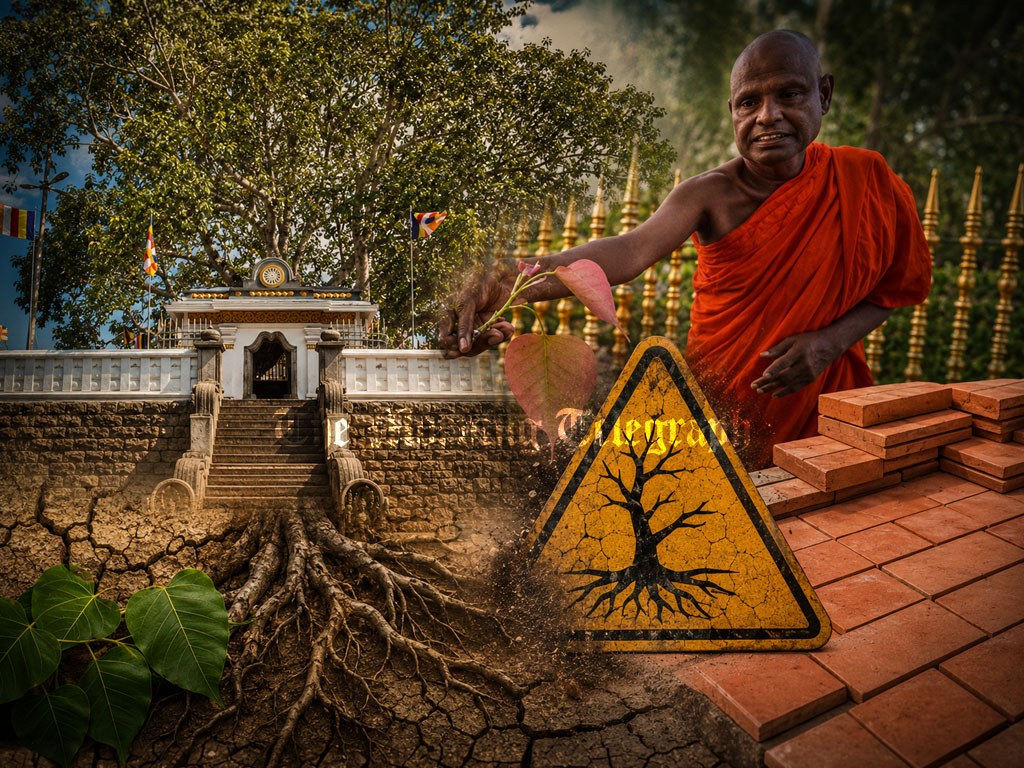
The terracotta tiling of the sacred sandy courtyard around the Sri Maha Bodhi is being presented as repair work, beautification, or modernization.
But that language is dangerously comforting.
A sacred site does not need cosmetic arrogance.
A 2,200-year-old living tree does not need modern decoration.
It needs protection, humility, science, and reverence.
One Case Can End. The Other May Haunt Us Forever.
Sri Lanka must pause and ask the painful question that many are avoiding.
Which event carries the greater danger to history?
A criminal allegation against an individual, however shocking, can be investigated and judged by a court of law.
Justice may take time, but it can still be delivered.
But if the natural environment of the Sri Maha Bodhi is damaged, that loss may be permanent.
No judgment can revive a dead root system.
No committee can restore a destroyed ecosystem.
No official statement can bring back a sacred atmosphere once it is buried beneath tiles.
The Sri Maha Bodhi is not an ordinary tree.
It is not a decorative landmark.
It is not a tourist backdrop.
It is considered the oldest living tree in the world with a recorded history.
For more than 2,200 years, it has stood through kingdoms, invasions, wars, droughts, storms, religious tensions, and political upheavals.
Generations bowed before it.
Kings protected it.
Pilgrims wept beneath it.
And now, in the name of improvement, Sri Lanka risks suffocating it.
The Silent Science of Destruction
Senior Professor Rangika Halwatura of the University of Moratuwa has issued a warning that should have shaken every responsible authority into action.
But instead of urgent national debate, the warning appears to be competing with sensational headlines and social media outrage.
His message is clear.
Covering natural sandy ground with terracotta tiles is not harmless beautification.
It may suffocate a living being.
The life of an ancient tree depends on systems most people never see.
Its roots, soil moisture, oxygen flow, water absorption, underground organisms, and natural temperature balance all work together to keep it alive.
Terracotta and concrete surfaces can disturb that balance.
They can reduce rainwater absorption.
They can trap heat.
They can compact the soil.
They can prevent roots from receiving oxygen.
And the roots of the Sri Maha Bodhi may stretch far beyond the visible trunk.
A sacred tree does not survive only above ground.
Its life depends on what happens below.
That is why careless surface work near such a tree is not simple construction.
It is a biological risk.
It is an ecological risk.
It is a heritage risk.
In Professor Halwatura’s own chilling words: “Inevitably, the tree must go to its next version. That means the tree must die.”
Those words should not be treated as another passing opinion.
They should be treated as a national alarm.
The tree must die.
If that warning is even partly true, then every responsible official should be asking why this work was allowed to proceed without the most careful scientific review.
Are neat tiles worth more than the world’s oldest recorded living tree?
Has Sri Lanka become so obsessed with concrete beauty that it can no longer recognize sacred simplicity?
The Poison of Distraction
The danger is not only physical.
It is also political, social, and spiritual.
While the country argues over the scandal involving the Atamasthanadhipathi Thero, the Sri Maha Bodhi’s natural environment is being transformed with far less public scrutiny.
Yes, justice must be demanded for the victim.
Yes, if the monk is proven guilty, he must face the full force of the law.
But another ugly pattern must also be confronted.
Some groups appear to be using one individual’s alleged crime to attack the entire saffron robe, the entire Sasana, and the Buddhist institution itself.
That is not justice.
That is exploitation.
Buddhism does not defend wrongdoing.
The Dhamma does not protect criminals.
If a monk commits a crime, it is that individual’s failure.
It is not the failure of the Sasana.
It is not the failure of the Sangha as a whole.
It is not the failure of a 2,600-year-old spiritual tradition.
To weaponize one allegation to insult an entire religious civilization is not courage.
It is intellectual dishonesty dressed as outrage.
But while these battles rage, the Sri Maha Bodhi may be facing the deeper threat.
The symbol of Buddhism’s living presence in Sri Lanka may be placed at risk not by foreign invasion, not by war, but by domestic negligence.
A World Heritage Treated Like a Construction Site
The most disturbing issue is the reported absence of proper approval.
The Department of Archaeology has confirmed that no formal permission was obtained for the terracotta tiling.
Only a wheelchair path had been approved.
Yet the entire courtyard has reportedly been paved without a proper environmental assessment.
If true, this is not a minor administrative mistake.
It is a disgraceful failure of heritage responsibility.
The Peradeniya Botanical Gardens, which holds custodianship of the sacred tree, has been asked for recommendations.
But why now?
Why after the work began?
Why were the scientists, botanists, archaeologists, and heritage experts not placed at the centre of the decision before a single tile touched the ground?
This is not how a sacred world heritage site should be handled.
This is not how a living civilizational memory should be protected.
This is not how a country honours its ancestors.
What Will Remain If We Fail?
The Sri Maha Bodhi is not only a Buddhist heritage.
It is Sri Lanka’s heritage.
It is world heritage.
It is a living bridge between the present and the age of King Devanampiyatissa and Sanghamitta Theri.
It connects this island to more than two thousand years of faith, identity, resilience, and civilizational continuity.
We are not owners of the Sri Maha Bodhi.
We are temporary guardians.
And temporary guardians have no moral right to make permanent mistakes.
If we destroy the natural environment around this sacred tree in the name of development, what will remain?
A paved courtyard.
A polished surface.
A heritage brand.
A dead tree.
And a nation that failed its own sacred memory.
The Question Sri Lanka Cannot Avoid
Sri Lanka must wake up before it is too late.
The country must not allow scandal, politics, or social media noise to distract it from a slower and more irreversible danger.
One man’s guilt or innocence will be decided by court.
That process can take months or years.
But the life of a 2,200-year-old living heritage may be at risk now.
Are we repairing a sacred site?
Or are we slowly destroying it?
Are we improving a courtyard?
Or are we suffocating a civilizational memory?
Are we protecting the Sri Maha Bodhi?
Or betraying it?
The answer should shame us.
And it should shake every authority into immediate action.