SOE profits dropped to Rs. 444 billion in 2025, while returns on Rs. 16.5 trillion in assets remained weak at just 2.7%.
SOE profits in Sri Lanka declined sharply in 2025, with the latest Treasury annual report revealing weaker performance across major State-Owned Enterprises despite ongoing restructuring efforts and governance reforms.
The report shows that the overall profitability of State-Owned Enterprises (SOEs), including major state corporations and statutory boards, continued to deteriorate during 2025. This comes despite government efforts to restructure these institutions and appoint suitable and accountable officials to oversee their management.
Several key institutions remained loss-making, while the total profit generated by the sector fell significantly compared to the previous year. As a result, the financial burden carried by the Treasury and ultimately the taxpaying public has increased by billions of rupees.

According to the Treasury report, the total profit generated by 51 major non-financial government-owned business entities amounted to Rs. 539 billion in 2024. By 2025, that figure had dropped by more than 17 percent to Rs. 444 billion.
The latest figure is even lower than the Rs. 445 billion profit recorded in 2023, when Sri Lanka was still struggling through the aftermath of the economic crisis. The report also notes that while approximately 527 state institutions operate across the country, formal performance data is published only for 51 of the largest entities.
Although many state enterprises appear profitable on paper, a closer examination of profitability relative to their asset base suggests a different picture. The report indicates that these institutions continue to operate at a highly inefficient level when measured against the assets under their control.
By 2025, the combined asset value of state enterprises had reached Rs. 16.5 trillion, or Rs. 16,500 billion. This represents approximately 50 percent of Sri Lanka’s Gross Domestic Product (GDP).
Yet from this enormous asset base, only Rs. 444 billion in profit was generated, producing a return on assets of just 2.7 percent.
The Treasury report further reveals that of the Rs. 444 billion total profit earned by state enterprises, Rs. 304 billion, representing more than 68 percent, came from the banking and financial sector. This category includes the Central Bank of Sri Lanka, People’s Bank, the National Savings Bank, and the Employees’ Provident Fund.
The Central Bank alone recorded a profit of Rs. 120 billion, accounting for around 27 percent of total SOE profits. This highlights the extent to which state sector earnings are concentrated within institutions that benefit from public deposits, regulatory authority, and state-backed advantages rather than open market competition.
Among other profitable state entities, institutions such as the Sri Lanka Ports Authority, the National Water Supply and Drainage Board, and the National Lotteries Board appear to derive much of their profitability from monopoly positions or special legal protections granted by the state.
The largest loss recorded during 2025 came from the Ceylon Electricity Board (CEB). After posting a profit of Rs. 141.6 billion in 2024, the utility recorded a substantial loss of Rs. 38.7 billion in 2025.
The report attributes this reversal to electricity tariff revisions, rising operational expenses, and structural cost issues. Data shows that the selling price of electricity per unit declined from Rs. 36.01 to Rs. 26.24, while the cost per unit stood at Rs. 30.23. The resulting financial gap ultimately becomes a burden carried by taxpayers.
Treasury data also indicates that state enterprises have struggled in sectors where they must compete directly with private businesses. Institutions including the State Engineering Corporation, the Central Engineering Consultancy Bureau, and the State Development and Construction Corporation collectively reported losses totaling Rs. 759 million.
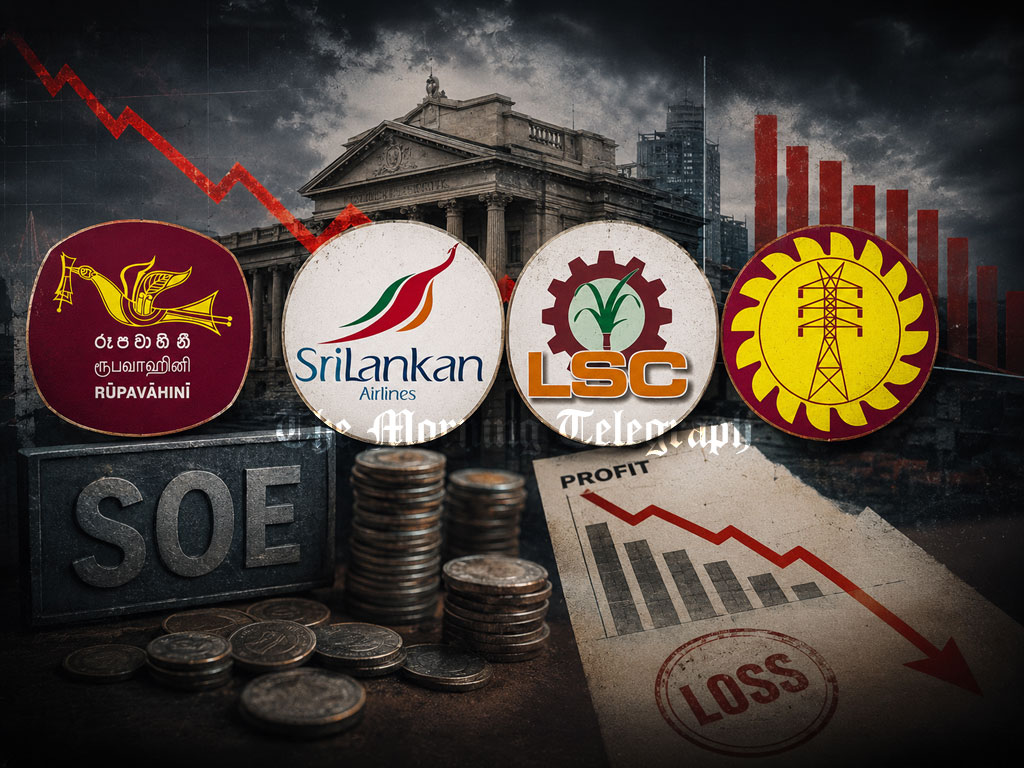
Meanwhile, SriLankan Airlines, Lanka Sugar Company, the State Plantation Corporations, and the Sri Lanka Rupavahini Corporation continued to remain in loss-making territory.
Of the Rs. 444 billion profit generated by state enterprises, only Rs. 56.5 billion was transferred to the Treasury through taxes and dividends. Although this amount exceeded the previous year’s contribution, the government was required to provide Rs. 103 billion in budgetary support to sustain those same institutions.
In effect, state enterprises received nearly twice as much financial assistance from the government as they returned through taxes and dividends.
The total losses incurred by state enterprises amounted to Rs. 69.8 billion, while direct budget support reached Rs. 103 billion. After accounting for the Rs. 56.5 billion received by the government, the net burden placed on taxpayers is estimated at approximately Rs. 117 billion.
The report also points to cases where institutions appear profitable only after receiving substantial taxpayer-funded assistance. SriLankan Airlines, for example, received Rs. 25.3 billion in capital support from the Treasury yet still recorded a loss of Rs. 23.2 billion. The National Water Supply and Drainage Board received Rs. 45.6 billion in capital assistance and reported a profit of Rs. 31.6 billion.
The Treasury further notes that several major institutions, including Lanka Sathosa, the National Water Supply and Drainage Board, Lanka Sugar Company, Milco, and the Development Lotteries Board, have yet to submit audited annual reports for 2024. According to the report, this highlights continuing concerns over governance, accountability, and transparency within Sri Lanka’s state-owned sector.