By Roy Denish
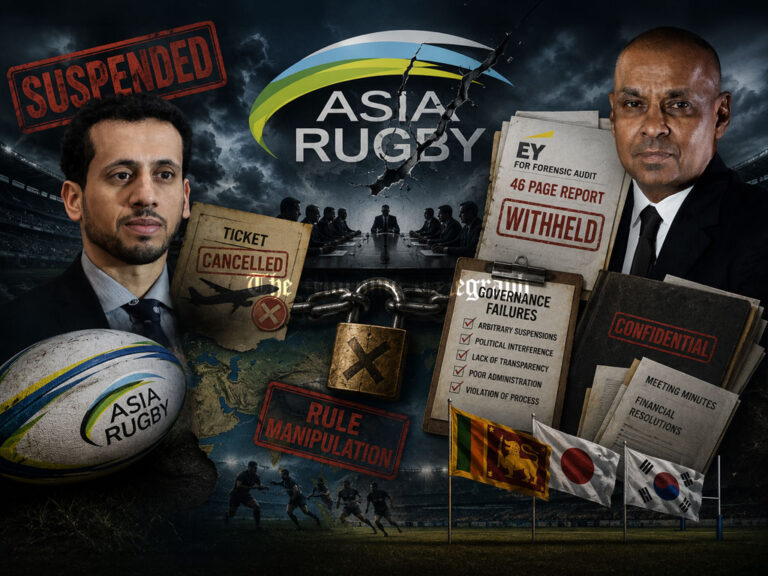
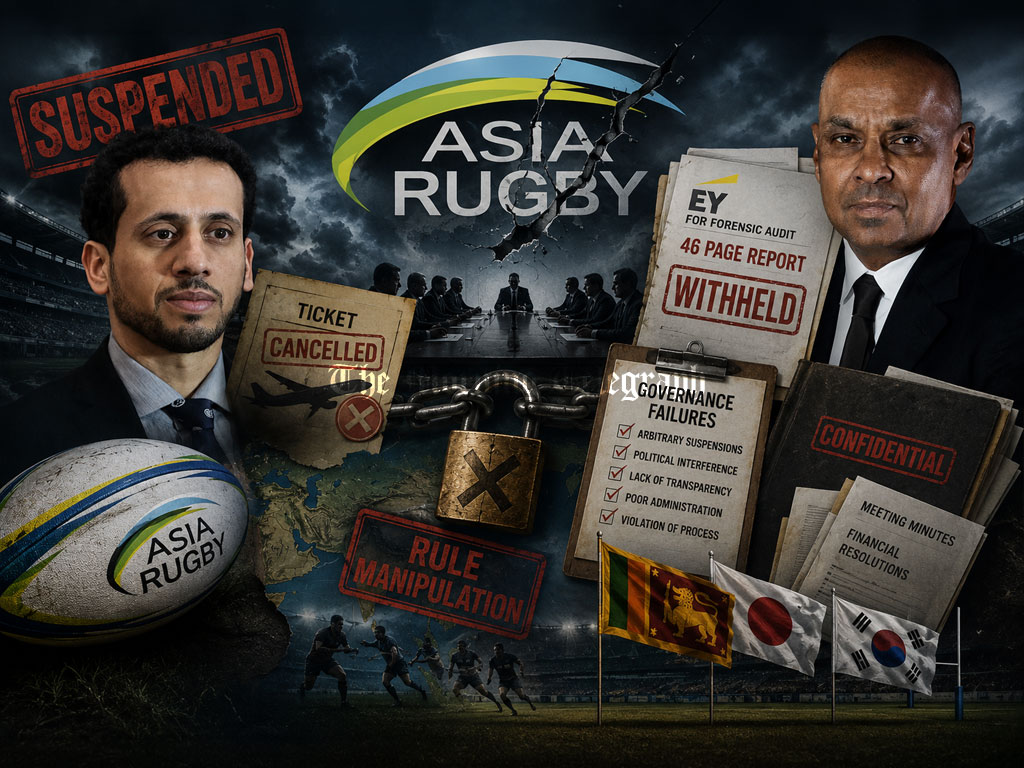
Asia Rugby is under growing pressure as allegations of governance failures, financial secrecy, arbitrary decision-making, and operational incompetence continue to mount. From the Sri Lanka visa fiasco to the overturned suspension of a senior Japanese rugby official, critics say the region’s governing body faces a credibility crisis that now threatens the future of rugby across Asia.
Asia Rugby is facing compounding crises as member unions step up accusations of administrative incompetence, political victimization, and systemic rule manipulation against the governing body’s top leadership.
The escalating friction, which recently led to the high-profile cancellation of a major championship fixture, has intensified scrutiny on Asia Rugby President Qais Al Dhalai and key executive committee members over their handling of regional governance.
The regional body, which oversees rugby union across the continent, has been repeatedly accused by domestic stakeholders of utilizing arbitrary suspensions and sudden constitutional maneuvers to suppress dissent from member nations while failing to manage baseline operational logistics.

A central point of contention remains the long-standing deadlock between Asia Rugby and Sri Lanka Rugby. Following periods of domestic administrative instability, the regional body imposed a blanket suspension on Sri Lanka, sidelining one of the region’s most passionate rugby-playing nations from international competition.
Former Sri Lankan rugby officials have leveled sharp critiques against Al Dhalai and Executive Committee members, including Tournament Committee Chairman Asanga Seneviratne. Critics allege that tournament rules and eligibility criteria have been altered arbitrarily to suit political agendas rather than tournament integrity, effectively punishing athletes and stalling development in south Asia.
The allegations of administrative heavy-handedness reached a peak during a severe governance dispute with the Japan Rugby Football Union.
Asia Rugby leadership unilaterally suspended JRFU Chairman Kensuke Iwabuchi from his position as regional Vice President after he raised formal queries regarding executive non-disclosure agreements and administrative transparency. The JRFU strongly condemned the suspension as an abuse of power and a violation of due process, prompting an intervention by the sport’s global governing body.
A formal independent review by a World Rugby Disciplinary Officer subsequently cleared Iwabuchi of any wrongdoing, concluding that his questions represented standard good governance practices. World Rugby ordered his immediate reinstatement, a decision that critics view as a direct rebuke of the competence and legal adherence of Asia Rugby’s executive leadership.
Further exacerbating the leadership crisis are explosive revelations regarding an independent forensic audit conducted by Ernst & Young. According to official oversight reports, Asia Rugby leadership actively withheld the damning 46-page financial and governance audit from its own council and committee members.
The investigation revealed that executive office bearers blocked access to the wider Asia Rugby digital dashboard, hiding critical working papers, meeting minutes, and financial resolutions from the Audit and Risk Committee. This deliberate concealment was reportedly designed to mask severe organizational failures, including an immature controls culture, a lack of transparent record-keeping, and the fact that Asia Rugby had failed to register as a legal corporate entity in the United Arab Emirates, forcing World Rugby funds to be funneled through separate accounts. By keeping committee members in the dark, executive leaders prevented any internal oversight or verification of the 43 critical deficiencies identified in the report.
Beyond boardroom politics, critics point to blatant operational failures as evidence of managerial incompetence and institutional complacency within the governing body.
The systemic administrative breakdown was put on display during the Asian Rugby Championship, when a highly anticipated premier-tier match between Sri Lanka and South Korea in Incheon was abruptly cancelled. The cancellation occurred because administrative bodies failed to coordinate and secure travel visas for the national contingent within the mandatory timeframe, leaving players stranded and disrupting the tournament schedule.
Rather than accommodating a logistical bottleneck, Asia Rugby strictly enforced tournament penalties, handing South Korea a walkover 20-0 victory. To make matters worse, Sri Lanka Rugby faces a hefty financial penalty under tournament regulations, with standard non-participation fines reaching up to $10,000 for missing a premier-tier match without a valid regulatory excuse.
Compounding the financial blow, local stakeholders confirmed that Sri Lanka Rugby has incurred over 5.5 million Sri Lankan rupees in losses due to the purchase of non-refundable airline tickets. The national team was booked to travel to Seoul via Singapore on Singapore Airlines flight SQ 469, which was scheduled to depart Bandaranaike International Airport in Colombo at 12:50 a.m. on Wednesday, June 10, 2026. The cancellation left the squad grounded despite extensive training preparations following their narrow 15-14 loss to Hong Kong China.
As pressure mounts from powerful member unions and regional stakeholders, calls are growing for comprehensive structural reforms and greater accountability from Asia Rugby’s executive office to restore institutional credibility to the sport across Asia.