By Dwayne Ferreira.
Iran war escalation fears sent oil prices surging and stocks lower after Donald Trump signalled the interim arrangement with Tehran was over.
Global markets are confronting fresh Iran war escalation fears after US President Donald Trump declared that the interim arrangement with Tehran was “over.” Oil prices surged while stocks retreated as investors prepared for another potentially dangerous phase of the conflict.
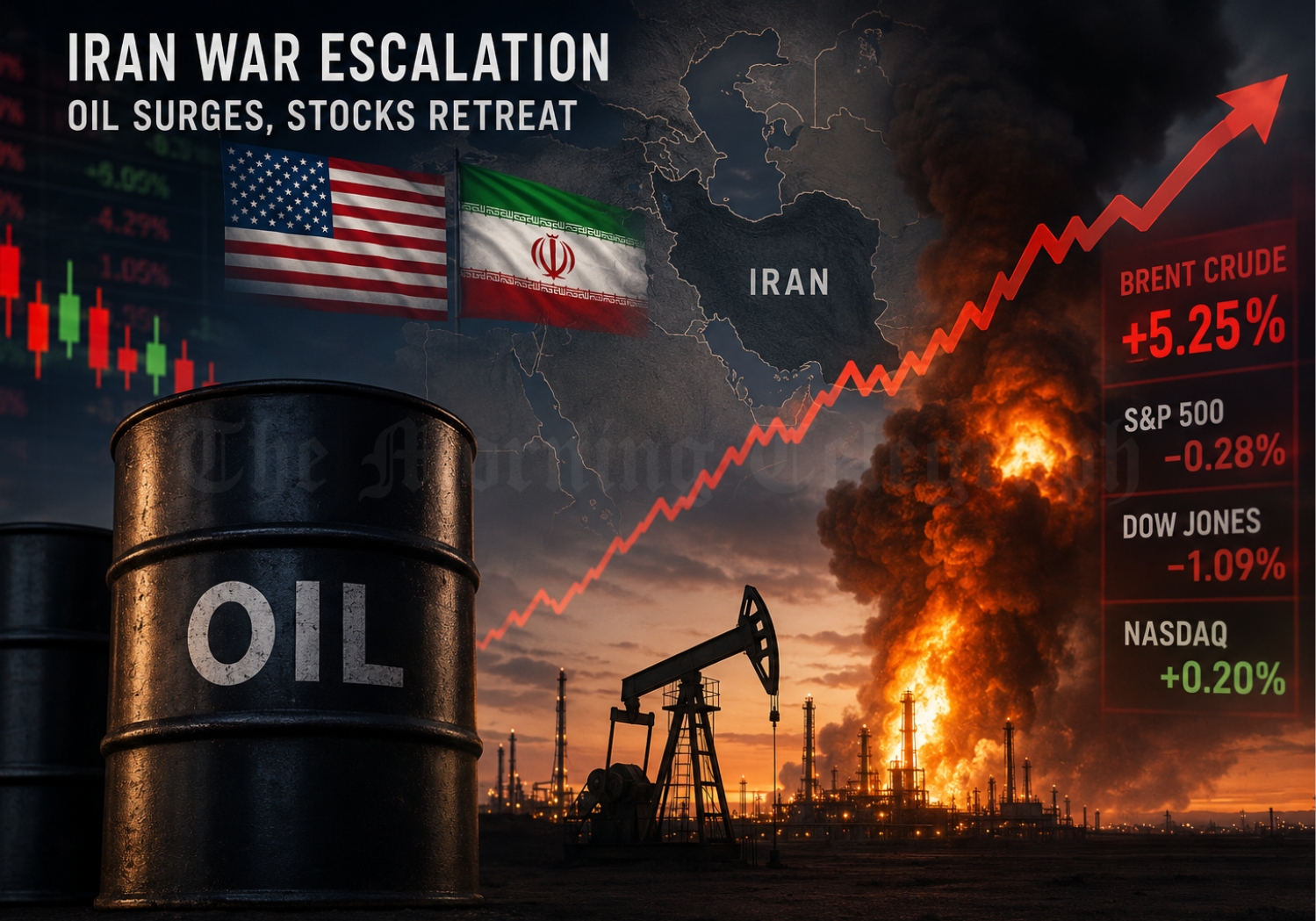
Oil prices jumped more than 5% as traders rapidly restored a geopolitical risk premium to energy markets. The sudden rise reversed some of the relief that had followed hopes for a sustained pause in fighting.
The market reaction followed Trump’s statement that the interim arrangement aimed at ending the conflict with Iran was over. He also indicated that further US military action could follow.
His comments quickly raised fears that the fragile period of de-escalation had collapsed. Investors also began weighing the renewed threat to commercial shipping and critical energy infrastructure across the Gulf.
Brent crude climbed to its highest level in around two weeks. Meanwhile, global equity markets came under renewed pressure as sentiment changed rapidly.
Investors who had been positioning for peace were suddenly preparing for another period of military confrontation, volatile energy prices and wider economic uncertainty.

Wall Street Retreats as War Fears Return
Renewed tensions quickly spread through US financial markets.
The S&P 500 closed 0.28% lower at 7,482.71, while the Dow Jones Industrial Average dropped 1.09%. However, the technology-heavy Nasdaq Composite finished 0.20% higher.
Gains among selected semiconductor stocks supported the Nasdaq despite weakness across much of the wider market.
Nine of the 11 major S&P 500 sectors ended lower. Industrial and materials companies were among those facing pressure as investors reassessed the economic risks created by renewed conflict.
Travel-related stocks also suffered as investors considered the consequences of higher fuel prices. Airlines and cruise operators remain particularly vulnerable to sustained increases in energy costs.
At the same time, another period of instability across Middle Eastern airspace could create additional disruption for international airlines and travel companies.
The difference between technology stocks and the broader market highlighted the complicated nature of the sell-off. Geopolitical fears pushed many sectors lower, but positive developments involving major semiconductor companies provided enough support to keep the Nasdaq slightly higher.
However, the central concern remained unchanged. Investors fear the Iran conflict could intensify again and deliver another shock to the global economy.
Iran War Escalation Puts Oil Markets on Alert
Energy markets provided the clearest indication of how dramatically sentiment had changed.
Oil prices had previously declined as investors hoped diplomatic efforts would reduce the risk of further military escalation. Trump’s declaration that the arrangement was over reversed much of that optimism.
The possibility of further US action against Iran immediately restored a geopolitical risk premium to crude prices.
At the centre of the concern is the Strait of Hormuz, one of the world’s most strategically important energy shipping routes.
The US Energy Information Administration identifies Hormuz as one of the world’s most important oil chokepoints. Any serious disruption to commercial shipping through the waterway could create consequences far beyond the Middle East.
Traders are watching the physical movement of oil, but they are also monitoring tanker insurance costs, shipping delays and the willingness of commercial operators to enter dangerous waters.
Even without a complete disruption to oil flows, repeated attacks, military exchanges and threats against commercial shipping could keep prices elevated.
As a result, governments and central banks could face new difficulties while trying to manage inflation and uncertain economic growth.
Investors Fear a Wider Regional Conflict
The latest market movements reflect more than a reaction to one political statement.
Investors are increasingly trying to calculate the risks of a broader military confrontation involving Iran, the United States and American allies and partners across the Gulf.
A sustained Iran war escalation could expose military bases, ports, energy infrastructure and commercial shipping routes to further attacks.
It could also force governments across the region to strengthen air defences and prepare for additional missile and drone threats.
For financial markets, that uncertainty creates a difficult environment.
Stocks often come under pressure when investors fear a combination of war, rising energy costs and slower economic growth. Meanwhile, higher oil prices can increase inflation expectations and complicate interest-rate decisions by central banks.
US Treasury yields also faced renewed pressure as markets considered whether another energy shock could keep inflation higher for longer.
The International Monetary Fund projects global growth of 3% in 2026. The outlook reflects the economic pressures created by war and other major global challenges.
A prolonged surge in energy prices could deepen concerns about the strength and durability of the global recovery.
Asian Economies Face Growing Oil Price Pressure
The consequences of another oil shock could prove particularly severe for major energy-importing economies.
Indian markets suffered their largest one-day decline in more than three months. Rising oil prices and renewed US-Iran tensions triggered a broad sell-off.
The Nifty 50 dropped 2.12%, while the Sensex fell 2.15%.
India remains highly sensitive to increases in global crude prices because of its dependence on imported energy. Higher oil costs can widen the trade deficit, weaken the currency and increase inflationary pressure.
The Indian rupee weakened as the market turmoil intensified, while bond yields moved higher.
Other Asian economies that depend heavily on imported oil could face similar pressure if crude prices continue to rise.
The impact could eventually extend far beyond financial markets. Higher energy costs can increase transportation, electricity generation, manufacturing and food distribution expenses.
Businesses could then face higher operating costs, while households may encounter additional pressure through increased prices for goods and services.
Global Markets Confront Another Dangerous Shock
The sudden reversal in sentiment shows how dependent global markets have become on developments in the Iran conflict.
Only days earlier, investors had been considering whether diplomacy could reduce military risks and restore greater stability to energy markets. That calculation has now changed.
Trump’s declaration that the arrangement was “over” has forced investors to consider renewed US strikes, Iranian retaliation and further threats to Gulf shipping.
The immediate result has been higher oil prices, weaker stock markets and renewed concern over inflation.
What happens next will depend heavily on whether the latest confrontation remains limited or develops into another sustained exchange of attacks.
For now, markets are behaving as though the risk of a wider war has returned.
Oil traders are once again adding a geopolitical premium to crude prices. Meanwhile, equity investors are reducing exposure to sectors vulnerable to higher energy costs.
Governments around the world are also watching the Gulf for signs of further escalation.
The ceasefire period had offered markets something increasingly rare during the Iran conflict: relative predictability.
That confidence has now been shaken.
If Washington and Tehran move further away from diplomacy and deeper into military confrontation, the consequences could spread far beyond the battlefield.
The next phase of the conflict could determine not only the security of the Gulf, but also the direction of oil prices, inflation and global economic growth in the months ahead.
For investors, governments and households, the central question is now whether the latest Iran war escalation remains contained or develops into a deeper conflict with consequences for the entire global economy.